Wednesday, 1 February 2012

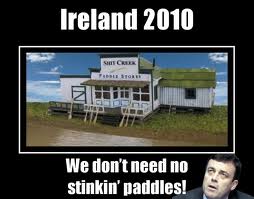
Australians, Grab A Paddle!


In an attempt to quash the myths surrounding mining and its effects on the economy, last year I wrote Mining The Truth - Absolute Power Absolutely or 730,000% ROI over 10yrs and I'm not going to go over all the data again, you can visit the link.


But, I notice that The Treasurer has eased up on the 'Australia is safe it has 'mining waffle and is now talking up the banks, low federal debt etc and encouraging private spending.

Why is that? He has seen (advised more likely, I doubt he can see shit from clay, ditto Hockey) how totally exposed Australia is and can't afford to wait for something to happen. As an example see Macrobusiness here.

How exposed?

  • Household debt is a smidge under 100% of GDP at $1.365Trillion (mostly mortgage debt, see bottom point).
  • Whilst Federal Govt debt is relatively low (compared to other G20 nations), private foreign debt (ie banks funding from overseas to feed the housing bubble) is $765Billion.
  • Mortgage (Owner occupier and Investor) debt (the Achilles heel) is $1.23Trillion*.


*When the Howard govt took office mortgage/housing debt was a mere $186Billion, it increased 5 fold in 11 years to $939Billion as debt was thrown at Australians like confetti, and the Dwarf and the Smirking Gonad repeatedly convinced Australians that  Debt=Wealth  and instead of doing something productive with the debt, went along the path of vying with Ireland to see who can creating the biggest property bubble in the history of the world.


If the Australian 'economy (*cough* aka debt fuelled Ponzi scheme) is $1.4Trillion and exports of Iron, Coal, Gold, Natural Gas and Oil only account for less than 10% of GDP, where is economic activity and why is the treasurer worried?

Services. The Wiki definition:

The tertiary sector of the economy (also known as the service sector or the service industry) is one of the three economic sectors, the others being the secondary sector (approximately the same as manufacturing) and the primary sector (agriculture, fishing, and extraction such as mining).

The service sector consists of the "soft" parts of the economy, i.e. activities where people offer their knowledge and time to improve productivity, performance, potential, and sustainability. The basic characteristic of this sector is the production of services instead of end products. Services (also known as "intangible goods") include attention, advice, experience, and discussion. The production of information is generally also regarded as a service, but some economists now attribute it to a fourth sector, the quaternary sector.

The tertiary sector of industry involves the provision of services to other businesses as well as final consumers. Services may involve the transport, distribution and sale of goods from producer to a consumer, as may happen in wholesaling and retailing, or may involve the provision of a service, such as in pest control or entertainment. The goods may be transformed in the process of providing the service, as happens in the restaurant industry. However, the focus is on people interacting with people and serving the customer rather than transforming physical goods.


70% of Australian economy is powered by 'services'. 70% of The Australian economy is driven by: Buying and selling crap to each other; Going out for a Latte; Getting someone to cut your lawn etc etc.

The governments of the last 16 years (AK, After Keating) are even proud of it:
DFAT: [Australia's]Service sector—world class tertiary industries

Australia has a competitive, world-class service sector that is underpinned by a skilled, multilingual workforce, a stable liberal democratic political system, a strong economy, and proximity to the major financial markets of Asia.

The service sector—or tertiary economy—accounts for 70 per cent of the country’s economic activity. It includes: banking, insurance and finance; the media and entertainment industries; consulting, tourism and retail; services provided by government, such as education, health and welfare; and other personal and business services.
If only 1.8% of the workforce is employed by Mining, what sector employs the most?

Australia has a well-developed tourism industry that welcomes more than five million visitors to the country each year and contributes around $20 billion to the economy annually. Additionally, Australians spend annually around $60 billion on domestic tourism, making 208 million trips in 2006–07. Overall, tourism accounts for 3.9 per cent ofgross domestic product. The industry employs 464 500 people nationally, or 4.5 per cent of the total workforce.

The retail industry is the largest employer in Australia, accounting for 920 000 jobs, or 12 per cent of the workforce. It typically accounts for around $150 billion in transactions annually. The majority of workplaces in the sector employ fewer than 20 people. The larger retail stores are mainly sellers of clothing and soft goods, supermarkets or grocery stores, and department stores. Around 44 000 of the people employed in the industry are working proprietors and partners.

The Australian food and beverage industry is recognised worldwide for its variety, high quality, healthy image, innovative manufacturing and packaging technologies. The diversity of foodstuffs available from Australia is huge and comprises grains, meats, dairy products, seafood, fruit and vegetables, bakery goods, olive oil, wine and other beverages, and confectionery, plus a host of individual gourmet treats and specialty lines.
12% of the workforce employed in retail, our biggest employment sector.

Can anyone see a problem? Since Paul Keating lost the 1996 election, 11 years of Liberal government and 4 years of Labor government, made Australia's economy into a giant Ponzi scheme.
  1. Banks borrow heavily from overseas and create and feed a Property boom (bubble) through easy credit.
  2. As new entrants into the scheme borrow more heavily believing the 'shortage' myth/scam and 'get in on the property ladder' bollocks, earlier entrants get rising home equity (as all Ponzi schemes work).
  3. This equity is used to buy, buy, buy, and spend, spend, spend on all sorts of retail junk, take holidays, cars, etc
  4. What happens to Ponzi schemes when you get no new entrants and the easy lending is tightened is simple: the schemes collapse, like the US and Irish property bubbles.

Can you see The Nurse and the Cop continuing to join the scheme until all their pay cheques go to (houses to $1M in 7 years bullshit) debt repayment? 

If home equity continues to fall at current rates and spending dries up at current rates what happens to that 'service' sector where 12% of Australia's employed are in retail, most of which are in businesses with less than 20 employees?

When those 'service' industries and shops start to lose money what happens to employment?

When unemployment climbs what happens to the housing Ponzi scheme?

This situation was obvious last year...Smells Like?

The USA, Housing vs Unemployment


Its easy to blame Greece etc and a Greek default will freeze money markets but Australia's woes were 16 years in the making and were spawned when you still paid for your Ouzo in Drachmas in downtown Athens.


Monday, 30 January 2012

Queensland Is Number 1!!


In October I asked Is Queensland Going Under? which had a fair bit of data that indicated that things were getting nasty in QLD Real Estate.

I ask again "Is Queensland going under?"

The population of NSW is over 7.2 million; Victoria around 5.6 million; and Queensland 4.6 million.

So why has Queensland got more houses for sale than the more populous southern states? Why is that number increasing (graph courtesy of RP data)?

81,199 listings for sale compared to 68,646 last year and 76,968 in NSW.


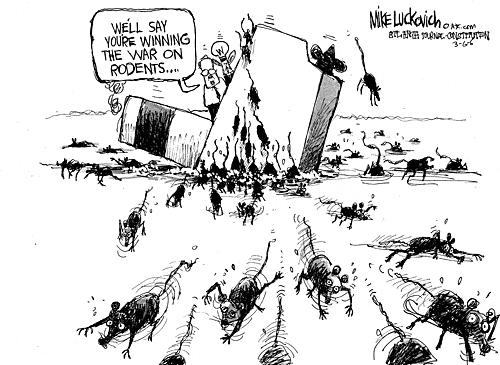
Rats and ships?


Sunday, 29 January 2012

Greece Is The Word

I solve my problems and I see the light
We gotta plug and think, we gotta feed it right
There ain't no danger we can go to far
We start believing now that we can be who we are

Greece is the word

They think our love is just a growing pain
Why don't they understand, It's just a crying shame
Their lips are lying only real is real
We start to find right now we got to be what we feel

Greece is the word

Greece is the word, is the word that you heard
It's got groove it's got meaning
Greece is the time, is the place is the motion
Greece is the way we are feeling

We take the pressure and we throw away

Conventionality belongs to yesterday
There is a chance that we can make it so far
We start believing now that we can be who we are

Greece is the word

Greece is the word, is the word that you heard
It's got groove it's got meaning
Greece is the time, is the place is the motion
Greece is the way we are feeling
This is the life of illusion
Wrapped up in trouble laced with confusion
What we doing here?


Reading Bloomberg this weekend, I have to laugh. The positive spin sans alarms and sirens is breathtakingly amazing.

Greece, Bankers Expect Debt-Swap Deal Next Week; and,
European Officials Said to Discuss Veto Powers Over Greek Budget Decisions
That offer equated to a loss of about 69 percent on the net-present value of Greek debt.

Bondholders agreed with European officials three months ago to implement a 50 percent cut in the face value of more than 200 billion euros ($263 billion) of debt by voluntarily swapping bonds for new securities. A worsening economy since then has made it more difficult to achieve a goal of cutting Greece’s debt to 120 percent of gross domestic product by 2020. 

69% Loss? Isn't that a default? Is this going to initiate a 'credit event'? If not why not?
Private investors hold about 60 percent of Greece’s 350 billion euros of debt.
Greek GDP is around €230B, so its debt is around 152% of GDP. That fits evenly between basket case Japan's 200% Debt-to-GDP and the USA's 107%.

But...
Greece now requires 145 billion euros for the second bailout, 15 billion euros more than was agreed in October, Der Spiegel reported today, citing an unidentified official from the troika in Greece.
So it has 152% of Debt-to-GDP and needs a further 63% of GDP worth of debt to maker it a round 215% of Debt-to-GDP.

Needs? Needs? Can you imagine if Australia urgently needed $880Billion AUD to stay afloat (half that may be so when the property market goes down the shitter, but thats a Feb blog update)?

Laughable. But its not over yet. Anyone remember Sudetenland in 1938 from history classes?
European policy makers are discussing plans to directly intervene in Greek budget decisions as the country struggles to cut its deficit, two euro-region government officials said today.

Under the proposals, European institutions would have powers to implement austerity measures agreed under the terms of Greece’s bailout agreements, said one of the officials, who declined to be identified because the talks are confidential. The plan would accelerate decision making and strengthen the power of officials overseeing Greece’s budget as part of the so- called troika of the European Commission, the European Central Bank and the International Monetary Fund, the person said.
Who is driving this?
Germany is proposing the creation of a commissioner with the power to veto budget decisions by Greece, the European Commission said that executive tasks must remain the full responsibility of the Greek government. 
9 out of 10 Greeks oppose the surrendering of sovereignty. They go to the polls in April. A hairy taxi driver who hasn't shaved or bathed this millennium would get a vote if he proposed telling the German's et al to 'fuck off'.


Tuesday, 24 January 2012

The IMF Has A Peek At Australia


First Moody's waving warning flags and now the IMF. In The Australian, Australian banks should hold more capital: IMF.

A STUDY by the International Monetary Fund is urging Australian banks adopt tougher capital requirements in case of a collapse in the country's property market. (aren't we different here?)

"Combining residential mortgage shocks with corporate losses expected at the peak of the global financial crisis would put more pressure on Australian banks' capital. Therefore, it would be useful to consider the merits of higher capital requirements for systemically important domestic banks," said the IMF paper made public today.
Banks continue to face concerns from global investors about the prospect for Australia's mortgage market after a broad decline in home prices last year.

According to the IMF paper, the banks' main vulnerability is their exposure to a highly indebted households through residential mortgage lending. Together, Australia's four largest banks hold more than 80 per cent of Australia's mortgages on their books.
Even so, the IMF paper said a stress test of the banking system based on the Irish experience showed banks could withstand "sizeable shocks to their exposure to residential mortgages". 
The IMF is now comparing Australia to Ireland?

The document is embedded below. I love this bit...
“The full recourse nature of mortgage lending also helps limit strategic loan defaults.”
If you are wondering where Crockett and Tubbs fit,  Florida has full recourse loans, a sought after location and people flocking their in droves. They were resilient in the midst of the downturn  right?

Miami's Vice


 Bank Capital Adequacy Australia 2012

Australia Now Driving On The Negative Equity Super Highway, Route 1 To Financial Perdition


Take the next right and let the journey begin...


Lots of articles appearing  in the media about negative equity and shattered housing dreams.

Local owners looking at negative equity 

The latest RP Data National Equity Report indicated that almost the entire area located to the east and south of Perth, effectively from Perth down to Albany and across to Esperance, was experiencing some of the nation’s highest levels of negative equity.

Report authors and RP Data researchers Tim Lawless and Cameron Kusher said that almost 5 per cent of homes nationwide were in negative equity.

“4.9 per cent of all Australian homes are currently valued at less than purchase price,” the report said.“The negative equity figure has risen from 3.7 per cent at the end of the last quarter.”

The report cited far north Queensland, the Gold Coast and the Sunshine Coast as having the highest instances of negative equity at 20.2 per cent, 14.0 per cent and 13.5 per cent respectively.
20.2% of Far North Queensland homes are in negative equity? 
14% on the Gold Coast?
13.5% of Sunshine Coast Properties? 
4.9% Nationally?

Thats a train wreck.

And, it will only get worse. Unemployment is still under 5.5%, wait until its over 10%. And, it will go there as the domestic purse strings tighten with falling home equity and the spiral begins. I wrote Smells Like? as the first evidence of retail contagion started to surface last year and it appears that indeed its not different here.

More Links: 


Jesse's Holiday Season Award For A Journalist Putting 24Karat Gold Coating On a Dog Turd:

1770 prices step back in time as beach towns await boom 
The reality is the banks are dumping their foreclosures.

According to Ms Skinner, the once $1.5m-$1.8m asking prices for beachfront penthouses at Loka Santi have slumped to a more realistic $350,000-$600,000. The average median house price in Agnes Water has slumped 20 per cent compared with the same time last year, according to RP Data.

Ms Skinner should know. Two years ago she paid $900,000 for a garden unit in the same block in which the penthouse was surrendered by the bank at a knock-down price. "It brought tears to my eyes," she said.

And, The Nice Try But Fail Award (One can still smell the odoriferous tang of dog faeces despite appearances):

Chinese lead increase in foreign investment in Queensland residential property in 2011

And buyers from China once again topped the list, according to new research by Colliers International.

The figures on buying patterns during the 2010-2011 financial year have shown 733 residential sales to foreign buyers.

In all, 506 of those sales were investments with 277 for owner-occupiers.
While overseas buyers eased back on spending, it was not at the same level of decline as local buyers.

Buyers from China actually stepped up their spending. They forked out $106.8 million on Queensland property - an increase of 50 per cent on last year.

733 sales to foreigners out of  over 100,000 sold across the state? Whats that under 0.7%? Not even 1% of QLD property goes into foreign hands and its a story? Of that 733 minutae, the Chinese bought 32% or 234 properties worth $106.8M or, $462K a property. Wow, we are saved.

Its worth following Michelle Hele at The Courier Mail, she is hilarious. Tasmania Real Estate Trouble first outed her in Yes, we are open!. This country badly needs an Australian Real Estate "Shill Tracker".

So where to from here?

Lets look to those silly Americans who nothing about exuberant bank lending and real estate crashes.

14.7 Million (19%) Of US Mortgages Have $770 Billion In Underwater Equity, $2.4 Trillion In Total Debt Impaired (This article is 18 months old but you'll get the picture)

I don't understand why Florida and California lead the pack, wasn't there a housing shortage there in 2006?
Southern California has been experiencing a massive population boom in recent years and it’s believed that 6 million new residents will be living in the region by 2020. The population increase, coupled with the housing shortage, has the CBIA worried that it will be increasingly difficult for first-time homebuyers to find a moderately priced unit

Hows it going 5 years on?
Case-Shiller Report… Housing Pain Remains

The Case-Shiller indices indicate a couple of things. First, the impact of foreclosed properties still weighs on home prices. And as more foreclosed properties hit the market now that lenders are ending their self-imposed moratorium on foreclosures, more pressure is expected on home prices.

As we take the exit, I check the NavMan to see exactly where we are...


Whats on the horizon to turn this baby around? Nothing.

If anything, external factors (China and Europe) will add a Nitrous Injection to the engine.

Wednesday, 18 January 2012

Apologies

Haven't posted for a while. My mother passed away and have been away dealing with it. I just got home and have a lot of stuff to post on banks and real estate and will back on deck in the near future.

Saturday, 7 January 2012

Jobs On the DebtStar, Be Quick!


So in last night's news the USA added 200,000 jobs last month and the spruikers cheered that the USA was in recovery but the market said "f*ck you". And, the spruikers scratched their heads and wondered why (Euro meltdown countdown nothwithstanding) as they bullshitted on about 'value' and a forward looking 'market'.

Here is the problem in a few lines.


US Jobs added in 2 years 2,283,000 (Great!!)
US National Debt added in 2 years $3,066,000,000,000 (Whoa!!) 
Borrowings per job $1,083,392 (See a problem?)
 

Average US wage is $47,000 so by borrowing $1,083,392, the US Govt has borrowed 23years wages per job.
 

US National Debt increase in 2 years 25%
US National Debt increase in 4 years 64%
 

US National Debt in January 2000 $5.774 Trillion
US National Debt in January 2008 $9.257 Trillion
US National Debt in January 2012 $15.201 Trillion (tripled in 12 years!!)
US National Debt in January 2015 $23.920 Trillion (estimate based on current growth!!)
 

12 years as a percentage of the USA's 235.5 year history is 5.1 % of the said nation's illustrious existence and in that short period the debt increased 163%. (Congratulations Dubya and Barack!).


Recovery my arse.

Unsustainable!
(but its OK, its an election year)

http://www.usdebtclock.org/