Showing posts with label China Economy. Show all posts

Saturday, 28 April 2012

Gold Flags


I haven't blogged for a while as most of the stuff I've written is coming to fruition so its pointless writing "see, I told you".


  • US debt spiralling out of control and the debt fuelled recovery stalling as the election looms.
  • European debt is spiralling out of control and the Monetary Union is simply imploding and civil unrest spreading as austerity triggers a poverty and economic spiral. 
  • UK debt spiralling and this week, officially in recession.
  • Australian property continues its slide (1.15% fall a month for 5 years is 50% off!) as the mining myth remains a mirage for the simpletons in suburbia as Australian debt approaches 270% of GDP (Australian Debt).
  • The Chinese bubble deflating rapidly.
  • Japan is just a train wreck.


So what next? If you think that Europe or the USA are going to pay their debts, you are delusional. Next step is an attempt at hyperinflation. They'll just print money like confetti in an attempt to make that $15Trillion debt today look like a $15 fifty years ago. It will cause chaos and spiralling unemployment but f*ck the little people, as long as the banking kleptocracy stays high and dry.


The strategy involves central bank simply printing money and buying government securities...


...and the government then drops its new money on the financial sector (M1, broad money supply) like confetti...


In 1980 the Zimbabwean dollar was worth more than the U.S. dollar, with ZWD 1 = USD 1.47. Throw in some money printing and on 18 July 2008, a report on Zimbabwe's inflation, said that an egg costs ZW$50 billion (GBP 0.17, USD 0.32), and it showed adverts for prizes of Z$100 trillion in a Zimbabwean derby and ZW$1.2 Quadrillion ($1,200,000,000,000,000.00: approx. GBP 2,100; USD 4,200) in a lottery. It also showed a monthly war pension currently is ZW$109 billion (GBP 0.37, USD 0.74), shops can only cash cheques if the customer writes double the amount, because the cost will go up by the time the cheque has cleared, and people can only withdraw a maximum of ZW$100 billion froman ATM.
http://en.wikipedia.org/wiki/Zimbabwean_dollar#Exchange_rate_history

In 2008,  thirteen US cents (yes 0.13c) got you...


Has the USA had hyperinflation before? It certainly has, Hyperiflation in History (with 32 cases).

If the USA tries to hyper-inflate, gold is going polaric. Even this week the  Bank of Japan announces fresh stimulus to boost growth.

Some signals.
  1. Fed Signals No Need for More Easing Unless Growth Falters (and growth WILL falter eg The Second Foreclosure Tsunami Is Coming, And Is About To Kill Any Hopes Of A "Housing Bottom")
  2. Risk off? Having Sold Most of its Own, IMF Now Lauds Gold as 'Safe Asset'
  3. Peter Schiff - QE3 is coming

Gold in a Bull Flag?

Firstly, some Technical Analysis 101. What is a Bull Flag?
Bull Flag Pattern 1
Bull Flag Pattern 2

Is Gold in a bull flag like in the links above? I think so.


How high could gold go? I came across this interesting piece of analysis. Ambitious? Maybe (or maybe not).


Friday, 23 March 2012

On Final Approach To Land


Last year I wrote  China's Imminent Landing and The Reasons For China's Imminent Bust

Please review the links above and the other China links.

Is the crash gathering pace?

Chinese Economy Already in ‘Hard Landing,’ JPMorgan’s Mowat Says

“If you look at the Chinese data, you should stop debating about a hard landing,” Mowat, who is based in Hong Kong, said at a conference in Singapore yesterday. “China is in a hard landing. Car sales are down, cement production is down, steel production is down, construction stocks are down. It’s not a debate anymore, it’s a fact.”

Read the rest in the Bloomberg link.


Thursday, 23 February 2012

Barron's Interviews Hugh Hendry

Anyone that reads this blog knows I'm a fan of Hugh Hendry.


Eclectica's acquired a nice reputation among contrarian investors, thanks to some enviable results. The London-based Eclectica Asset Management saw a 12% return last year in its flagship Eclectica hedge fund, and an eye-popping 46% gain in a new fund that buys credit-default protection on Japanese corporations. Much owes to the relentless logic and cheeky inventiveness of Hugh Hendry, chief investment officer. The Glasgow-born Hendry tells Barron's why he expects a hard landing in China, and why hyperdeflation will precede hyperinflation.

Hugh Hendry of Eclectica talks about hyperdeflation, why China might have a hard landing, and his off-the-beaten tracks Japan plays.

Keeping an Eye on Wealth Creation

Barron's: What makes a great macro fund manager?
 
Hendry: First and foremost, an ability to establish a contentious premise outside the existing belief system, and have it go on and be adopted by the rest of the financial community. My great hero is [Caxton Associates' founder] Bruce Kovner, who was able to imagine the dollar falling to 100 yen—when the rate was 200. I am an existentialist. To my mind, the three most important principles when it comes to investing are Albert Camus' principles of ethics: God is dead, life is absurd and there are no rules. Of course, that's a doctrine of promoting the individual. You own your own decisions. As CIO of Eclectica, with $700 million [under management], I have no engagement with the sell side.

Where do you find yourself outside the existing belief system today?
 
In 2009, I made a YouTube video of the empty skyscrapers in Wuhan, China. Goldman Sachs and others articulate a very reasonable and compelling argument of being invested in China. With the evidence of my own eyes, I concluded that China had a very robust system of creating gross-domestic-product growth, but forsaking the creation of wealth.

When America was having its China moment in the 19th century, it occurred against the backdrop of a gold standard, a hard-money regime, with a public sector that was minuscule versus the overall size of the economy. As an entrepreneur, if your project failed to generate a sustainable level of cash flow, you failed.

China's great opportunity is taking place within the U.S. fiat system, and so the consequences are perhaps less stark than in 19th-century America, which had stops and starts and many depressions, though with an overarching prosperity. China has not had that volatility.

If you talk about a hard landing in China, you talk about GDP growth of 5%, not minus 5% or minus 15%. The Chinese government prints money. It can build superfast railways and overbuild airports, because the rest of the economy can subsidize it. China's swollen public sector is directing asset allocation, rather than pursuing profit maximization. They see [their system] as a success. But it creates a bubble, which can prove quite damaging.

You've already had a hard landing—in the Chinese stock market.
 
I should add something else that is contentious—U.S. quantitative easing [that eventually sent more money flowing to China], promoted because America had two sharp recessions and pursued orthodox policies, and had very little to show in the creation of jobs.


The policy was very successful. China now has inflation. Minimum wages have grown 20% annually for the past three years. This has encouraged the Chinese to tighten monetary policy. When you have bubbles and you tighten, bad things happen. China's stock and property markets are weak, a side-effect of quantitative easing. We may now have the pricking of the Chinese bubble. A year or two down the line, it could have enormous repercussions for the global economy.

How does one play it?
 
The world is very fearful of hyperinflation. Pension schemes have a preponderance of real assets, from forestry to gold to TIPS [Treasury inflation-protected securities], because they are very fearful. The road to hyperinflation is via hyperdeflation. That is why it's proving so difficult for hedge funds to make money. How does the rational mind that anticipates hyperinflation own 10-year government Treasuries yielding less than 2%? It can't. That's why people are struggling. To lay the seeds of hyperinflation, you need really, really bad things to happen. I thought the U.S. housing market having a massive crash would be hyperdeflationary. But then my Chinese friends pumped $1 trillion of credit into their $5 trillion economy, and created a global recovery, which has just come to an end. I'm speculating that hyperdeflation happens before hyperinflation. What's the worst that could happen? But the sum of all my fears would be China having a real hard landing of minus 5% or minus 10% GDP growth. If we had that—and Europe—the Fed would be printing $20 trillion, and I would have gold at $5,000. You can have a modest amount of gold, but you can't have all your assets in real assets, in case we get that hyperdeflation event.

That view would be consistent with interest rates staying low forever.
 
Last year, our fund made 12%, mostly from investing in the short end of interest-rate curves, on the presumption that rates will remain low forever. The risk premium in fixed income was huge, but the performance of global macro last year was quite disappointing. Most people understood Europe, but chose to bet on the euro being weak, which is a hard trade, because there's no risk premium or carry in foreign exchange.

This time last year, British interest rates were at a 300-year-low at 0.5%, and if you asked an investment bank to guess where rates would be in three years, it was betting above 4%. The figure today is more like 1.3%.

So how do you make money?
 
Would you believe that the AIG strategy of selling too much credit protection in risky assets like mortgage-backed securities is alive and booming today in Japan? It doesn't concern mortgages. It is credit-default swaps on individual Japanese corporations.

Do you seriously believe Japanese corporations are going to fail?
 
Clearly, they can and do go bust. I'm buying the CDS on investment-grade Japanese corporations because of the overpricing anomaly. Japan had a bust 20 years ago, and yet today the banking stocks, relative to [Japanese bourse] Topix, are making fresh lows.

If I'm a Japanese bank and I lend money to a new business, I get 1% on 10-year paper. Then the bank gets a call from me, and I'm willing to pay 50 basis points for five-year protection on this same company. So suddenly, the yield has gone from 1% to 1½%. Compare that to five-year Japanese government bonds, yielding 30 basis points. The bank thinks: This is a great trade! Japanese steel companies are investment-grade and won't go bankrupt. So, the bank gets this huge yen yield, and thinks it is not taking any risk. You'd better believe it will sell way too much of that good thing.

One of my partners told me about Japanese steel: Here is a country with no energy, no iron ore or coal, yet it's the largest exporter of steel in the world, exports half its output. To put that in context, China manufactures 700 million tons of steel and exports perhaps 30 million. Japan produces 110 million tons and exports 40 million. As long as Asia is strong, they are fine. But if Asia hiccups or reverses, plant-utilization rates go from very high to very, very low very quickly.

Then we discovered that Warren Buffett owned shares of South Korea's Posco [5490.S. Korea], and that Korea was the biggest importer of Japanese steel, but Posco and Hyundai [5380.S. Korea] are building huge, integrated steel plants. They have a surplus of steel capacity and—guess what?—they're exporting to Japan, because the yen is so strong.

Initially, I wanted to buy a three-year, out-of-the-money put on Nippon Steel. My broker said, "I've been in a 20-year bear market; my boss will kill me." Then I thought, being long credit protection is being long volatility. I redialed his credit counterpart. I said: "I'm thinking of purchasing up to a billion yen of five-year credit-default swaps in Nippon Steel." The first thing he said was, "Would you consider 10 billion?" So one part of the bank is banned from selling volatility, and the other part is having a party. I bought reams of the stuff.

In August 2010, we set up a stand-alone fund to buy this credit protection. You no longer pay 50 basis points, you pay 130 basis points. U.S. Steel credit protection is more like 650 basis points, because in America, people are cautious on selling protection on such volatile businesses. They don't share that worry in Japan. It could make them very, very vulnerable.

Any other potential disaster catalysts? 
 
Continuing yen appreciation; an exogenous shock—like a run on the Italian bond market; a slowdown in China; a sharp Asian recession. Japan is confronted by a European sovereign-type loss of confidence in the JGB market. We bought protection on steel names, and also on businesses with a huge sensitivity to the yen. I think the yen could soar from these levels [about 79 to the dollar] into the 60s, if not the 50s, with further dislocation in European sovereigns or a China hard landing.

From the early 1960s almost, Japan began recording current-account surpluses. Unlike Germany, it always invoiced in dollars.

So Japan is short its own currency, and has an enormous private-sector hoard of foreign assets. If the Nikkei falls, and your hedge and private-equity funds fall, pension funds in Tokyo will have fewer yen assets, but their liabilities will be the same. So they'd have to sell some overseas dollar assets and retrade them back to yen. If we have a series of bad events from China to Europe, that will express itself in a very strong yen rally.

What other names have you bought protection on?
 
Shipping companies, such as Mitsui OSK [9104.Japan]. The only place in the world one can buy credit protection on the shipping industry is Japan. These are very leveraged businesses, and there was overbuilding. We have protection in Nippon Sheet Glass [5202.Japan], which bought Pilkington. We have protection in trading companies like Sumitomo[8053.Japan] and Marubeni [8002.Japan]—companies leveraged, opaque and very geared to the global economy.

We've barely discussed Europe.
 
We are partly playing it through Japan. If events kick off again in Europe, the correlation across all [global] asset classes will go to one. So the steel CDS is 130 basis points, while to insure against default by the French government, I'd be paying the same amount. Which is riskier? A very leveraged steel company that can't tax you? Or a government that can? Our bearish bets are largely outside Europe. As for Greece, the end game will be the Greeks rejecting austerity. The euro is nothing but a gold standard lacking flexibility, and all the onus is on private citizens to take the pain. Eventually, a Greek politician will say, 'Vote for me, and I'll get us out of this system.'

What else do you own?
 
In the next 12 months, we'll see further pathological swings in investor sentiment. Despite my reservations, I'm modestly long equity-market futures, some nonindustrial commodities, and some bullish fixed-income positions. We are very bullish agricultural commodities and agricultural equities, and hold a global basket of businesses—with interests ranging from fertilizer to farm equipment.

Tuesday, 3 January 2012

What Will 2012 Bring?


So, now the hangovers have abated, what will 2012 bring?

Marcus Padley
I'll start with a broker I thoroughly respect, Marcus Padley (writes for Fairfax etc), who appears who made some predictions whilst having a few beers pre-Christmas.

Headlines you may see in 2012 
  • ANZ raises interest rates 100bp at monthly monetary policy meeting. Declares interest rate settings “appropriate for our shareholders” and “profit margins within target band”
  • RBA closed. Glenn Stevens joins Macquarie
  • Westfield charges Retailers $10,000 per square megabyte on New Westfield Virtualand website
  • Gerry Harvey declares the internet a ‘fad’
  • Mercedes Benz prices jump 218% on euro break up. German exports fall 98% Greek Drachma jumps 14% to 0.0002374 Deutschmarks as faceless EU plant retires from post as Greek Prime Minister aged 45 on seven eighths of his final two years salary plus benefits
  • German taxi driver earns 10 times as much as new Greek PM
  • Rogue Trader at Goldman Sachs makes $US100bn profit shorting euro. Joins Cramer’s White House Administration as US Treasury Secretary
  • Berlusconi releases second Love Song CD “Don’t cry for me Angela Merkel, you know the truth is, I never loved you. All through my wild days, my mad existence, I knew the euro, wouldn’t go the distance”


...etc. Read the rest in the link, its quite amusing.


His 2011 predictive history sans beer (I assume) is worth a read, he is rather good... Let's share the financial obvious with hindsight. If you like what you read you can sign up for a free weeky newsletter at the bottom of this page: Marcus Today. Also a free end of day report here.

Art Cashin
Art is a 40 year trading veteran on the floor of the NYSE working for UBS.

Art Cashin of UBS

Europe Rumbles Continue Beneath More Upbeat Headlines - Ever since last week’s liquidity operation, most headlines out of Europe have leaned toward the reassuring side. Beneath those headlines, however, there are signs the strains remain and may, in fact, be growing.

European banks are making great use of the ECB’s overnight deposit facility. Last night they parked $590 billion at the ECB breaking the record they had set the night before. They are clearly unwilling to lend to other European banks, highlighting the distrust and fear in the interbank marketplace. While the ECB’s lending initiative calmed the markets somewhat, it apparently has done nothing to free up the logjam blocking interbank lending.

The distrust on the streets is said to be growing also. Barroom gossip says that safe-deposit boxes are in a demand that borders on frenzy. They allow you to take your Euros and covert them into something of value (gold, Swiss Francs, etc.) and sock it away in a safe place. Others are said to be buying property in London and elsewhere lest you awake one day and discover that your Euros have reverted to drachmas or lira.

Savvy bankers are said to be setting up personal and communal trusts domiciled in places like the Bahamas, the Caymans or the Isle of Jersey. Some banks are offering depository accounts denominated (and repayable) in alternate currencies like the dollar or the yen.

We think a Lehman-like event would most likely be triggered by a run on a bank or a series of banks. The scramble for currency (value) protection among the public could turn into that bank run in the same way that a crowd can instantly turn into a mob. Watch the money flows out of Greece and Italy very carefully. The pot continues to bubble.

Outflows From Italy and Greece


Max Keiser (the irrepressible!)


My Predictions
  • At least one Eurobank will fail as capital flight from the PIIGS increases in intensity. (Capital flight occurring now, banks insolvent and on ECB life support)
  • Credit contagion and freeze. (TED Spread, Euribor etc rising now)
  • Crash of various debt fuelled asset classes. (Stocks, property easing as credit freezes, economies stall and UE climbs are occurring now)
  • China's manufacturing sector continues to contract (now 2 months running), their housing and debt sector collapses. (happening now at a rapid rate)
  • Japanese economy on the verge of collapse as Yen reaches all time high.(happening now, this year they borrowed more than tax revenue for the first time)
  • ASX will see 2xxx (Eurobank failure - replay of 2008)
  • Unemployment in Oz 9% and rising (rising now as property prices fall)
  • Australian bank profits turn to losses ala USA, Ireland, Britain etc with abysmal outlook for 2013 as another 8-10% wiped off house prices.(outcome of Property Prices falling another 8-10% plus credit freeze)
  • 40% of Americans and 8% of Australians have 'underwater mortgages' or negative equity.(outcome of Property Prices falling another 8-10%)
  • US Debt over $17 trilion (thats a gimme)(based on last 3 years debt growth and Obama's debt addiction and election year)
  • Gold over $2500 USD as QE3 is triggered following a late 2008 NYSE -30% replay, which puts a boost under stockmarkets, but little else as US unemployment U3 nudges 12% . (based on late 2008, early 2009)
  • Australia's Deficit increases as tax revenues dwindle (outcome of Property Prices falling another 8-10% and UE rising, CGT and PAYG revenues falling)
  • Australian states get credit downgrades as the stamp duty money flow slows to trickle and their in massive deficits leading to massive cuts in state public servants. (outcome of Property Prices falling another 8-10%, Stamp Duty revenues dwindle)
  • If Ron Paul doesn't get GOP nomination, No Hope Obama hits the front. (coin flip)
  • AUD breaches 75c.(based on late 2008, early 2009 carry unwind, Risk OFF)
  • Coin toss on Iran invasion as China declares alliance. (historical friendship established a long time ago, google it)
  • Russia continues to take a more aggressive and militaristic stance towards the west with a possible China alliance (enemy of my enemy is my friend). (occurring now)
  • Civil unrest climbs in the PIIGS and UK - soldiers used to keep it under control as civil war draws closer as unemplyment climbs, credit is frozen and austerity creates a depression.(starting to occur now as austerity bites)
  • Le Pen and the far right take more dominant positions in France if not president Le Pen (starting to occur now)


On China/Iran and Russia/West (videos in links):
China to Protect Iran Even if Result Starts World War III

Russia Retaliates Against US: Puts Radar Station On Combat Alert, Prepares To Take Out European Missile Defense Systems


HAPPY NEW YEAR!!

Thursday, 29 December 2011

The Chinese Insolvencies Begin


Will "it" (financial Armageddon) come from the West (Europe) or the East (China and Japan) in 2012? Or, will be a synchronous pincer movement? Time will tell.


The China Daily says it will be an unhappy New Year for Chinese banks.


Provincial borrowers defer loan payments


Hunan Provincial Expressway Construction Group is delaying payment on 3.11 billion yuan ($490.5 million) in interest, documents governing the securities show this month. Guangdong Provincial Communications Group Co, the second-largest debtor, is following suit. So are two others among the biggest 11 debtors, for a total of 30.16 billion yuan, according to bond prospectuses from 55 local authorities that have raised money in capital markets since the beginning of November.

As local governments delay payments for projects commissioned as part of the stimulus to ward off recession in 2009, less money is available for bank lending even as China is taking steps to inject more into the economy. The central bank has held interest rates at 6.56 percent since July to boost the economy, while the US Federal Reserve and the Bank of Japan have kept benchmark rates near zero since 2008.

"When companies start to roll over debt they're not retiring debt, and banks aren't retrieving their capital, so you're crowding out new lending," Patrick Chovanec, a professor at Tsinghua University in Beijing, said in a Dec 13 interview. "This is a problem that's going to start to bite next year." 

Local governments had 10.7 trillion yuan in debt at the end of last year, 79 percent due to banks, (Jesse's contagion-ometer says thats $1.7Trillion USD!!) according to the country's first audit released in June. So-called local financing vehicles that meet collateral requirements can have a one-time extension on their loans, Zhou Mubing, vice-chairman of the China Banking Regulatory Commission, said at a conference on Oct 24 organized by the Internet portal Sina.com.cn, according to a transcript of his comments on the website.


$1.7Trillion USD? I wonder if Wayne Swan reads or gets briefed on the Chinese news?

Even after the reduction in interest payments, Gansu Provincial Highway said that interest and principal payments in 2011 will amount to 3.33 billion yuan, more than its 2010 cash flow of 3.04 billion yuan, according to bond-marketing materials.

"This prospectus is telling us that banks can expect to only receive roughly half of what would have been expected in interest payments," Charlene Chu, a Beijing-based banking analyst with Fitch Ratings, said of the Gansu disclosure. 

Chinese New Year is 23rd January  2012 and its the Year Of The Dragon (no kidding!).

新年好


Friday, 2 December 2011

China's Economic Slump


The Coming China Collapse: Economic, Political Or Both?

Even with this enormous credit expansion, recent estimates (.pdf) still place the number of Chinese living on less than $2 per day at approximately 480 million, over a third of the entire population. The credit push has lead China to consume more than half of the world's cement, 47% of the world's coal and 48% of all iron ore. This, for a country whose GDP is just 10.7% of the entire global economy and hundreds of millions wallow in poverty.

Sustaining the credit expansion in an attempt to prevent a recession has built the world's largest house of cards. Estimates have put the number of vacant apartments built as high as 64 million. Entire ghost cities have been constructed and sit virtually empty. The homes are simply unaffordable. The average Beijing citizen's entire annual income would purchase just 10 square feet of residential property. In the commercial sector, China holds the record for the world's largest shopping mall. Currently it is 98% vacant.

China's real estate bubble, one of the few remaining, is losing air at an astonishing speed. In just the past few weeks, hundreds of real estate brokerages have shuttered and thousands of workers have been laid off. The private SouFun Group in Beijing announced that the number of transactions fell by more than half in six of the 35 cities it surveyed just this month compared to last year. At least some declines were seen in 80% of the cities it surveyed.
Fear of punishment kept a lid on public protests in China for decades. However, a recent wave of protests might be enough to foment into an unstoppable movement. In August, an estimated 12,000 people gathered in Dalian demanding the closure of a chemical plant. In a defeat for the government, the protests ultimately succeeded and authorities announced the plant would be closed. That protest and victory by civilians was just one recent example. While Beijing still has success stifling news of dissent and protests from reaching the outside world, the sheer numbers have been overwhelming. According to Sun Liping, a professor at Tsinghua University, as many as 180,000 separate protests and other unrest occurred in China last year. That is nearly 500 for each and every day of the year.

Beijing has been forced to close off sources of easy credit to keep inflation from running rampant. The tightening brings copper to a tipping point where massive business defaults could occur, pushing prices even lower. In turn, the slowing of China's real estate market could be pushed into a freefall that makes the rest of the world's problems look miniscule. Pile all of those potential economic disasters on a poor and angry populace seeing success in fighting government for the first time in decades and the outcome will be anything but stable. In fact, China may not be the largest country on the planet for many more years. What was once called China could be dozens of smaller states fighting for the scraps left after the fall of Beijing.

I shudder to think of the economic consequences to European and American countries if the scenario plays out.


Economic Trouble in the West Shows Signs of Catching Up With Asia

HONG KONG — Asia’s ability to stay resilient amid the West’s economic troubles is slowly waning.

For much of this year, the economies of the Asia-Pacific region appeared to be blissfully isolated from the turmoil in other parts of the world. Asian stock markets fell along with those in the rest of the world, but the region’s economies continued to power ahead.

Within the last few weeks, however, cracks have emerged in the region’s mighty economies, and analysts and policy makers have become more concerned about the painful disruption that could spill into Asia as the situation in Europe continues to deteriorate and the United States’ growth remains subdued.
Exports from Asia have been softening for months as demand in Europe, in particular, has slowed. Although many countries depend less on exports than they once did, the sector remains crucial for economies like those of Taiwan and South Korea and for the small, open economies of Hong Kong and Singapore, economists say.

“The potential risks for Asia have increased” as the European crisis has moved beyond small peripheral economies like Greece, enveloping larger countries like Italy, Spain and even France, said Frederic Neumann, co-head of Asian economic research at HSBC in Hong Kong.


China won't save us – safeguard your wealth now

Thank goodness for China.

The US is going nowhere. Europe's heading back into recession. But China should be able to keep global growth going.

And even if China suffers a few bumps along the road, it's the superpower of the future. So best invest in it now.

At least, that's the story the bulls are sticking to.

Sadly, it isn't likely to work out that way. With China now facing some huge problems, the country is a long way from being a 'safe haven' for investors.


Let me explain why – and then we'll take a look at where you should really be looking to invest your money in these uncertain times.


China PMI Falls for First Time Since 2009

China’s manufacturing contracted for the first time since February 2009 as the property market cooled and Europe’s crisis cut export demand, a survey showed. 

The Purchasing Managers’ Index fell to 49.0 in November from 50.4 in October, the China Federation of Logistics and Purchasing said in a statement today. The median estimate in a Bloomberg News survey of 18 economists was 49.8. A level above 50 indicates expansion.

The central bank last night announced the first cut in banks’ reserve requirements since 2008, moving two hours before the U.S. Federal Reserve led a global effort to ease Europe’s sovereign-debt crisis. The move will add about 370 billion yuan ($58 billion) to the financial system and more reductions may follow as the government seeks to support growth, Citigroup Inc. said
.
Today’s report “clearly adds to the urgency for easing,” said Yao Wei, a Hong Kong-based economist with Societe Generale SA. “The PMI is showing weakness across the board and this would seem to be the reason the government cut banks’ reserve requirements. If this trend continues we should see another cut pretty soon.”

Wednesday, 23 November 2011

Chinese Manufacturing Shrinking


The report below confirms some of my recent posts:
The Reasons For China's Imminent Bust
Its On: China vice premier sees chronic global recession
"Every Province Of China Is Greece"
Chinese Bears Getting Bigger (has further links within)


The internal Chinese economy is in trouble.


Monday, 21 November 2011

Its On: China vice premier sees chronic global recession


China vice premier sees chronic global recession

"The one thing that we can be certain of, among all the uncertainties, is that the global economic recession caused by the international financial crisis will be chronic," Wang was quoted by the official Xinhua news agency as saying at the weekend.


Wang's comments were the most bearish forecast ever by a top Chinese decision-maker about the world economy, and Beijing's worry about a worsening global environment could translate into an impetus for pro-growth policies at home.

I read this as the Politburo can blame the world for the for the shit hitting the fan internally as the Ponzi disaster that is the Chinese economy is now unravelling.

Saturday, 19 November 2011

The Reasons For China's Imminent Bust


Gordon Chang: The Reasons For China's Imminent Bust

The global dominant narrative about China is wrong, claims Gordon Chang. Don't expect it to be the 'pocketbook of last resort' that will rescue world markets from their current malaise.


And don't expect its remarkable economic growth to continue. In fact, expect a "hard landing" for China - and soon.

Forbes.com columnist and international lawyer Gordon Chang has spent much of his time since the early 1980s working and living in China. His primary knowledge of the country and his relationships there give him a superior understanding to how its economy is actually faring than many analysts based in the West. And what he sees today doesn't inspire confidence.

We are seeing the first real signs of slowdown in China's economic growth looking at the year-over-year numbers for the past several months. Car sales have decreased nearly 5% since last year, and property values are beginning to plummet in key markets (30% in October alone in Shanghai).

Gordon sees these as the inevitable harbingers of a coming collapse in China due to excessive stimulus policies the government undertook starting in 2009. The bubbles and malinvestment created by this stimulus have not been addressed, and increasing weakness and transitions inside the political system are making it less likely they will be before market forces intervene.

On The Repercussions of Excessive Stimulus

Inefficiency eventually catches up with every economy. They have a semi-closed system so that they are not necessarily subject to the principles of economics in the same way that we are, but they can only delay the inevitable. They cannot prevent it entirely, and that is really going to be their problem. Because they have done a lot which just does not make economic sense. I mean it might make sense in terms of rapid buildup of an economy, but they have to pay a price. And they have not paid their price yet.

The one thing that people say is "These Chinese leaders are so great at economic management because they got through 2008-2009 and they had enormous double-digit growth while the rest of us were suffering." Well yes, they did that but they did that at great cost.

And so for instance in 2009, the first full year of their stimulus plan, they dumped something like $1.1 trillion into a then $4.3 trillion economy. And so did they create growth? Yes, they did, but they also created a stock market bubble, a property market bubble, and inflation. And they have yet to deal with the property market and the inflation problems. Those are dislocations that they do not have the answers to. I would rather have our economic problems than theirs any day of the week.   

On Growing Political & Social Instability

Starting at the end of next year, the Communist party is going to change the officers of their Politburo Standing Committee, the apex of political power in China. We are going to have a new General Party Secretary. And then in the early part of 2013, the government officers change. And sometime after that, the all-important Central Military Commission has a revamp of membership. And so at this time of political transition, the important economic decisions are not being made. But it is even worse than that, because corruption indeed is engulfing the political system. It is causing so much friction in society. The Communist Party is not able to mediate conflict and its only answer is to increase coercion.

And that is why you have survey after survey of the rich and the super-rich, they talk about leaving China. It is not the poor who are going, which we have seen in many waves throughout the last couple hundred years, now the rich are thinking of getting out. They are getting passports, they are putting their families offshore, and this is of concern because this is a leading indicator.
If you go about 25 miles south of where I live, and go to Princeton, New Jersey, you will see a lot of beautiful homes. I mean, they are all paid for, they have got a wife there, they have kids, and they have one or two Mercedes in the driveway. It is the perfect American family, except one thing is missing, and that is Dad. Dad is a senior official in Beijing and he is stealing as much money as he can. And at maybe not the first sign of trouble, but perhaps the second sign of trouble, he is on the United flight to New York, because he is not going to stay to defend a regime that is shaking. And that is one of the reasons why I think we have to be concerned about the way the Chinese economy is going, because the Chinese rich are starting to see the signs and are beginning to bail out.
We are talking about the people who have benefited the most from this system. And they can see the problems at the top of society. We have now a weak General Party Secretary, Hu Jintao, and he is going to be followed by probably by someone who is just as weak, especially in his beginning years, Xi Jinping. This is a political system that will not be able to make the decisions and to implement them that everyone knows have to be made. And that is why, for instance, we have not seen much in the way of reform over the last five years. In fact, we have seen a reversal of reform. And most of the conditions that have given rise to China's extraordinary growth either no longer exist or are disappearing fast. And so this is an economy in trouble.

On The Popping of China's Real-Estate Bubble

There was just too much money in the economy and so people then poured money into apartments. And China has gone on a tear building ghost cities and all the rest of it. And now the progression that you talked about -- skyrocketing prices and then stable prices, selling volume, and then property price declines -- is what we are seeing in China.
 In October, last month, prices in places like Shanghai declined 30%, as we saw developers start to offer these enormous discounts. And by the way, these discounts were so big that people who bought at earlier stages in these same developments, where these discounts were being offered have now taken to the streets complaining if you are giving 30% discounts to these other guys, then give it to me as well. And so we have not got a little bit of social unrest because of falling property prices.
 In Wenzhou, which is in prosperous Zhejiang Province, which was perhaps the most prosperous province up to about a year ago, developers are, one developer is now offering BMWs to the first 150 buyers of apartments. And this is just a sign that property prices have not only softened, but they are starting to fall quickly.
You know, every market has to go to equilibrium. There are too many apartments in China and not enough buyers and occupiers. And it was going to go to equilibrium in some fashion. What is really surprising observers is that the rapidity at which we see this move to equilibrium. Last year there were, in about I guess it was April or May, the state grid in China reported there were 64.5 million apartments that showed no electricity usage for six consecutive months. That is enough housing for 200 million people, but yet Beijing was decreeing the building of 30 to 50 million more apartment units....
 But at the end of the day, there has got to be a correction. And what goes up fast comes down fast. And what we are seeing is the down phase. The only issue is whether Beijing can stop the down phase by administrative measures. But so far the Chinese leaders, Premier Wen Jiabao, last Sunday said "nope, we are going to stay with these tightening measures." And that has really created great pessimism in the Chinese property market...
 And so really what we have is a government now that is really trying to bring the property market down. And of course it wants to do so gradually, you know, orderly. But as you say, it is a bubble, there is a pin and the problem is that Chinese leaders cannot manage the process of bringing the property market down to equilibrium....

When China's elite analysts start talking about prices being 50% of where they are this year that means that they are probably privately thinking that no, prices will not halve: they might go down even further than that. And that is really a problem because that mentality, once it gets embedded in people's minds in China really means that, Chinese leaders then have very few tools in which to prop up the property market.   


Thursday, 17 November 2011

The Shit Is Going To Hit The Fan In 2012

I was a little incredulous when I read this, I've blogged regularly that the Chinese economy is just a property bubble come ponzi scheme and its going to go down Japan's path of the early 20th century but I am amazed as to how bad it is.... Buyers and developers face some harsh home truths

"The decline in home prices is just beginning. And this price adjustment will cut deeper than was the case in 2008 to 2009," said Chen Li, head of China equity strategy at UBS Securities. "The fluctuations in the property market, in fact, may pose the biggest challenge to China's economy next year."

Meanwhile...
European Government Bond Market "Frozen" says Bank of Italy Managing Director

Only open this one  on an empty stomach...
JPMorgan, Goldman Keep Investors in Dark on European Debt Risk ; Net Position Disclosure Hides True Risk

Back on the Debtstar...
$15,OOO,OOO,OOO,OOOBAMA! - It's Official: Total US Debt Passes $15 Trillion
Too sad for commentary, but here is some math: total US debt has increased by 41.5%, or $4.4 trillion, from $10,626,877,048,913 on January 20, to $15,033,607,255,920, under Obama as president.
(as a reminder the most recently updated debt ceiling is $15.194 trillion)


Wednesday, 16 November 2011

"Every Province Of China Is Greece"

Check this out.

Chinese Banking System Nearly Bankrupt Says Professor of Finance at the Chinese University of Hong Kong; Nothing Shocking About Mistrust, Lies, Suppression of News


Larry Lang, chair professor of Finance at the Chinese University of Hong Kong, said in a lecture that he didn’t think was being recorded that the Chinese regime is in a serious economic crisis—on the brink of bankruptcy. In his memorable formulation: every province in China is Greece.

The restrictions Lang placed on the Oct. 22 speech in Shenyang City, in northern China’s Liaoning Province, included no audio or video recording, and no media. He can be heard saying that people should not to post his speech online, or “everyone will look bad,” in the audio that is now on Youtube.

In this new millennium I often wonder how a 1930s style global depression  is going to play out and who will be at war with who in the end.

Also, the EU failure barometer, Italian 10 Year Bond now over 7%.

Thursday, 3 November 2011

Chinese Bears Getting Bigger


In June I wrote Chinese Bears.

All the waffle on the Chinese economy being based on exports and manufacturing is just smoke and mirrors.
China is a "housing-led economy", says UBS economist Jonathan Anderson, who estimates that property construction alone accounted for 13 per cent of gross domestic product in 2010, twice the share of the 1990s.

While China's anticipated growth is still well above that of other large economies, any reduction could have deep consequences.

The global economy is now even more dependent on China for demand for anything from commodities to luxury goods, given the tepid recovery in the US and Europe's continuing sovereign-debt problems.

If the Chinese housing market slows faster than people had expected, the impact would be felt in a number of markets that export heavily to China.

Many Latin American and African economies have shifted their focus toward Chinese demand for their raw materials, and many Western firms, including US retailers and fast-food chains, now bank on Chinese consumers feeling wealthier to make up for stagnating sales elsewhere.

This was sent to me the other day (h/t Paddy).
Shanghai Homeowners Smash Showroom in Protest of Falling Prices; Developer Warns on Price Drops; "Twilight Zone" of Phony Accounting and Shadow Money

 The property bubble in China has finally burst. Denial has turned to anger as Shanghai Homeowners Smash Showroom in Protest Over Falling Prices

22% Drop Overnight

The drop from 18,000 to 14,000 yuan is a 22% overnight drop and that is just a down payment on the carnage that is coming.

Read the juicy bits in the link.

Then read Chinese, Japanese, Money Please, the parallels are uncanny.

Wednesday, 5 October 2011

Chinese Crash Alternatives

This is a must read.

I love this bit.

Would the government allow all this to happen?

Eventually, we believe that the Chinese government can handle any potential financial market turmoil in China this time because of high domestic savings. However, this doesn’t mean that the ride will always be smooth.

One of the biggest misperceptions about China in our opinion is a belief that the government is monolithic, and run by “a few wise men in Beijing” whose policies are followed to the letter. In our view this could not be further from the truth (A big misperception about China, 23 Feb 2010). Many policies in China are the result of negotiations and compromises between different interest groups, and the policies are often behind the curve and sometimes bring about unintended consequences.

Our overall thesis is that the government has been too aggressive applying both monetary and fiscal stimulus to counter the last global financial crisis and that we are now living with the unintended consequences, chiefly among them economically, high inflation pressure and instability in the financial market.

Cui BAC Part 2 - Cleanv

Saturday, 1 October 2011

China's Imminent Landing


"Ladies and gentleman, please fasten your seat belts,  we expect a few bumps before commencing our approach to land"


I have blogged about this 1920s Japan style crash before. Its not unexpected by any means.

I've posted before (eg here, here and particularly here) that the China Will Save Us rhetoric is nothing but exaggerated bullshit but we may as well put it to bed.

Links to Articles

China 'faces subprime credit bubble crisis'

Here Comes The "China Hard Landing" - Full Bank Of America Presentation Slides


Prominent Deflationist Schilling Sees Deflation, A China Hard Landing And 800 On The S&P

China Manufacturing Contracts for Third Month, Survey Shows (Note. Manufacturing is shrinking)

Cash Crunch in China Picks Up Momentum; Chinese Economy "Teetering On the Edge"

How Can China Save Europe When It's Defaulting On Its Own Debt? (Nothing to see here move along Australia)

Wenzhou officials implicated in illegal loan sharking practices (A prime example of The Problem, now multiply at least 1000 times)


Is anyone making a quid out of this?

Let me refresh your memory. A few months ago I posted a link with a video of Hugh Hendry doing some research in the Province of Graft and Corruption in the Peoples Republic of Bubbleland

Well Old Hughie is laughing today.

Hugh Hendry Fund Soars 40% YTD As China Sinks

Hugh Hendry was raking it in and is now up 38.65% YTD, with a stunning +22.5% in August alone (or pretty much mirroring the collapse at Paulson & Co) and another 11% in September! As the FT reports, Hugh Hendry's Eclectica fund has "has soared in value over the past two months as global markets have plummeted and industry peers have suffered damaging losses." Hendry's opinion on China is no secret, with an indicative snippet being that he anticipates a 1920's Japan-like crash in China.

Mr Hendry - a former Odey Asset Management trader - is one of only a handful of hedge fund managers positioned against Chinese growth and therefore pitted against heavyweight investors such as Anthony Bolton.

The fund, which raised a modest $150m from a handful of London investors when it launched late last year is up 38.65 per cent so far this year, having returned 22.5 per cent in August - the hedge fund industry’s worst month since the collapse of Lehman Brothers three years ago.

The news comes as concerns of a Chinese slowdown gather speed. Wu Xiaoling, the former deputy central bank governor and vice director of the finance and economy committee of the National People’s Congress said the economy would cool next year and efforts to spur growth will be constrained by inflation, in an article published by the Chinese central bank’s official newspaper.

Mr Hendry’s fund is up a further 11 per cent for September, according to an investor. Mr Hendry declined to comment.

Anyone else?


Yes, Mr Jim Chanos

June 2010
Chanos Shorting Majors, Ford; Discusses Ways To Express Chinese Bearishness

August 2010 (people thought he was balmy a year ago when he came out with this stuff)
Chanos: "China's Treadmill To Hell" Will Break This Year And The Bubble Will Pop, Kynikos Is Shorting Chinese Developers And Construction Suppliers

Forward the clock 13 months...

September 2011
Jim Chanos Debunks The Myth Of China As The World's "White Knight"

On the Chinese government's balance sheet:
"The Chinese government's balance sheet directly does not have a lot of debt. The state-owned enterprises of the local governments and all the other ancillary borrowing vehicles have lots of debt and its growing at a very fast rate. The assumption is that the state stands behind all this debt. We see that the debt in China, implicitly backed by the Chinese government, probably has gone from about 100% of GDP to about 200% of GDP recently. Those are numbers that are staggering. Those are European kind of numbers if not worse."

On how a Chinese property bubble will play out:
"I think that will be the surprise going into this year, and into 2012 - that it is not so strong. The property market is hitting the wall right now and things are decelerating. The CEO of Komatsu said last week that he is having trouble getting paid for his excavator sales in China. Developers are being squeezed. They're turning to the black market for lending, this shadow banking system that is growing by leaps and bounds like everything in China. "Regulators over there are really trying to get their hands around the problem. In the meantime, local governments have every incentive to just keep the game going. So they will continue with these projects, continuing to borrow as the central government tries to rein it in."

Chanos on his long and short positions:
"We are short Chinese banks, the property developers, commodity companies that sell into China, anything related to property there is still a short." "We are long the Macau casinos. It's our long corruption, short property play. We feel that there's American management and American accounting. They are growing at a faster rate even than the property developers."

On the IMF lowering growth estimates for China:
"A lot of people are assuming that half of all new loans in China are going to go bad. In fact, the Chinese government even said that last year relating to the local governments. If we assume that China will grow total credit this year between 30% to 40% of GDP, and half of that debt will go bad, that is 15% to 20%.  Say the recoveries on that are 50%. That means that China, on an after write off basis, may not be growing at all. It may be having to simply write off some of this stuff in the future so its 9% growth may be zero."

So, Europe is screwed; USA is bankrupt; China is facing a Japanese style financial catastrophe...

Psssst want to buy some shares and an investment property?


Monday, 19 September 2011

Weekend Of The Zombies


Links from the weekend's global Zombie jamboree:

Europe

Is September 20 Greek Default Day?

Euro Declines as European Finance Chiefs Fail to Reassure on Greek Debt

DSK Says Greece Is Done

Euro Bulls Capitulate After Trichet Comments

Germany Rejects Geithner's Leveraged Rescue Fund Proposal; First Time Ever, Majority of Germans No Longer See Benefits to Eurozone Membership

European Leaders Remain Divided, Geithner Brushed Off; German Banks Need $175 Billion Capital

Interactive Infographic Of The Doomed European Financial System


USA

Obama Proposes $4 Trillion in Spending Cuts "Over 120 Years"
(that'll make a dent in the $15T deficit and $115T in unfunded liabilities)

More on the Coming Wave of Foreclosures

China

China Home Prices Rise, Challenge Curbs

Home Prices Rise in All 70 Monitored China Cities;Local Governments Rely on Ponzi Land Sales to Pay Mounting Debt;Tightening Concerns Hit China Stocks


China is in quite a pickle, a gargantuan bubblicious picle as outlined months ago, while everyone is staring at Greece...  and Double, Double Toil and Trouble .


Back in June it took 57 years income to buy an average apartment in the capital (Chinese Bears)


Calculations based on Soufun data show that in the opening months of 2006 an average-price new apartment in China's capital would cost around $US100,000 — the equivalent of 32 years' disposable income for the average resident.

By 2011, the average price had more than doubled to $US250,000, but relatively modest increases in income mean it would now take 57 years of saving for the average resident to cover the cost.


So does China cool the bubble or risk doing a Japan (?) while they are waiting for Europe and the USA to get back to buying junk with money they haven't got. I hope they can wait a decade or three.


---------------------------------------------------------------------------------------------------------------

But the Winner Is...


This guy is amazing. I watched him a few days ago describe a 20% (or such like) property loss over a number of years as a sideways market. A wildebeeste in a suit...

Great Depression coming…Not!

For long-term investors worried about the unbelievable volatility on stock markets at the moment and wondering what their next money move is, there could only be one reason why you would want to change your general strategy - a Great Depression!

Do I expect it? No. Does anyone? Yes, Harry S. Dent, Jr. Is he right? Could be, but I doubt it.
If Harry, the author of The Great Depression Ahead, is right, then we all should go to cash and wait on the sidelines until we can guess the right time to get back into stocks. That would mean that we're choosing to take 5-6% on a term deposit until we're pretty sure that we're out of the woods, but is this the wisest strategy?
Hmmm. We've been sinking deeper into a swamp of foetid decay for 4 years and that swamp is so deep in the forest there is no fucking sunlight.

Anyone with half a brain should have been in cash 3.5 years ago. Lets look at Australian stocks over 5 years....


How is a loss over 5 years of -19.4% compared to that 5% in cash?

$100,000 invested in 2006:
  • Cash @ 5% is now worth $127,000; 
  • ASX200 is now worth $80,600.
50% needed straight up to catch up. Whats that story about the hare and the tortoise?

Indeed why would you change such a winning strategy when Capt Crack-Pipe says stay on course?

The 2007 highs were false highs and were created by the silliness of sub-prime loans and cheap money right around the world [but not Australia, no Housing Bubble from cheap money here], and what's happening now is that governments like in Greece, companies such as Centro and many financial institutions around the world are being given a reality check.

This is what the ‘muddle-through thesis' looks like on a day-to-day basis and it can be really scary and sometimes quite exciting but the long-term investor shouldn't be distracted by the daily noise.

Stay on course says the Captain!! No storm ahead.
This could take over a year but when the consensus says the worst is over, there will be a big bounce in stocks. Until then, I have faith that the collective wills of governments and the best economic minds in the world can avoid the policy mistakes that created the Great Depression of the 1930s.
Sure will be a bounce, expecially when the ASX has lost another 50-70%. And, a lot of bounces in between especially when one is Running Up The Down Escalator

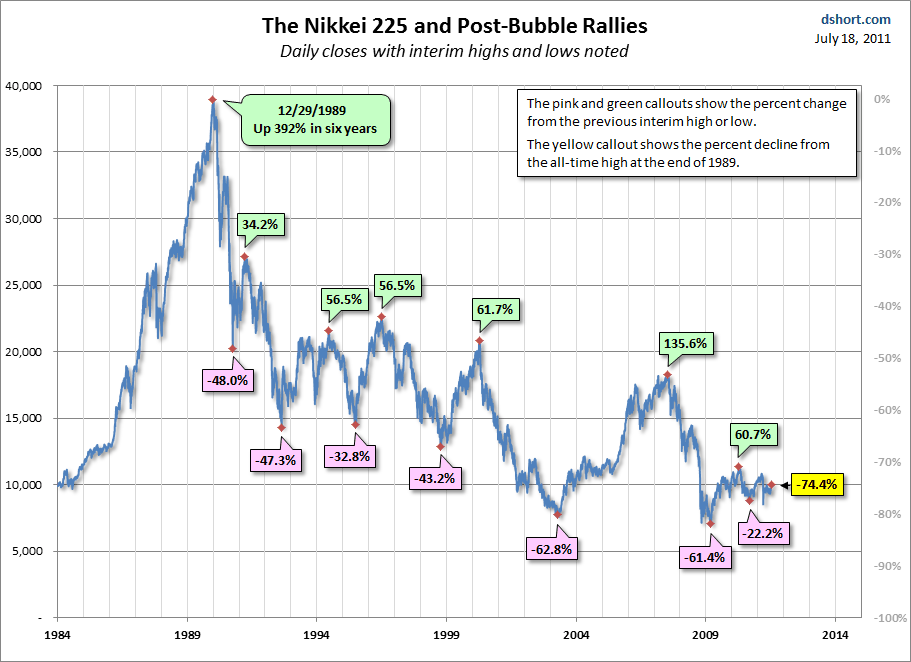
(today the Nikkei is another 12% lower than above. Overall - 77.4% over 21 years)


Inhale deeply Captain and hold it, this shit is expensive.

I think a Goldilocks downturn is more likely where stock prices don't rise by much, unemployment doesn't go too high and house prices don't fall by too much. This view rests on my belief that the likes of Brazil, Russia, India and China or the BRICs, will give the global economy the grunt that was missing in the 1930s.

This is a tongue in cheek comment, but thank God for formerly underdeveloped and Communist countries that are now playing catch up in the materialism/capitalism game!

Great Depression? Not!

Ahhh The China Myth coupled with another DEEEP pull on the pipe. Stay on course.

Peter Switzer is the founder of the Switzer Super Report, a newsletter and website for self-managed super funds.

Is this a cunning anti-alzheimers plan to keep older minds active via keeping pending retirees in the workforce until they are 85?


-------------------------------------------------------------------------------------------------------------

Gold Insights


The Dutch Ask Their Central Bank: "Where Is Our Gold?"

Central banks return as gold buyers  (video in link)

Analysis

Analytical 1
A Closer Look at the Gold Continuation Triangle, and the Coming Breakout to 2100

Analytical 2 (charts expand when clicked on)
Gold Daily and Silver Weekly Charts - Antics Abounding

Speculation

Ambitious?
Gold-Backed Dollar Puts ‘Fair Value’ at $10,000 an Ounce: Chart of the Day

Really Ambitious?
Stephen Leeb - Gold, Minimal Downside, $12,000 Upside


"Standby....Green Light! Go! Go! Go!" 

Thursday, 28 July 2011

You Can Fool Some Of the People All Of the Time!

Terry McCrann Is screaming for a rate rise in the Australian and Victoria's freckle wiper the Herald-Sun.

Rates must go up and they will.

In his important speech on Tuesday -- it's important to understand, before he had any knowledge of yesterday's inflation figures -- Stevens argued that softening was achieving the necessary 'making way' in the non-resources economy for the resources boom.

But the clear inflation pressure means he can't assume that will continue. China is pouring a tsunami of money into Australia. We could all too easily see inflation kicking up above 1 per cent a quarter as it did in 2008.

A Tsunami? Australia's GDP is around $1 200 000 000 000 or $1.2T

Australia's exports to China was $58B last year
Australia's imports from China was $39B last year

A nett gain of $19B on trade.

China's foreign investment in Australia was  $16.3B last year.

FIRB Annual Report 2009/10 (p33)
Approved investment from the US fell by 1 per cent from $39.6 billion in 2008-09 to
$39.1 billion in 2009-10. Proposed investment was primarily in the mineral exploration
and development sector, accounting for 64 per cent of total US investment. The US was
also the leading nationality for foreign investment in the services sector, accounting for
48 per cent of investment in that sector.

The UK was Australia’s second largest investor in 2009-10 with $28.6 billion.
Investment in the mineral exploration and development sector accounted for
$22.2 billion, representing 77 per cent of total UK investment in Australia.

China was the third largest investor in 2009-10 with total proposed investment of
$16.3 billion. The majority of this proposed investment was in the mineral exploration
and development sector, accounting for $12.2 billion and representing 75 per cent of
that country’s proposed investment.

So a nett $19B in trade and $16.3B in Investment is a total of $35.3B or 2.9% of GDP.

A Tsunami?