Showing posts with label Japanese Economy. Show all posts

Saturday, 28 April 2012

Gold Flags


I haven't blogged for a while as most of the stuff I've written is coming to fruition so its pointless writing "see, I told you".


  • US debt spiralling out of control and the debt fuelled recovery stalling as the election looms.
  • European debt is spiralling out of control and the Monetary Union is simply imploding and civil unrest spreading as austerity triggers a poverty and economic spiral. 
  • UK debt spiralling and this week, officially in recession.
  • Australian property continues its slide (1.15% fall a month for 5 years is 50% off!) as the mining myth remains a mirage for the simpletons in suburbia as Australian debt approaches 270% of GDP (Australian Debt).
  • The Chinese bubble deflating rapidly.
  • Japan is just a train wreck.


So what next? If you think that Europe or the USA are going to pay their debts, you are delusional. Next step is an attempt at hyperinflation. They'll just print money like confetti in an attempt to make that $15Trillion debt today look like a $15 fifty years ago. It will cause chaos and spiralling unemployment but f*ck the little people, as long as the banking kleptocracy stays high and dry.


The strategy involves central bank simply printing money and buying government securities...


...and the government then drops its new money on the financial sector (M1, broad money supply) like confetti...


In 1980 the Zimbabwean dollar was worth more than the U.S. dollar, with ZWD 1 = USD 1.47. Throw in some money printing and on 18 July 2008, a report on Zimbabwe's inflation, said that an egg costs ZW$50 billion (GBP 0.17, USD 0.32), and it showed adverts for prizes of Z$100 trillion in a Zimbabwean derby and ZW$1.2 Quadrillion ($1,200,000,000,000,000.00: approx. GBP 2,100; USD 4,200) in a lottery. It also showed a monthly war pension currently is ZW$109 billion (GBP 0.37, USD 0.74), shops can only cash cheques if the customer writes double the amount, because the cost will go up by the time the cheque has cleared, and people can only withdraw a maximum of ZW$100 billion froman ATM.
http://en.wikipedia.org/wiki/Zimbabwean_dollar#Exchange_rate_history

In 2008,  thirteen US cents (yes 0.13c) got you...


Has the USA had hyperinflation before? It certainly has, Hyperiflation in History (with 32 cases).

If the USA tries to hyper-inflate, gold is going polaric. Even this week the  Bank of Japan announces fresh stimulus to boost growth.

Some signals.
  1. Fed Signals No Need for More Easing Unless Growth Falters (and growth WILL falter eg The Second Foreclosure Tsunami Is Coming, And Is About To Kill Any Hopes Of A "Housing Bottom")
  2. Risk off? Having Sold Most of its Own, IMF Now Lauds Gold as 'Safe Asset'
  3. Peter Schiff - QE3 is coming

Gold in a Bull Flag?

Firstly, some Technical Analysis 101. What is a Bull Flag?
Bull Flag Pattern 1
Bull Flag Pattern 2

Is Gold in a bull flag like in the links above? I think so.


How high could gold go? I came across this interesting piece of analysis. Ambitious? Maybe (or maybe not).


Thursday, 23 February 2012

Barron's Interviews Hugh Hendry

Anyone that reads this blog knows I'm a fan of Hugh Hendry.


Eclectica's acquired a nice reputation among contrarian investors, thanks to some enviable results. The London-based Eclectica Asset Management saw a 12% return last year in its flagship Eclectica hedge fund, and an eye-popping 46% gain in a new fund that buys credit-default protection on Japanese corporations. Much owes to the relentless logic and cheeky inventiveness of Hugh Hendry, chief investment officer. The Glasgow-born Hendry tells Barron's why he expects a hard landing in China, and why hyperdeflation will precede hyperinflation.

Hugh Hendry of Eclectica talks about hyperdeflation, why China might have a hard landing, and his off-the-beaten tracks Japan plays.

Keeping an Eye on Wealth Creation

Barron's: What makes a great macro fund manager?
 
Hendry: First and foremost, an ability to establish a contentious premise outside the existing belief system, and have it go on and be adopted by the rest of the financial community. My great hero is [Caxton Associates' founder] Bruce Kovner, who was able to imagine the dollar falling to 100 yen—when the rate was 200. I am an existentialist. To my mind, the three most important principles when it comes to investing are Albert Camus' principles of ethics: God is dead, life is absurd and there are no rules. Of course, that's a doctrine of promoting the individual. You own your own decisions. As CIO of Eclectica, with $700 million [under management], I have no engagement with the sell side.

Where do you find yourself outside the existing belief system today?
 
In 2009, I made a YouTube video of the empty skyscrapers in Wuhan, China. Goldman Sachs and others articulate a very reasonable and compelling argument of being invested in China. With the evidence of my own eyes, I concluded that China had a very robust system of creating gross-domestic-product growth, but forsaking the creation of wealth.

When America was having its China moment in the 19th century, it occurred against the backdrop of a gold standard, a hard-money regime, with a public sector that was minuscule versus the overall size of the economy. As an entrepreneur, if your project failed to generate a sustainable level of cash flow, you failed.

China's great opportunity is taking place within the U.S. fiat system, and so the consequences are perhaps less stark than in 19th-century America, which had stops and starts and many depressions, though with an overarching prosperity. China has not had that volatility.

If you talk about a hard landing in China, you talk about GDP growth of 5%, not minus 5% or minus 15%. The Chinese government prints money. It can build superfast railways and overbuild airports, because the rest of the economy can subsidize it. China's swollen public sector is directing asset allocation, rather than pursuing profit maximization. They see [their system] as a success. But it creates a bubble, which can prove quite damaging.

You've already had a hard landing—in the Chinese stock market.
 
I should add something else that is contentious—U.S. quantitative easing [that eventually sent more money flowing to China], promoted because America had two sharp recessions and pursued orthodox policies, and had very little to show in the creation of jobs.


The policy was very successful. China now has inflation. Minimum wages have grown 20% annually for the past three years. This has encouraged the Chinese to tighten monetary policy. When you have bubbles and you tighten, bad things happen. China's stock and property markets are weak, a side-effect of quantitative easing. We may now have the pricking of the Chinese bubble. A year or two down the line, it could have enormous repercussions for the global economy.

How does one play it?
 
The world is very fearful of hyperinflation. Pension schemes have a preponderance of real assets, from forestry to gold to TIPS [Treasury inflation-protected securities], because they are very fearful. The road to hyperinflation is via hyperdeflation. That is why it's proving so difficult for hedge funds to make money. How does the rational mind that anticipates hyperinflation own 10-year government Treasuries yielding less than 2%? It can't. That's why people are struggling. To lay the seeds of hyperinflation, you need really, really bad things to happen. I thought the U.S. housing market having a massive crash would be hyperdeflationary. But then my Chinese friends pumped $1 trillion of credit into their $5 trillion economy, and created a global recovery, which has just come to an end. I'm speculating that hyperdeflation happens before hyperinflation. What's the worst that could happen? But the sum of all my fears would be China having a real hard landing of minus 5% or minus 10% GDP growth. If we had that—and Europe—the Fed would be printing $20 trillion, and I would have gold at $5,000. You can have a modest amount of gold, but you can't have all your assets in real assets, in case we get that hyperdeflation event.

That view would be consistent with interest rates staying low forever.
 
Last year, our fund made 12%, mostly from investing in the short end of interest-rate curves, on the presumption that rates will remain low forever. The risk premium in fixed income was huge, but the performance of global macro last year was quite disappointing. Most people understood Europe, but chose to bet on the euro being weak, which is a hard trade, because there's no risk premium or carry in foreign exchange.

This time last year, British interest rates were at a 300-year-low at 0.5%, and if you asked an investment bank to guess where rates would be in three years, it was betting above 4%. The figure today is more like 1.3%.

So how do you make money?
 
Would you believe that the AIG strategy of selling too much credit protection in risky assets like mortgage-backed securities is alive and booming today in Japan? It doesn't concern mortgages. It is credit-default swaps on individual Japanese corporations.

Do you seriously believe Japanese corporations are going to fail?
 
Clearly, they can and do go bust. I'm buying the CDS on investment-grade Japanese corporations because of the overpricing anomaly. Japan had a bust 20 years ago, and yet today the banking stocks, relative to [Japanese bourse] Topix, are making fresh lows.

If I'm a Japanese bank and I lend money to a new business, I get 1% on 10-year paper. Then the bank gets a call from me, and I'm willing to pay 50 basis points for five-year protection on this same company. So suddenly, the yield has gone from 1% to 1½%. Compare that to five-year Japanese government bonds, yielding 30 basis points. The bank thinks: This is a great trade! Japanese steel companies are investment-grade and won't go bankrupt. So, the bank gets this huge yen yield, and thinks it is not taking any risk. You'd better believe it will sell way too much of that good thing.

One of my partners told me about Japanese steel: Here is a country with no energy, no iron ore or coal, yet it's the largest exporter of steel in the world, exports half its output. To put that in context, China manufactures 700 million tons of steel and exports perhaps 30 million. Japan produces 110 million tons and exports 40 million. As long as Asia is strong, they are fine. But if Asia hiccups or reverses, plant-utilization rates go from very high to very, very low very quickly.

Then we discovered that Warren Buffett owned shares of South Korea's Posco [5490.S. Korea], and that Korea was the biggest importer of Japanese steel, but Posco and Hyundai [5380.S. Korea] are building huge, integrated steel plants. They have a surplus of steel capacity and—guess what?—they're exporting to Japan, because the yen is so strong.

Initially, I wanted to buy a three-year, out-of-the-money put on Nippon Steel. My broker said, "I've been in a 20-year bear market; my boss will kill me." Then I thought, being long credit protection is being long volatility. I redialed his credit counterpart. I said: "I'm thinking of purchasing up to a billion yen of five-year credit-default swaps in Nippon Steel." The first thing he said was, "Would you consider 10 billion?" So one part of the bank is banned from selling volatility, and the other part is having a party. I bought reams of the stuff.

In August 2010, we set up a stand-alone fund to buy this credit protection. You no longer pay 50 basis points, you pay 130 basis points. U.S. Steel credit protection is more like 650 basis points, because in America, people are cautious on selling protection on such volatile businesses. They don't share that worry in Japan. It could make them very, very vulnerable.

Any other potential disaster catalysts? 
 
Continuing yen appreciation; an exogenous shock—like a run on the Italian bond market; a slowdown in China; a sharp Asian recession. Japan is confronted by a European sovereign-type loss of confidence in the JGB market. We bought protection on steel names, and also on businesses with a huge sensitivity to the yen. I think the yen could soar from these levels [about 79 to the dollar] into the 60s, if not the 50s, with further dislocation in European sovereigns or a China hard landing.

From the early 1960s almost, Japan began recording current-account surpluses. Unlike Germany, it always invoiced in dollars.

So Japan is short its own currency, and has an enormous private-sector hoard of foreign assets. If the Nikkei falls, and your hedge and private-equity funds fall, pension funds in Tokyo will have fewer yen assets, but their liabilities will be the same. So they'd have to sell some overseas dollar assets and retrade them back to yen. If we have a series of bad events from China to Europe, that will express itself in a very strong yen rally.

What other names have you bought protection on?
 
Shipping companies, such as Mitsui OSK [9104.Japan]. The only place in the world one can buy credit protection on the shipping industry is Japan. These are very leveraged businesses, and there was overbuilding. We have protection in Nippon Sheet Glass [5202.Japan], which bought Pilkington. We have protection in trading companies like Sumitomo[8053.Japan] and Marubeni [8002.Japan]—companies leveraged, opaque and very geared to the global economy.

We've barely discussed Europe.
 
We are partly playing it through Japan. If events kick off again in Europe, the correlation across all [global] asset classes will go to one. So the steel CDS is 130 basis points, while to insure against default by the French government, I'd be paying the same amount. Which is riskier? A very leveraged steel company that can't tax you? Or a government that can? Our bearish bets are largely outside Europe. As for Greece, the end game will be the Greeks rejecting austerity. The euro is nothing but a gold standard lacking flexibility, and all the onus is on private citizens to take the pain. Eventually, a Greek politician will say, 'Vote for me, and I'll get us out of this system.'

What else do you own?
 
In the next 12 months, we'll see further pathological swings in investor sentiment. Despite my reservations, I'm modestly long equity-market futures, some nonindustrial commodities, and some bullish fixed-income positions. We are very bullish agricultural commodities and agricultural equities, and hold a global basket of businesses—with interests ranging from fertilizer to farm equipment.

Sunday, 31 July 2011

Quicklinks - 31 July


1. Murray Dawe's (Slipstream Trader) outlook for the ASX: 29th July 2011 - Slipstream Trader Market Update


2. Peter Brandt's scary post on Head-And-Shoulder Techs and the possibility of 75% declines in the NYSE (hat tip to Avidchartist):  Charts indicate a 75% decline in the U.S. stock market is possible

Jesse's notes (if you scoff at such declines):
  • Christmas 1989, Nikkei 225 (Japanese Stock Index) tops at 38,916
  • August 1992 - 14,820  Down 62% off peak in 30 months
  • June 1995 - 14,517 Down 62.7% off peak in 5 years and 6 months
  • October 1998 - 12,879 Down 67% off peak in 8 years and 10 months
  • April 2003 - 7,874 Down 79.8% off peak in 13 years and 4 months (BINGO!!)
  • February 2009 - 7,568 Down 80.6% off peak in 19 years and 4 months (BINGO MkII)
  • Today (29th July 2011 close) it sits at 9,833 in 21 years and 7 months since its peak, its down 74.7% since peak (BINGO Mk III).


(The stock part of the chart below only goes to early 2008 before the GFC kicked off but it paints a trend)


3. Mike Shedlock on Cap-and-Trade: New NASA Data Blow Gaping Hole In Global Warming Alarmism; Idiocies of Cap-and-Trade Exposed


4. Bloomberg on one of the [many] holes in the Euroidiots 'solution' last week:  Greek Bondholders May Shun Rescue as Potential Losses Top 21%: Euro Credit


5. Crude Oil in Australian Dollars over 3 months, 15.5% declines (anyone noticed a 15.5% decline in petrol prices? Me neither); $WTIC:$XAD - May, June, July

Tuesday, 12 July 2011

Paradigms and Plateaus


First, lets roll back the clock....

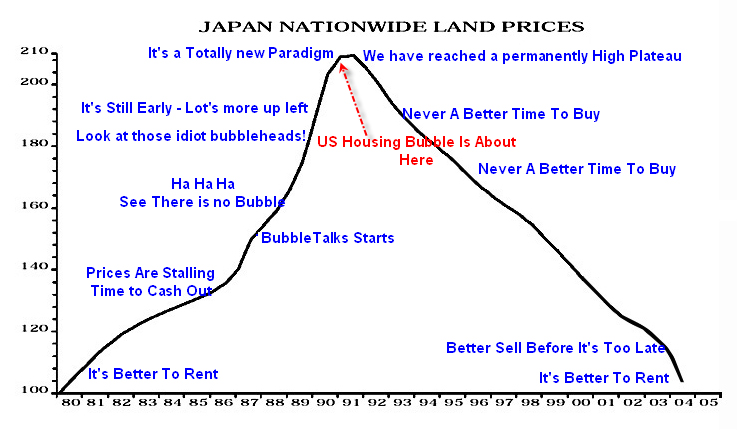
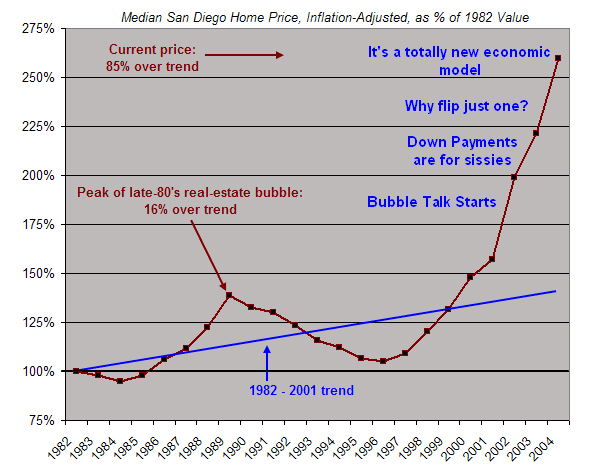
March 26th 2005; Its a totally new paradigm.


Quotes from 2005.

Ron Shuffield, president of Esslinger-Wooten-Maxwell Realtors says that "South Florida is working off of a totally new economic model than any of us have ever experienced in the past." He predicts that a limited supply of land coupled with demand from baby boomers and foreigners will prolong the boom indefinitely.

"I just don't think we have what it takes to prick the bubble," said Diane C. Swonk, chief economist at Mesirow Financial in Chicago, who was an optimist during the 90's. "I don't think prices are going to fall, and I don't think they're even going to be flat."


How did those markets go?


That new paradigm in Southern Florida of limited supply of land coupled with demand from baby boomers and foreigners [that] will prolong the boom indefinitely saw 55% falls in 34 months.

Roll forward 6 years to the Weekend's Mexican Bogan Rag, The Herald Sun. What a headline.

Decade of pain for Melbourne's property market


Deluded Quasi Pessimist:

The good news for homeowners is that AMP Capital chief economist Shane Oliver and Grattan Institute program director Saul Eslake - the ANZ's chief number cruncher for close to 14 years - say Victoria will avoid a US-style property crash which saw prices plunge by 30 per cent.

Instead, house prices will continue their single-digit slide into 2012 before stagnating for five to 10 years as wages catch up with a median house price which has climbed 133 per cent since 2000.
"We are facing a situation where we are just spinning the wheels for up to 10 years until incomes catch up with property prices," Mr Oliver said.

Deluded Industry Vested Interest Spruiker:

The Housing Industry Association's chief economist Harley Dale said price growth was likely to track inflation over the next 10 years. "That means you are not talking about any real growth," he said.


FAIL boys FAIL. History has shown it never happens. I wrote about this in April under History Never Repeats. Where Reinhart and Rogoff analyse 800 years of Markets....

The authors present eight centuries of financial folly, demonstrating the common theme that excessive debt accumulation regardless of the source — government, business or consumer — poses greater systemic risks than it seems at the time of the boom. (MoneyWatch recently interviewed Reinhart for her views on the current state of the economy.)

  • Infusions of cash make a government look like it’s providing greater growth than is actually being provided.
  • Private-sector borrowing binges inflate housing and stock prices beyond sustainable levels and make banks seem more stable and profitable than they really are.
  • Large-scale buildups of short-term debt make an economy vulnerable to crisis of confidence.
They demonstrate that financial crises are protracted affairs that share three characteristics:

  • Asset market collapses are deep and prolonged. Declines in real housing prices average 35 percent and stretch over six years. Equity prices collapse an average of 56 percent over a downturn lasting three-and-a-half years. Thus, the most recent crisis seems quite typical.
  • The aftermath of banking crises is associated with deep declines in output and employment. Unemployment rises an average of 7 percent over cycles lasting more than four years on average. Output falls more than 9 percent over two-year periods, and it has taken about four-and-a-half years for output to fully recover.
  • Government debt surges an average of 86 percent in real terms. The main cause is not spending but a decline in revenues
The bottom line is that the aftermath of crises has a deep and lasting effect on asset prices, output and employment. Unemployment increases and housing price declines have extended for five and six years, respectively. The authors also note that V-shaped recoveries in equity prices are far more common than V-shaped recoveries in real housing prices or unemployment. (2009 is certainly not an exception.)

IT IS NEVER DIFFERENT.

To cap it off the industry is as straight as a $3 note. A shining example of the fear, the dishonesty and total disrespect for buyers and the market: Agents withold house price data.


MELBOURNE real estate agents and vendors are increasingly withholding or manipulating data provided to the Real Estate Institute of Victoria, prompting calls for the mandatory reporting of all property sales to protect consumers.

A Sunday Age investigation has found that 27 per cent of all auction results published by the industry body in June were missing critical information - including the sale price, passed-in price or the reserve. Many auctions were not reported at all, distorting clearance rates that are used by buyers and sellers to gauge market strength.


Last month, agency RT Edgar sent a newsletter to clients warning there was a ''serious question mark'' over media reporting on the market because many agents were withholding sale prices and passed-in results. RT Edgar director Michael Ebeling said agents who were doing the right thing were being disadvantaged
because their competitors' clearance rates seemed better because they withheld information.

''We cannot see how the media is getting reliable sales statistics, and as a result are reporting misinformation about the market,'' the email said.

Despite conceding that the reporting system is a ''bit rubbery around the edges'', the Real Estate Institute of Victoria has refused to back calls for compulsory reporting of all auction results.


''It is not the role of the REIV to force home owners to publicly declare the amount for which their homes sell. If a person really wants to know the price for which a home sells, they can attend the auction,'' Mr Raimondo said.

But buyers advocate Christopher Koren said many agents were resorting to ''sneaky behaviour'' to mislead buyers over the true state of the market and that mandatory reporting was ''an obvious and necessary reform''.


Why would they withold the information it if it didn't indicate the shit was hitting the fan?


Thursday, 9 June 2011

Fukushima Whistleblower

Embedded video and worth your while:
http://www.abc.net.au/7.30/content/2011/s3240273.htm

Hows it going today?

Ski Sapporo at night will be a new marketing campaign. It will glow in the dark by winter.

Tuesday, 7 June 2011

Chinese, Japanese, Money Please


Leith van Onselen at Macrobusiness has posted an outstanding article on Chinese credit issuance. Chinese Banks Feeling the Heat.

Chinese banks’ aggressive credit expansion in the past two years greatly facilitated China’s strong economic recovery during the global financial crisis. Since the beginning of 2009 until now, total loans at Chinese banks grew by 65%. In other words, close to 40% of their total loans were lent out in the past two and a half years, especially in 2009 when the world was in a financial crisis. China’s financial system is highly leveraged with the ratio of bank loans to GDP already hitting 120%, higher than the peak level of Japan during its financial bubble. This ratio could be even higher if offbalance sheet loans are factored in


  • Close to 40% of their total loans were lent out in the past two and a half years
  • China’s financial system is highly leveraged with the ratio of bank loans to GDP already hitting 120%

Did someone say credit fuelled bubble?

The rapid westernisation and industrialisation over the last 20 years has indeed been something to behold.


Impressive.

Has any other non Western nation experienced such rapid industrilisation, westernisation and modernisation?

Japan early 20th century.

http://eh.net/encyclopedia/article/mosk.japan.final

Japan achieved sustained growth in per capita income between the 1880s and 1970 through industrialization. Moving along an income growth trajectory through expansion of manufacturing is hardly unique. Indeed Western Europe, Canada, Australia and the United States all attained high levels of income per capita by shifting from agrarian-based production to manufacturing and technologically sophisticated service sector activity.

Still, there are four distinctive features of Japan's development through industrialization that merit discussion:


1. The proto-industrial base

Japan's agricultural productivity was high enough to sustain substantial craft (proto-industrial) production in both rural and urban areas of the country prior to industrialization.


2. Investment-led growth

Domestic investment in industry and infrastructure was the driving force behind growth in Japanese output. Both private and public sectors invested in infrastructure, national and local governments serving as coordinating agents for infrastructure build-up.
  • Investment in manufacturing capacity was largely left to the private sector.
  • Rising domestic savings made increasing capital accumulation possible.
  • Japanese growth was investment-led, not export-led.


3. Total factor productivity growth -- achieving more output per unit of input -- was rapid.

On the supply side, total factor productivity growth was extremely important. Scale economies -- the reduction in per unit costs due to increased levels of output -- contributed to total factor productivity growth. Scale economies existed due to geographic concentration, to growth of the national economy, and to growth in the output of individual companies. In addition, companies moved down the "learning curve," reducing unit costs as their cumulative output rose and demand for their product soared.
The social capacity for importing and adapting foreign technology improved and this contributed to total factor productivity growth:
  • At the household level, investing in education of children improved social capability.
  • At the firm level, creating internalized labor markets that bound firms to workers and workers to firms, thereby giving workers a strong incentive to flexibly adapt to new technology, improved social capability.
  • At the government level, industrial policy that reduced the cost to private firms of securing foreign technology enhanced social capacity.
Shifting out of low-productivity agriculture into high productivity manufacturing, mining, and construction contributed to total factor productivity growth.


4. Dualism

Sharply segmented labor and capital markets emerged in Japan after the 1910s. The capital intensive sector enjoying high ratios of capital to labor paid relatively high wages, and the labor intensive sector paid relatively low wages.

Dualism contributed to income inequality and therefore to domestic social unrest. After 1945 a series of public policy reforms addressed inequality and erased much of the social bitterness around dualism that ravaged Japan prior to World War II.

The parallels are remarkable. Dualism is the catalyst.
After the Tokugawa government collapsed in 1868, a new Meiji government committed to the twin policies of fukoku kyohei (wealthy country/strong military) took up the challenge of renegotiating its treaties with the Western powers. It created infrastructure that facilitated industrialization. It built a modern navy and army that could keep the Western powers at bay and establish a protective buffer zone in North East Asia that eventually formed the basis for a burgeoning Japanese empire in Asia and the Pacific.

Central government reforms in education, finance and transportation

Jettisoning the confederation style government of the Tokugawa era, the new leaders of the new Meiji government fashioned a unitary state with powerful ministries consolidating authority in the capital, Tokyo. The freshly minted Ministry of Education promoted compulsory primary schooling for the masses and elite university education aimed at deepening engineering and scientific knowledge. The Ministry of Finance created the Bank of Japan in 1882, laying the foundations for a private banking system backed up a lender of last resort. The government began building a steam railroad trunk line girding the four major islands, encouraging private companies to participate in the project. In particular, the national government committed itself to constructing a Tokaido line connecting the Tokyo/Yokohama region to the Osaka/Kobe conurbation along the Pacific coastline of the main island of Honshu, and to creating deepwater harbors at Yokohama and Kobe that could accommodate deep-hulled steamships.

Not surprisingly, the merchants in Osaka, the merchant capital of Tokugawa Japan, already well versed in proto-industrial production, turned to harnessing steam and coal, investing heavily in integrated spinning and weaving steam-driven textile mills during the 1880s.
Geographic economies of scale in the Tokaido belt
Concentration of industrial production first in Osaka and subsequently throughout the Tokaido belt fostered powerful geographic scale economies (the ability to reduce per unit costs as output levels increase), reducing the costs of securing energy, raw materials and access to global markets for enterprises located in the great harbor metropolises stretching from the massive Osaka/Kobe complex northward to the teeming Tokyo/Yokohama conurbation. Between 1904 and 1911, electrification mainly due to the proliferation of intercity electrical railroads created economies of scale in the nascent industrial belt facing outward onto the Pacific. The consolidation of two huge hydroelectric power grids during the 1920s -- one servicing Tokyo/Yokohama, the other Osaka and Kobe -- further solidified the comparative advantage of the Tokaido industrial belt in factory production. Finally, the widening and paving during the 1920s of roads that could handle buses and trucks was also pioneered by the great metropolises of the Tokaido, which further bolstered their relative advantage in per capita infrastructure.
Organizational economies of scale -- zaibatsu
In addition to geographic scale economies, organizational scale economies also became increasingly important in the late nineteenth centuries. The formation of the zaibatsu ("financial cliques"), which gradually evolved into diversified industrial combines tied together through central holding companies, is a case in point. By the 1910s these had evolved into highly diversified combines, binding together enterprises in banking and insurance, trading companies, mining concerns, textiles, iron and steel plants, and machinery manufactures. By channeling profits from older industries into new lines of activity like electrical machinery manufacturing, the zaibatsu form of organization generated scale economies in finance, trade and manufacturing, drastically reducing information-gathering and transactions costs. By attracting relatively scare managerial and entrepreneurial talent, the zaibatsu format economized on human resources.

But...

Emergence of the dualistic economy

With the drive into heavy industries -- chemicals, iron and steel, machinery -- the demand for skilled labor that would flexibly respond to rapid changes in technique soared. Large firms in these industries began offering premium wages and guarantees of employment in good times and bad as a way of motivating and holding onto valuable workers. A dualistic economy emerged during the 1910s. Small firms, light industry and agriculture offered relatively low wages. Large enterprises in the heavy industries offered much more favorable remuneration, extending paternalistic benefits like company housing and company welfare programs to their "internal labor markets." As a result a widening gulf opened up between the great metropolitan centers of the Tokaido and rural Japan. Income per head was far higher in the great industrial centers than in the hinterland.


The deja vu is getting spooky.

And the dualism?

China's billionaire explosion
The World's Billionaires list that Forbes published on March 10 - the eighth such list that Flannery has contributed to since he opened the company's Shanghai bureau in 2003 - featured 115 people from the Chinese mainland, compared to 64 in the previous year.

Wages in China
Annual average income for employees in Shanghai reached around 65,000 CNY (10,000 USD) in year 2011. Average salary for software engineer/developer in China is around 100,000 CNY (15,400 USD). More experienced software senior developers receive around 150,000 CNY (25,000 USD) and more.

Factories are increasing payments to workers. Governments are raising minimum wages.
The incomes of factory workers are still low compared to the workers in United States and Europe. The hourly earning in southern China is only about 80 cents per hour.


Billionaires, Poor wages (by global standards) and Peasants. Dualism? Thats Treblism (is that a word?).

What happens next? It pops...

Export Led Boom and Bust

The export-led boom was broad-based. All industries benefited. Among them, marine transportation and shipbuilding were extremely profitable and expanded most strongly. Between 1913 and 1919, total manufacturing output rose 1.65 times while individual industries enjoyed the following output increases: machinery (3.1 times), steel (1.8 times), chemicals (1.6 times) and textile (1.6 times).


Clearly, this export-led boom was temporary (only as long as WW1 continued, which meant about 4 years). Japanese manufacturing was still internationally uncompetitive in cost and quality. Japan was capturing overseas markets under the special condition of the European war, which artificially boosted both the demand for and the prices of Japanese exports. Domestically, too, quick import substitution was possible because European goods did not arrive. In retrospect, most of the business expansion during WW1 was inefficient, excessive and unsustainable.


Because of the unprecedented boom, mediocre merchants and producers became suddenly rich and greatly expanded their enterprises. A class of nouveau riche called narikin emerged (in Japanese chess, narikin means a pawn becoming a gold general). They were often without culture or taste and fond of showing off their material wealth.


WW1 required very little military operation from Japan. Japan did not engage in any serious combat. But Japan had a military alliance treaty with the UK (1902-1923, with Russia as the potential enemy), so the government used this treaty as an excuse for capturing German-occupied territories in Jiaozhou Wan (around Qingdao) in China and islands in the Southern Pacific.


In 1918 when WW1 ended, a small business setback occurred. But the economy continued to do well in 1919. Then came the big crash of 1920. This postwar recession meant that the bubble had finally collapsed. Serious price deflation was recorded in many key commodities. Within the year of 1920, the price of cotton yarn fell by 60%, that of silk by 70%, and the stock market index plunged 55%. There was no downward price rigidity in those days. Macroeconomic adjustment was effected mostly in prices and less in output.


When the bubble ended, the lack of competitiveness and overcapacity of the Japanese economy, previously hidden under unsubstantiated exuberance, was now exposed. Most narikin were bankrupted. Their happy days were short.


After that and throughout the 1920s, Japan went through a series of recession and a few banking crises (the biggest bank runs occurred in 1927--see lecture 8). The economy slowed down significantly compared with the WW1 period, but no severe fall in output occurred. Domestic demand was not buoyant but steady. Recessions were frequent but short-lived. Prices remained flexible. Trade deficits returned and persisted, financed by the drawing down of the previously accumulated gold reserves. During the 1920s, the sky above the Japanese economy was neither sunny nor pouring. It was as if thick clouds gathered and stayed above the economy, depressing the economic mood of the country (a bit like now, since the 1990s).


Faced with the onset of a long recessionary period, it is noteworthy how the Japanese government reacted. It had two policy options: to rescue weakened industries and banks saddled with bad debt, or to eliminate inefficient units in order to streamline the economy despite transitional pain. The Japanese government chose the first option. In particular, the Bank of Japan provided emergency loans to ailing banks and industries to avoid further bankruptcies and unemployment. This policy eased the short-term pain but implanted a time bomb in the Japanese economy which exploded several years later.


So who else shares this view? Plenty but the Japan 1920s parallel was suggested by Hugh Hendry (2010).

“There are striking parallels with Japan in the 1920s, when ultimately the whole system collapsed,” said Hendry, 41, whose firm manages $420 million in assets. “China could precipitate a much greater crisis elsewhere in the world.”

Japan’s export boom collapsed after the war amid excess global capacity, slashing growth and sparking a stock-market crash and bank runs.

Hendry’s flagship Eclectica Fund, a global macro hedge fund with $180 million in assets, may gain almost $500 million from its options if China’s economy plunges into a recession, he said. The options cost the fund about 1.5 percent of its net asset value annually, Hendry said.

China’s vulnerability to a crash comes from the “inherent instability” created by a lending binge for infrastructure projects that’s “unprecedented in 400 years of economic history,” Hendry said. The country is also exposed to exports to a U.S. economy that could shrink from $14.6 trillion at the end of March to $10 trillion within 10 years, he said.

“China’s at the mercy of a credit bubble,” Hendry said. “Once you’ve unleashed the genie it’s out there. They are ultimately unstable and it’s that instability that creates their demise.”

China’s bubble may burst within a year or it may take three years, as Citigroup Inc. economists Willem Buiter and Shen Minggao estimate, Hendry said.
2012 - 2013 sits with me.

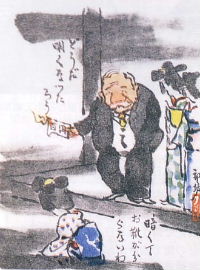
The narikin in caricature: he burns a 100 yen
note for light so the girl can find his shoes.


A Healthy Glow


Plutonium found in soil at Okuma

Plutonium that is believed to have come from the crippled Fukushima No. 1 power plant has been detected in the town of Okuma about 1.7 km away from the plant's front gate, a Kanazawa University researcher said Sunday.

It is the first time plutonium ejected by the stricken facility has been found in soil beyond its premises since the March 11 megaquake and tsunami led to a core meltdown there.

Not to worry.

Professor Masayoshi Yamamoto of Kanazawa University said the level of plutonium detected in soil in Okuma, Fukushima Prefecture, is lower than the average level observed in Japan after nuclear tests were conducted abroad.
Where abroad? Chernobyl?

Whats the penalty for being complicit in intergenerational mass murder?

I can't comprehend what is to be gained by the Japanese government down playing this and covering this whole fiasco up.


Friday, 27 May 2011

Letter from a Fukushima Mother


From ZeroHedge. Hiroko Tabuchi is reporter with the New York times.

Letter from a Fukushima mother

When Tomoko-san, a mother of two in Fukushima City, heard from an NGO worker that I was going to be in Fukushima to report on a story about radiation levels at local schools, she was kind enough to volunteer her time to speak to me – and handed me this letter. I promised to translate it and share it with you. So here it is:

To people in the United States and around the world,


I am so sorry for the uranium and plutonium that Japan has released into the environment. The fallout from Fukushima has already circled the world many times, reaching Hawaii, Alaska, and even New York.


We live 60 kilometers (37 miles) from the plant and our homes have been contaminated beyond levels seen at Chernobyl. The cesium-137 they are finding in the soil will be here for 30 years. But the government will not help us. They tell us to stay put. They tell our kids to put on masks and hats and keep going to school.


This summer, our children won’t be able to go swimming. They won’t be able to play outside. They can’t eat Fukushima’s delicious peaches. They can’t even eat the rice that the Fukushima farmers are making. They can’t go visit Fukushima’s beautiful rivers, mountains and lakes. This makes me sad. This fills me with so much regret.


Instead, our children will spend the summer in their classrooms, with no air conditioning, sweating as they try to concentrate on their lessons. We don’t even know how much radiation they’ve already been exposed to.
I was eight years old when the Fukushima Daiichi plant opened. If I had understood what they were building, I would have fought against it. I didn’t realize that it contained dangers that would threaten my children, my children’s children and their children.


I am grateful for all the aid all the world has sent us.


Now, what we ask is for you to speak out against the Japanese government. Pressure them into taking action. Tell them to make protecting children their top priority.


Thank you so much,


Tomoko Hatsuzawa
Fukushima City
May 25, 2011
[Translated by Hiroko Tabuchi]

You can get the official latest update on the Tepco and Japanese govts mismanagement here.

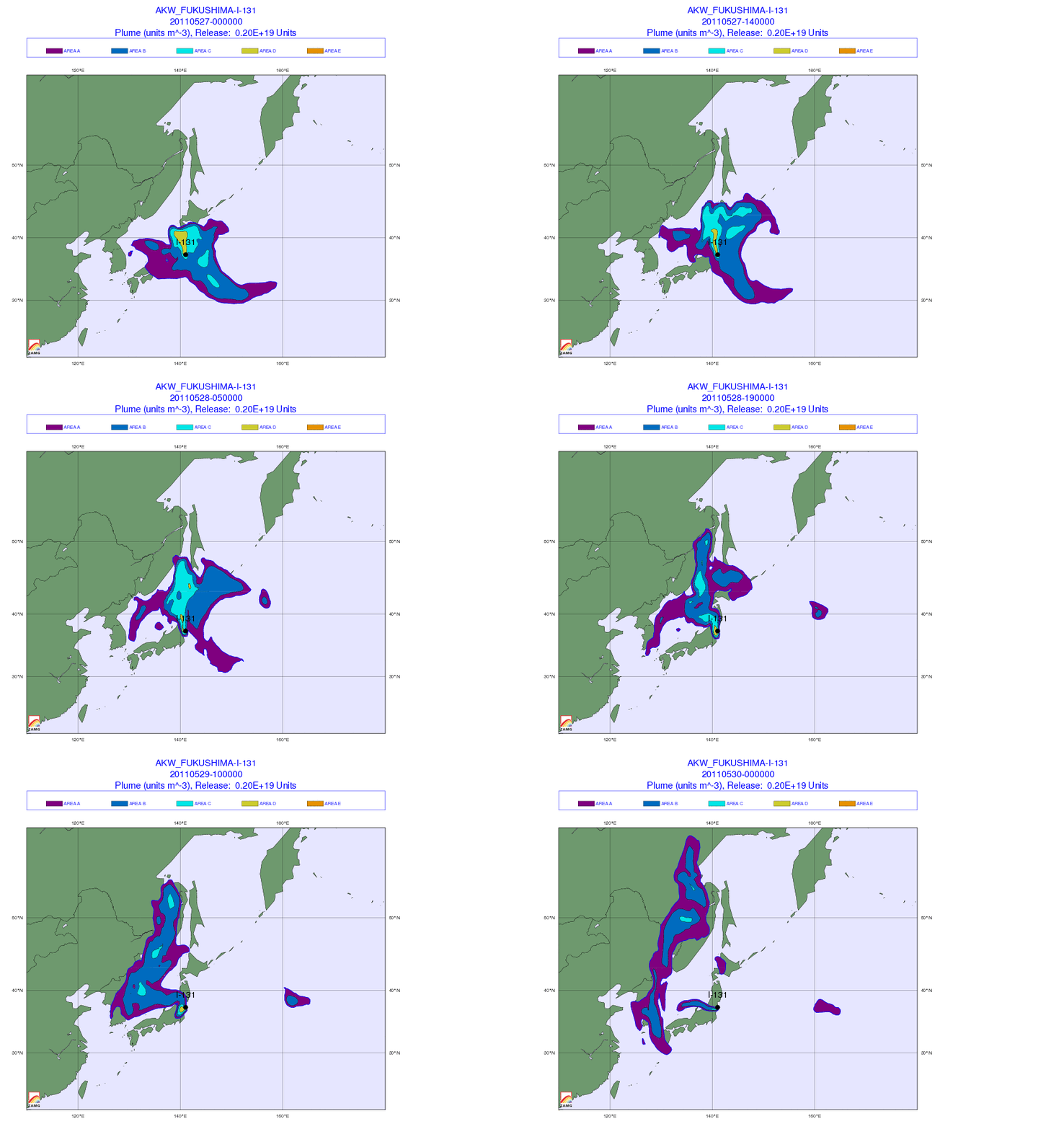
Also recent Iodine131 plume updates from http://www.zamg.ac.at/wetter/fukushima/


Thursday, 19 May 2011

Japanese Economy has Collapsed


Zero Hedge

Confirming once again that Wall Street economist (and sell side in general) is the most useless profession in the world (though gladly accepting a 7 figures compensation), is the latest data out of Japan which is yet another stunner to most, as nobody, nobody, could have possible predicted that the Japanese economy would literally fall off a cliff in Q1, plunging at a 3.7% rate (down from -3% previously), which is double the consensus print of -1.9%. DOUBLE. And in nominal terms the collapse was simply epic: -5.2%!

And yes, this is officially a recession. Of course, anyone reading Zero Hedge would have been perfectly aware of this outcome. 4 short days ago we said: "Increasingly we have come to believe that the real marginal economy over the next several quarters will be neither that of the contracting US, nor that of the rapidly tightening, yet still very much inflationary China, but the (arguably) third largest one: that of Japan."

Today our prediction is more than confirmed. And instead of hiding deep in the whatever holes these morlocks cralwed out of, Bloomberg for some inexplicable reason continues to look to their blatantly horrendous opinion. “The negative economic impact from the disaster will be on full display during the second quarter,” Hiroshi Watanabe, a senior economist at the Daiwa Institute of Research in Tokyo, said before the report. “This recession may be deep, but short.” Yeah, sure. Short. We'll just hold our breath. And for it to be short, it means that the BOJ will be forced to print a few hundred trillion in Yen asap (just as we predicted here and here) right? Which in turn means that the USDJPY will surge and shift the Japanese recession even faster over to the US. And yes it means that the turbo print button among the central banks will get the F5 treatment as the second round of currency devaluation completes a lap.
Some more much delayed reality:
Highlighting the disaster’s effect on companies, Toyota Motor Corp. said profits plunged while Nippon Steel Corp. reported its first net loss in six quarters, after the quake closed plants, cut supply chains and caused power shortage.

Factory output fell by a record and retail sales and exports declined in March because of power shortages spurred by a nuclear accident in Fukushima, northeast of Tokyo, and damage to transportation facilities after the temblor.

“It’s hard to think that companies will become aggressive about increasing business spending when uncertainties remain strong,” said Junko Nishioka, chief economist at RBS Securities Japan Ltd. in Tokyo. “Capital spending will likely be in a declining trend as corporate profits may do worse than expected.”

Capital investment dropped 0.9 percent in the first quarter, the first decline in six quarters, today’s data showed.

Consumer spending fell 0.6 percent in the January-March period from the previous three months, today’s report showed.

GFC II here we come. QE3 from the US Fed is a gimme.