Showing posts with label Geopolitical. Show all posts

Thursday, 16 February 2012

"Driving Greece Towards Violent Revolution"


Zerohedge
Summary Of Greek Reform "Pledges" 

De Spiegel
Anti-German Mood Heats Up in Greece

UK Telegraph
For Greece a tear, for Brussels a blush 

Greek death spiral accelerates 


We learn that:
Greece's manufacturing output contracted by 15.5pc in December from a year earlier.
Industrial output fell 11.3pc, compared to minus 7.8pc in November.
Unemployment jumped to 20.9pc in November, up from 18.2pc a month earlier.
I have little further to add. This is what a death spiral looks like.

It is what can happen if you join a fixed exchange system, then take out very large debts in what amounts to a foreign currency, and then have simultaneous monetary and fiscal contraction imposed upon you.

Germany discovered this on the Gold Standard when it racked up external debt from 1925 to 1929 (owed to American bankers) in much the same way as Greece has done.

When the music stopped – ie, when the Fed raised rates from 1928 onwards – Germany blew apart in much the same way as Greece is blowing apart. This is not a cultural or anthropological issue. It is the mechanical consequence of capital flows into a country that cannot handle it, as Germany could not handle it in the late 1920s.

By the way, Greeks work an average 42 hours a week, one of the highest in Europe. Just want to put the record straight on that.

 I previously posted a link to the EU's Nigel Farage: Nigel Farage Is On Fire

 Here is his latest, succinctly describes the situation in under 2 minutes.


Some previous posts come to mind
"A Global Financial Crisis of Epic Proprtions"

Youth Unemployment In The EU
Austerity will involve cutting military budgets, pensions and some charismatic officers getting forced early retirement on reduced pensions. Now add reduced social welfare to those youths and you get no hope, no future, no cash. A powderkeg. All it needs is charismatic leadership offering hope and a future (add patriotism and nationalism).

How do you think Franco, Hitler and Mussolini got traction? The stage is set and only fools can't see we are back in the 1920s 


Wednesday, 8 February 2012

How To Start A War


Throughout history, war planners have used various forms of deception to trick their enemies. Because public support is so crucial to the process of initiating and waging war, the home population is also subject to deceitful stratagems. The creation of false excuses to justify going to war is a major first step in constructing public support for such deadly ventures. Perhaps the most common pretext for war is an apparently unprovoked enemy attack. Such attacks, however, are often fabricated, incited or deliberately allowed to occur. They are then exploited to arouse widespread public sympathy for the victims, demonize the attackers and build mass support for military “retaliation.”
Like schoolyard bullies who shout ‘He hit me first!’, war planners know that it is irrelevant whether the opponent really did ‘throw the first punch.’ As long as it can be made to appear that the attack was unprovoked, the bully receives license to ‘respond’ with force. Bullies and war planners are experts at taunting, teasing and threatening their opponents. If the enemy cannot be goaded into ‘firing the first shot,’ it is easy enough to lie about what happened. Sometimes, that is sufficient to rationalize a schoolyard beating...or a genocidal war.

Such trickery has probably been employed by every military power throughout history. During the Roman empire, the causes of war -- cassus belli -- were often invented to conceal the real reasons for war. Over the millennia, although weapons and battle strategies have changed greatly, the deceitful strategem of using pretext incidents to ignite war has remained remarkably consistent.
Read: 
  1. How to Start a War: The American Use of War Pretext Incidents.
  2. Show of Force in Strait of Hormuz - Risk of 'Accidental' Gulf War on the Rise

Then lock up your sons because the Russians and Chinese (and probably the Indians who source their oil from Iran) won't be pleased....

China to Protect Iran Even if Result Starts World War III (scary videos embedded)
Russia issues stark warning against attack on Iran


At the Nuremberg trials Hitler's second in command, Hermann Göring spoke about war and extreme nationalism to Captain Gilbert, as recorded in Gilbert's Nuremberg Diary:
Naturally, the common people don't want war; neither in Russia nor in England nor in America, nor for that matter in Germany. That is understood. But, after all, it is the leaders of the country who determine the policy and it is always a simple matter to drag the people along, whether it is a democracy or a fascist dictatorship or a Parliament or a Communist dictatorship. ...voice or no voice, the people can always be brought to the bidding of the leaders. That is easy. All you have to do is to tell them they are being attacked, and denounce the pacifists for lack of patriotism and exposing the country to danger. It works the same way in any country

That is why young Australian join the army to go to places unconnected to Australia like Gallipoli, Turkey or Afghanistan. We...
are being attacked
To not go is a...
lack of patriotism and exposing the country to danger.
 It always has been and always will be.

Those Turks were a big threat to Australia and Britain in 1915. Its navy was 13 ships to Britain's 160.

Gallipoli, like Afghanistan and Iraq was/is 'defending' Australia. As Iran will be.

When they come home in a box, they were a brave young patriotic man  defending Australia with weeping dignitaries fawning over the casket.

Actually, what they are is a  corpse. When a negotiated peace is finally made with the protagonists because its another un-winnable theatre someone should put a chess pawn on their grave.

Tuesday, 3 January 2012

What Will 2012 Bring?


So, now the hangovers have abated, what will 2012 bring?

Marcus Padley
I'll start with a broker I thoroughly respect, Marcus Padley (writes for Fairfax etc), who appears who made some predictions whilst having a few beers pre-Christmas.

Headlines you may see in 2012 
  • ANZ raises interest rates 100bp at monthly monetary policy meeting. Declares interest rate settings “appropriate for our shareholders” and “profit margins within target band”
  • RBA closed. Glenn Stevens joins Macquarie
  • Westfield charges Retailers $10,000 per square megabyte on New Westfield Virtualand website
  • Gerry Harvey declares the internet a ‘fad’
  • Mercedes Benz prices jump 218% on euro break up. German exports fall 98% Greek Drachma jumps 14% to 0.0002374 Deutschmarks as faceless EU plant retires from post as Greek Prime Minister aged 45 on seven eighths of his final two years salary plus benefits
  • German taxi driver earns 10 times as much as new Greek PM
  • Rogue Trader at Goldman Sachs makes $US100bn profit shorting euro. Joins Cramer’s White House Administration as US Treasury Secretary
  • Berlusconi releases second Love Song CD “Don’t cry for me Angela Merkel, you know the truth is, I never loved you. All through my wild days, my mad existence, I knew the euro, wouldn’t go the distance”


...etc. Read the rest in the link, its quite amusing.


His 2011 predictive history sans beer (I assume) is worth a read, he is rather good... Let's share the financial obvious with hindsight. If you like what you read you can sign up for a free weeky newsletter at the bottom of this page: Marcus Today. Also a free end of day report here.

Art Cashin
Art is a 40 year trading veteran on the floor of the NYSE working for UBS.

Art Cashin of UBS

Europe Rumbles Continue Beneath More Upbeat Headlines - Ever since last week’s liquidity operation, most headlines out of Europe have leaned toward the reassuring side. Beneath those headlines, however, there are signs the strains remain and may, in fact, be growing.

European banks are making great use of the ECB’s overnight deposit facility. Last night they parked $590 billion at the ECB breaking the record they had set the night before. They are clearly unwilling to lend to other European banks, highlighting the distrust and fear in the interbank marketplace. While the ECB’s lending initiative calmed the markets somewhat, it apparently has done nothing to free up the logjam blocking interbank lending.

The distrust on the streets is said to be growing also. Barroom gossip says that safe-deposit boxes are in a demand that borders on frenzy. They allow you to take your Euros and covert them into something of value (gold, Swiss Francs, etc.) and sock it away in a safe place. Others are said to be buying property in London and elsewhere lest you awake one day and discover that your Euros have reverted to drachmas or lira.

Savvy bankers are said to be setting up personal and communal trusts domiciled in places like the Bahamas, the Caymans or the Isle of Jersey. Some banks are offering depository accounts denominated (and repayable) in alternate currencies like the dollar or the yen.

We think a Lehman-like event would most likely be triggered by a run on a bank or a series of banks. The scramble for currency (value) protection among the public could turn into that bank run in the same way that a crowd can instantly turn into a mob. Watch the money flows out of Greece and Italy very carefully. The pot continues to bubble.

Outflows From Italy and Greece


Max Keiser (the irrepressible!)


My Predictions
  • At least one Eurobank will fail as capital flight from the PIIGS increases in intensity. (Capital flight occurring now, banks insolvent and on ECB life support)
  • Credit contagion and freeze. (TED Spread, Euribor etc rising now)
  • Crash of various debt fuelled asset classes. (Stocks, property easing as credit freezes, economies stall and UE climbs are occurring now)
  • China's manufacturing sector continues to contract (now 2 months running), their housing and debt sector collapses. (happening now at a rapid rate)
  • Japanese economy on the verge of collapse as Yen reaches all time high.(happening now, this year they borrowed more than tax revenue for the first time)
  • ASX will see 2xxx (Eurobank failure - replay of 2008)
  • Unemployment in Oz 9% and rising (rising now as property prices fall)
  • Australian bank profits turn to losses ala USA, Ireland, Britain etc with abysmal outlook for 2013 as another 8-10% wiped off house prices.(outcome of Property Prices falling another 8-10% plus credit freeze)
  • 40% of Americans and 8% of Australians have 'underwater mortgages' or negative equity.(outcome of Property Prices falling another 8-10%)
  • US Debt over $17 trilion (thats a gimme)(based on last 3 years debt growth and Obama's debt addiction and election year)
  • Gold over $2500 USD as QE3 is triggered following a late 2008 NYSE -30% replay, which puts a boost under stockmarkets, but little else as US unemployment U3 nudges 12% . (based on late 2008, early 2009)
  • Australia's Deficit increases as tax revenues dwindle (outcome of Property Prices falling another 8-10% and UE rising, CGT and PAYG revenues falling)
  • Australian states get credit downgrades as the stamp duty money flow slows to trickle and their in massive deficits leading to massive cuts in state public servants. (outcome of Property Prices falling another 8-10%, Stamp Duty revenues dwindle)
  • If Ron Paul doesn't get GOP nomination, No Hope Obama hits the front. (coin flip)
  • AUD breaches 75c.(based on late 2008, early 2009 carry unwind, Risk OFF)
  • Coin toss on Iran invasion as China declares alliance. (historical friendship established a long time ago, google it)
  • Russia continues to take a more aggressive and militaristic stance towards the west with a possible China alliance (enemy of my enemy is my friend). (occurring now)
  • Civil unrest climbs in the PIIGS and UK - soldiers used to keep it under control as civil war draws closer as unemplyment climbs, credit is frozen and austerity creates a depression.(starting to occur now as austerity bites)
  • Le Pen and the far right take more dominant positions in France if not president Le Pen (starting to occur now)


On China/Iran and Russia/West (videos in links):
China to Protect Iran Even if Result Starts World War III

Russia Retaliates Against US: Puts Radar Station On Combat Alert, Prepares To Take Out European Missile Defense Systems


HAPPY NEW YEAR!!

Thursday, 22 December 2011

50 Frightening Facts...On The US Economy


The Roman Empire lasted five centuries, at this rate the American Empire won't complete one. Some startling facts below with embedded links to sources.


#1 A staggering 48 percent of all Americans are either considered to be "low income" or are living in poverty.

#2 Approximately 57 percent of all children in the United States are living in homes that are either considered to be "low income" or impoverished.

#3 If the number of Americans that "wanted jobs" was the same today as it was back in 2007, the "official" unemployment rate put out by the U.S. government would be up to 11 percent.

#4 The average amount of time that a worker stays unemployed in the United States is now over 40 weeks.

#5 One recent survey found that 77 percent of all U.S. small businesses do not plan to hire any more workers.

#6 There are fewer payroll jobs in the United States today than there were back in 2000 even though we have added 30 million extra people to the population since then.

#7 Since December 2007, median household income in the United States has declined by a total of 6.8% once you account for inflation.

#8 According to the Bureau of Labor Statistics, 16.6 million Americans were self-employed back in December 2006.  Today, that number has shrunk to 14.5 million.

#9 A Gallup poll from earlier this year found that approximately one out of every five Americans that do have a job consider themselves to be underemployed.

#10 According to author Paul Osterman, about 20 percent of all U.S. adults are currently working jobs that pay poverty-level wages.

#11 Back in 1980, less than 30% of all jobs in the United States were low income jobs.  Today, more than 40% of all jobs in the United States are low income jobs.

#12 Back in 1969, 95 percent of all men between the ages of 25 and 54 had a job.  In July, only 81.2 percent of men in that age group had a job.

#13 One recent survey found that one out of every three Americans would not be able to make a mortgage or rent payment next month if they suddenly lost their current job.

#14 The Federal Reserve recently announced that the total net worth of U.S. households declined by 4.1 percent in the 3rd quarter of 2011 alone.

#15 According to a recent study conducted by the BlackRock Investment Institute, the ratio of household debt to personal income in the United States is now 154 percent.

#16 As the economy has slowed down, so has the number of marriages.  According to a Pew Research Center analysis, only 51 percent of all Americans that are at least 18 years old are currently married.  Back in 1960, 72 percent of all U.S. adults were married.

#17 The U.S. Postal Service has lost more than 5 billion dollars over the past year.

#18 In Stockton, California home prices have declined 64 percent from where they were at when the housing market peaked.

#19 Nevada has had the highest foreclosure rate in the nation for 59 months in a row.

#20 If you can believe it, the median price of a home in Detroit is now just $6000.

#21 According to the U.S. Census Bureau, 18 percent of all homes in the state of Florida are sitting vacant.  That figure is 63 percent larger than it was just ten years ago.

#22 New home construction in the United States is on pace to set a brand new all-time record low in 2011.

#23 As I have written about previously, 19 percent of all American men between the ages of 25 and 34 are now living with their parents.

#24 Electricity bills in the United States have risen faster than the overall rate of inflation for five years in a row.

#25 According to the Bureau of Economic Analysis, health care costs accounted for just 9.5% of all personal consumption back in 1980.  Today they account for approximately 16.3%.

#26 One study found that approximately 41 percent of all working age Americans either have medical bill problems or are currently paying off medical debt.

#27 If you can believe it, one out of every seven Americans has at least 10 credit cards.

#28 The United States spends about 4 dollars on goods and services from China for every one dollar that China spends on goods and services from the United States.

#29 It is being projected that the U.S. trade deficit for 2011 will be 558.2 billion dollars.

#30 The retirement crisis in the United States just continues to get worse.  According to the Employee Benefit Research Institute, 46 percent of all American workers have less than $10,000 saved for retirement, and 29 percent of all American workers have less than $1,000 saved for retirement.

#31 Today, one out of every six elderly Americans lives below the federal poverty line.

#32 According to a study that was just released, CEO pay at America's biggest companies rose by 36.5% in just one recent 12 month period.

#33 Today, the "too big to fail" banks are larger than ever.  The total assets of the six largest U.S. banks increased by 39 percent between September 30, 2006 and September 30, 2011.

#34 The six heirs of Wal-Mart founder Sam Walton have a net worth that is roughly equal to the bottom 30 percent of all Americans combined.

#35 According to an analysis of Census Bureau data done by the Pew Research Center, the median net worth for households led by someone 65 years of age or older is 47 times greater than the median net worth for households led by someone under the age of 35.

#36 If you can believe it, 37 percent of all U.S. households that are led by someone under the age of 35 have a net worth of zero or less than zero.

#37 A higher percentage of Americans is living in extreme poverty (6.7%) than has ever been measured before.

#38 Child homelessness in the United States is now 33 percent higher than it was back in 2007.

#39 Since 2007, the number of children living in poverty in the state of California has increased by 30 percent.

#40 Sadly, child poverty is absolutely exploding all over America.  According to the National Center for Children in Poverty, 36.4% of all children that live in Philadelphia are living in poverty, 40.1% of all children that live in Atlanta are living in poverty, 52.6% of all children that live in Cleveland are living in poverty and 53.6% of all children that live in Detroit are living in poverty.

#41 Today, one out of every seven Americans is on food stamps and one out of every four American children is on food stamps.

#42 In 1980, government transfer payments accounted for just 11.7% of all income.  Today, government transfer payments account for more than 18 percent of all income.

#43 A staggering 48.5% of all Americans live in a household that receives some form of government benefits.  Back in 1983, that number was below 30 percent.

#44 Right now, spending by the federal government accounts for about 24 percent of GDP.  Back in 2001, it accounted for just 18 percent.

#45 For fiscal year 2011, the U.S. federal government had a budget deficit of nearly 1.3 trillion dollars.  That was the third year in a row that our budget deficit has topped one trillion dollars.

#46 If Bill Gates gave every single penny of his fortune to the U.S. government, it would only cover the U.S. budget deficit for about 15 days.

#47 Amazingly, the U.S. government has now accumulated a total debt of 15 trillion dollars.  When Barack Obama first took office the national debt was just 10.6 trillion dollars.

#48 If the federal government began right at this moment to repay the U.S. national debt at a rate of one dollar per second, it would take over 440,000 years to pay off the national debt.

#49 The U.S. national debt has been increasing by an average of more than 4 billion dollars per day since the beginning of the Obama administration.

#50 During the Obama administration, the U.S. government has accumulated more debt than it did from the time that George Washington took office to the time that Bill Clinton took office.
The root of the problems?
Of course the heart of our economic problems is the Federal Reserve.  The Federal Reserve is a perpetual debt machine, it has almost completely destroyed the value of the U.S. dollar and it has an absolutely nightmarish track record of incompetence.  If the Federal Reserve system had never been created, the U.S. economy would be in far better shape.  The federal government needs to shut down the Federal Reserve and start issuing currency that is not debt-based.  That would be a very significant step toward restoring prosperity to America.

One presidential candidate wants to end the Fed and stop ridiculous Romanesque military forays to foreign lands (he's done military time having used his medical degree in a role as a flight surgeon in the USAF in the 60s)...


I doubt the Kleptocrats at the Fed and the banking cabal will allow the racketeering to end that easily, the propaganda campaign against Paul is fierce. Expect more of the same and the spiral to get faster and tighter.


Saturday, 17 December 2011

Agincourt, An Anglo French Stoush

I love this speech.


25th October 1415, Seventy Eight years after the Hundred Years War started, where peasant English archers defeated French Knights in full armour on destriers.

So now we have the French getting feisty again. What are the British doing, being part of this cabal of clowns? The British are in deep poo but they have their own currency and can dump these clowns.

Britain's fiscal position is worse than France's BUT they don't need to join France in shitter's ditch shackled to the PIIGS.

I love France, its history and the French. I love how THEY (Naval blockade and superior land forces) not the Colonial Army defeated Cornwallis at Yorktown to give America its  freedom. The food, the people, magnifique!

Its not about France or the French, its about citizens surrendering their democratic rights to a banking cabal that runs the governments, and, in that aspect I salute Mr Cameron and Britain.

The British have their own currency and can dig themselves out of the shit as they have in the past, or they may not, but at least they have not surrendered sovereignty to a banking cabal.

French leaders declare a war of words on Britain 

Christian Noyer, the governor of the Bank of France, said that Britain faced larger national debts, higher inflation and slower growth than France.
François Baroin, the finance minister, said Britain was “marginalised” and faced “a very difficult economic situation” because of Coalition policies.
The blunt remarks are the latest sign of Anglo-French tension following David Cameron’s refusal last week to back a new European treaty drawn up in response to the eurozone crisis.
George Osborne, the Chancellor, also provoked anger in France recently by suggesting it could be the next eurozone economy to experience a debt crisis. France and Germany want a new treaty to create a “fiscal union” of eurozone members, to control their deficits and reassure the markets.
Mr Baroin told the French parliament that the pact had been backed by every country in Europe, “with the singular, now solitary, exception of Great Britain, which history will remember as marginalised”. 

Ouch, a white glove with a feather inside.


The interest rate – or yield – on British government bonds is around 2.2 per cent. The French rate is around 3.2 per cent

No 10 said: “We have put in place a credible plan for dealing with our deficit and the credibility of that plan can be seen in what has happened to yields in this country.”

Senior British sources said French leaders were so panicked by the prospect of losing their AAA credit rating that they were trying to spread confusion by undermining the economic reputations of other nations. 

One government source said: “It’s so obvious what they are up to. They are in a completely different place to us. Where do you hide a tree? In a wood.”

David Ruffley, a Conservative member of the Treasury select committee, criticised the remarks. “This is another example of Gallic self-delusion on an epic scale,” he said. “They are tied to a currency that could become a basket case at any moment.”

Fitch warned of a downgrade France last night.
France’s AAA Outlook Cut as Fitch Reviews Italy, Spain Ratings

Whats funny is that the French are in debt to British banks, who have maximum French exposure. Interesting times.


Thursday, 24 November 2011

The Russian Federation Will...Take Out Any Part Of The US Missile Defense System, In Europe.

Nice.

(7 minutes in): "First, I am instructing the Defense Ministry to immediately put the missile attack early warning radar station in Kaliningrad on combat alert. Second, protective cover of Russia's strategic nuclear weapons, will be reinforced as a priority measure under the programme to develop out air and space defenses. Third, the new strategic ballistic missiles commissioned by the Strategic Missile Forces and the Navy will be equipped with advanced missile defense penetration systems and new highly-effective warheads. Fourth, I have instructed the Armed Forces to draw up measures for disabling missile defense system data and guidance systems if need be... Fifth, if the above measures prove insufficient, the Russian Federation will deploy modern offensive weapon systems in the west and south of the country, ensuring our ability to take out any part of the US missile defense system, in Europe. One step in this process will be to deploy Iskander missiles in Kaliningrad Region.

 Full must watch address to the public: for English closed captioning hit the CC button


Monday, 21 November 2011

Its On: China vice premier sees chronic global recession


China vice premier sees chronic global recession

"The one thing that we can be certain of, among all the uncertainties, is that the global economic recession caused by the international financial crisis will be chronic," Wang was quoted by the official Xinhua news agency as saying at the weekend.


Wang's comments were the most bearish forecast ever by a top Chinese decision-maker about the world economy, and Beijing's worry about a worsening global environment could translate into an impetus for pro-growth policies at home.

I read this as the Politburo can blame the world for the for the shit hitting the fan internally as the Ponzi disaster that is the Chinese economy is now unravelling.

Youth Unemployment In The EU

Nuremberg Rally 1936


Youth unemployment 15-24yo PIIGSUK

Portugal 27.7%
Ireland 29.8%
Italy 27.8%
Greece 42.9%
Spain 45%
UK 20.4%

More austerity anyone?


Austerity will involve cutting military budgets, pensions and some charismatic officers getting forced early retirement on reduced pensions. Now add reduced social welfare to those youths and you get no hope, no future, no cash. A powderkeg. All it needs is charismatic leadership offering hope and a future (add patriotism and nationalism).

How do you think Franco, Hitler and Mussolini got traction? The stage is set and only fools can't see we are back in the 1920s

Friday, 18 November 2011

Nigel Farage Is On Fire

Here is a speech by Nigel Farage to the European parliament. It is a must watch. Brilliant stuff.

Thursday, 17 November 2011

The Shit Is Going To Hit The Fan In 2012

I was a little incredulous when I read this, I've blogged regularly that the Chinese economy is just a property bubble come ponzi scheme and its going to go down Japan's path of the early 20th century but I am amazed as to how bad it is.... Buyers and developers face some harsh home truths

"The decline in home prices is just beginning. And this price adjustment will cut deeper than was the case in 2008 to 2009," said Chen Li, head of China equity strategy at UBS Securities. "The fluctuations in the property market, in fact, may pose the biggest challenge to China's economy next year."

Meanwhile...
European Government Bond Market "Frozen" says Bank of Italy Managing Director

Only open this one  on an empty stomach...
JPMorgan, Goldman Keep Investors in Dark on European Debt Risk ; Net Position Disclosure Hides True Risk

Back on the Debtstar...
$15,OOO,OOO,OOO,OOOBAMA! - It's Official: Total US Debt Passes $15 Trillion
Too sad for commentary, but here is some math: total US debt has increased by 41.5%, or $4.4 trillion, from $10,626,877,048,913 on January 20, to $15,033,607,255,920, under Obama as president.
(as a reminder the most recently updated debt ceiling is $15.194 trillion)


Sunday, 13 November 2011

Long Live European Democracy - A Tale About Little PIIGS.

 (street of Athens)

I'm away from home on business until Christmas and my posts will be infrequent. Apologies.

But, onwards and upwards, last week, democracy died. Elected representatives of Greece and Italy surrendered to the banking cartels and now those countries are run by cartel reps. No one dares ask the people via referendum or plebiscite.

Bravo. Civil wars in 2013? Earlier? If you think the populations of a country like Italy will take tough it out, austerity so German and French bankers can get the cash, you are dreaming. A country that makes Maserati, Lamborghini and Ferrari and high end aerospace products and aircraft, top end fashion etc are going to take Irish and Greek austerity...dream on.

First, a timeline for Greece [and some PIIGS]


Following is a timeline of Europe’s debt crisis from the signing of the Maastricht Treaty to Greece’s agreement to set up a government of national unity.

1992

Feb. 7: Maastricht Treaty signed, setting up an “irrevocable” monetary union without a central finance ministry or a mechanism to leave the euro.

16 Sept: Europe’s Exchange Rate Mechanism blown into disarray when the U.K. is forced to exit the currency regime, a precursor to monetary union. Billionaire George Soros reportedly makes $1 billion selling the pound. Italy later exits and the Spanish peseta, Portuguese escudo and Irish punt are devalued.

1996 

Dec. 13: In the absence of a euro finance ministry, EU leaders consent to a German-inspired “Stability Pact” designed to impose financial penalties on countries that overstep deficit limits.

1998 

March 14: Greece enters the ERM.
  
1999 

Jan. 1: Euro established with 11 founding members.

2001 

Jan. 1: Greece enters euro region. Greek 10-year bonds yield 5.36 percent, Spanish 10-year bonds 5.09 percent and Italian 10- year bonds 5.16 percent. Germany’s 10-year bund yields 4.85 percent.

2003 

Nov. 24-25: Germany, France override EU budget rules after saying they expect to exceed the EU’s 3 percent deficit limit for a third year. Spain, Netherlands, Finland and Austria object.

2005 

March 20: EU finance ministers bow to German pressure to relax deficit rules.

2008 

Sept. 15: Lehman Brothers files for bankruptcy, triggering worldwide market panic.

Sept. 30: Ireland guarantees all deposits and most debt liabilities of its banks. Irish 10-year bonds yields 4.590 percent.

2009 

Jan 14: S&P cuts Greece to A- from A. The rating company cites the country’s weakening finances as the global economy slowed. Greek 10-year bond yields rise to 5.43 percent the next day.

Jan. 15: Ireland nationalizes Anglo Irish Bank.


Jan. 19: S&P cuts Spain to AA+ from AAA.

May 6: Spanish Finance Minister Elena Salgado sees “green shoots” in Spanish economy. Ten-year bonds yield 3.93 percent.

Oct. 4: George Papandreou leads Socialist Pasok Party to landslide victory in Greek elections, beating New Democracy by the widest victory margin since 1981 on pledges to boost spending and wages.

Oct. 20: New Greek Finance Minister Papaconstantinou says deficit will balloon to 12.5 percent of GDP this year, more than double the previous government’s forecast. Yield on Greek 10- year bond 4.58 percent.

Oct. 26: Former head of Greek National Statistics Service says his body “holds no responsibility” for the revision of deficit figures since 2008.

Nov. 5: Papandreou announces first budget. The plan aims to trim the deficit to 9.4 percent GDP in 2010.

Dec. 16: S&P Cuts Greece to BBB+ from A-, three steps above junk.

2010 

Jan. 14: Greece adopts three-year plan to bring the European Union’s biggest budget deficit within the EU limit in 2012. The same day, ECB President Jean-Claude Trichet said Greece won’t win any special treatment from the central bank.

Jan. 21: Papaconstantinou says Greece won’t need a rescue package. The yield on Greece’s 10-year bond reaches 6.248 percent, a euro-era high.

Jan. 29: EU Commissioner Joaquin Almunia says in Davos there is no ‘Plan B’ for Greece. “Greece will not default. In the euro area, default does not exist.”

Feb. 2: Greek government announces austerity package to get deficit to 3 percent of GDP in 2012.

Feb. 11: EU leaders hold first emergency summit on Greece. EU agrees to take “determined and coordinated action” to protect financial stability of euro area, without giving further details.

Feb. 15: Papaconstantinou says “we are basically trying to change the course of the Titanic. People think we are in a terrible mess. And we are.”

March 4: Germany snubs aid for Greece in “historic moment” for EU as protesters seize Finance Ministry in Athens.

March 8: Portuguese government announces new budget cuts, more asset sales and a freeze on public wages.

March 10: Former Italian Prime Minister Romano Prodi says Greece’s problems are “completely over. I don’t see any other case now in Europe.”

March 16: Euro-region finance ministers lay groundwork for making emergency loans available to aid Greece. S&P affirms Greece BBB+ rating and takes it off Creditwatch negative. Papaconstantinou says the EU needs a “loaded gun” to fend off speculators.

March 18: Papandreou calls on EU partners to come up with specific aid measures within a week to help Greece, hints he might seek support from IMF if EU partners don’t act.

March 24: Fitch cuts Portugal’s credit rating to AA-.

March 25: Trichet says that the ECB will continue to accept bonds rated as low as BBB- as collateral, reversing his January refusal to give Greece special treatment. Later that day in Brussels, Trichet abandons his opposition to IMF involvement in a Franco-German plan to give Greece bilateral loans at market rates.

March 26: Head of Greek debt agency says rescue deal “wipes out the risk of default.”

March 30: Ireland says country’s banks need to raise an additional 31.8 billion euros of capital.

April 8: Greece’s 10-year bond yield reaches 7.4 percent, pushing the spread on German bunds to a euro-era high of 442 basis points.

April 12: Euro-area finance ministers agree to provide up to 30 billion euros of loans to Greece over the next year with the IMF agreeing to put up another 15 billion euros in funds.

April 21: Greece, facing 8.5 billion euros in bond redemptions the following month, begins talks with the EU, the ECB and the IMF on conditions tied to 45 billion-euro in aid.

April 22: The EU revises Greece’s 2009 budget deficit to 13.6 percent of GDP, higher than the government’s previous forecast of 12.9 percent. Ireland overtakes Greece as the EU nation with the largest deficit with its shortfall revised to 14.3 percent. Moody’s cuts Greece one level to A3.

April 23: Papandreou asks EU for a 45 billion-euro bailout from the EU and IMF, calling it a “a new Odyssey for Greece.” “But we know the road to Ithaca and have charted the waters,” he added, referring to the return of mythological hero Ulysses to his island home.

April 27: Ireland can “easily” weather the impact of the Greek crisis on financial markets, the country’s debt agency head said.

April 27: S&P become first rating company to cut Greece to junk, downgrades Portugal to A-.

April 28: S&P cuts Spain’s credit rating for second time since January 2009, pushing the euro to a one-year low of $1.3115.

May 2: Euro-region agrees on a 110 billion-euro rescue package for Greece. Greece agrees to 30 billion euros in austerity cuts over the next three years in exchange for the aid.

May 3: The ECB says it will indefinitely accept Greek collateral regardless of the country’s credit rating.

May 5: Protests in Athens against the government’s austerity plans turn violent and three people are killed when they become trapped in a bank set ablaze by demonstrators.

May 6: Greek Parliament approves deficit cuts. Greek 10-year yields reach 12 percent the next day.

May 7-8: European leaders agreed to set up an emergency fund to stem the sovereign crisis and said the workings of the financial backstop will be hammered out before the markets open May 10.

May 9-10: EU finance chiefs, in a 14-hour overnight session in Brussels, agree to set up a 750 billion-euros rescue mechanism for countries facing financial distress and the ECB said it will buy government and private debt in the biggest attempt yet to end the sovereign-debt crisis. The meeting gives birth to the European Financial Stability Facility, the region’s temporary bailout mechanism, with initial capital of 440 billion euros.

May 10: Merkel’s party suffers its worst postwar defeat in Germany’s most populous state after a regional vote overshadowed by aid for Greece. The result cost Merkel control of the upper house of parliament. Bundesbank President Axel Weber publicly criticizes ECB bond purchases.

May 12-13: Spain announces public-wage cuts and a pension freeze while Portugal says it will lower the salaries of top government officials and increase taxes. Spain cuts deficit target to 6 percent in 2011 and trims growth outlook.

May 18: Greece receives its first bailout loan for 14.5 billion euros, one day before 8.5 billion euros in bonds come due.

May 27: Italian Prime Minister Silvio Berlusconi unveils 25 billion euros in deficit cuts meant to help “defend the euro.”

May 28: Fitch cuts Spain’s AAA rating one level to AA+

June 23: Greek 10-year bond yield closes above 10 percent for first time in euro’s history.

June 14 Moody’s cuts Greece to junk.

July 13 Greece returns to bond markets for first time since bailout, selling 1.62 billion euros of six-month bills.

July 23: Europe publishes the results of bank stress tests. Only 7 of 91 lenders flunk the test.

Aug 24: S&P cuts Ireland’s credit rating to AA- because of concern over the costs of shoring up the country’s banking system.

Sept. 29: Spain’s first general strike in eight years to protest cuts and an increase to the retirement age.

Sept. 30: Ireland prepares to take majority control of Allied Irish Banks Plc and pump extra cash into Anglo Irish Bank Corp. Moody’s cuts Spain’s AAA rating to Aa1.

Oct. 4: Greece announce draft budget plan to cut the deficit to 7 percent of GDP in 2011.

Oct. 18: German Chancellor Angela Merkel and French President Nicolas Sarkozy meet in Deauville, France and agree that private investors must contribute to future EU bailouts and Sarkozy backs Merkel’s call for a permanent rescue mechanism from 2013.

Nov. 4: Trichet signals concern that forcing bondholders to take losses will drive up borrowing costs.

Nov. 12: Seeking to calm markets, finance ministers of France, Germany, Italy, Spain and the U.K. issued a statement at a G-20 in Seoul saying any private sector involvement would not apply to outstanding debt and would only come into effect from 2013.

Nov. 14: Irish Enterprise Minister Batt O’Keefe says Ireland doesn’t need a bailout, refutes talk of crisis.

Nov. 21: Ireland says it will apply for a bailout.

Nov. 23: S&P Cuts Ireland two steps to A from AA-.

Nov. 28: Ireland gets 85 billion-euro bailout. European leaders scale back proposals to inflict losses on bondholders.

Dec. 23: Fitch cuts Portugal to A+.

2011 

Jan. 14: Fitch follows S&P and Moody’s in cutting Greece to junk.

Jan. 24: Spain announces new capital requirements for banks. Salgado says the capital shortfall won’t be more than 20 billion euros.

Feb. 11: Axel Weber resigns from Bundesbank after opposing the ECB’s crisis policy.

Feb. 25: Ireland holds general election, with the ruling Fianna Fail swept from power in the worst result in its history.

March 11: EU summit agrees to expand powers of EFSF to allow it to buy debt in primary markets and tap its full 440 billion euros in firepower. EU also reaches preliminary agreement to cut the rates on emergency loans to Greece by 100 basis points for first three years and extend maturities of the loans to 7.5 years.

March 21: EU finance ministers decide on mechanisms for allowing the region’s permanent bailout mechanism, the ESM, lend 500 billion euros from 2013. The ESM will draw on 80 billion euros of paid-in capital, enabling it to lend a full500 billion euros.

March 23: Portugal’s Prime Minister Jose Socrates resigns after opposition rejects austerity package.

March 25: European Union leaders cut the start-up capital for the future permanent euro emergency aid mechanism, the ESM, after German demands to make smaller upfront payments.

April 6: Portuguese Prime Minister Jose Socrates requests EU bailout, saying he “tried everything” to avoid seeking aid.

April 15: Papandreou announces 76 billion euros of austerity measures, later increased to 78 billion euros, running through the end of 2015. The program pledged to raise 50 billion euros from state asset sales and aims to cut the budget deficit to 1 percent of GDP in 2015.

April 17: True Finns, who oppose euro bailouts, win 19 percent of the vote in Finnish elections.

May 6: Finance ministers from Spain, France, Germany and Italy hold unannounced meeting in Luxembourg that prompt press reports that Greece will leave the euro. Trichet walks out, refusing to attend any meeting that discusses Greek haircuts. Luxembourg Prime Minister Jean-Claude Juncker, who chairs finance ministers’ meetings, says possible further aid for Greece was discussed.

May 9: S&P cuts Greece two levels to B from BB-, threatens further cuts.

May 11: German Chancellor Angela Merkel signals that she will support Mario Draghi’s candidacy to succeed Trichet as president of ECB.

May 13: EU published new debt and deficit forecasts and predicts that Ireland, Portugal, Greece will all to have debt of more than their total GDP in 2011.

May 16: Portugal’s 78 billion-euro bailout approved by finance ministers. ECB’s Executive Board member Juergen Stark says restructuring would be “catastrophe” and wipe out Greek banks. Bini Smaghi says no difference between soft-hard restructuring.

May 17: European finance ministers for the first time float the idea of talks with bondholders to extend Greece’s debt-repayment schedule.

May 18: IMF Managing Director Dominique Strauss-Kahn resigns after being charged with attempting to rape a New York hotel maid. The case is thrown out three months later by a Manhattan judge.

May 20: ECB’s governing council member and Bundesbank President Jens Weidmann says central bank won’t take Greek bonds as collateral if maturities extended.

May 22: Spain’s ruling Socialists suffer worst local election defeat in 30 years.

May 24: Greece announces details on additional 6 billion euros of 2011 budget cuts, plan to speed asset sales. ECB governing council member Christian Noyer says Greek restructuring would be ‘horror story.’

May 27: Greek Cabinet passes another 6 billion euros in austerity measures and gave some details on planned assets sales.

June 5: Social Democratic and People’s Party win majority in Portuguese election, routing Socrates’ Socialists.

June 7: EU Monetary Affairs Commissioner Olli Rehn says June may be the “beginning of the end” of the crisis.

June 13: S&P Cuts Greece to CCC, the lowest rating for any country it reviews in the world.

June 15: Papandreou announces Cabinet reshuffle and confidence vote.

June 17: Papandreou appoints Defense Minister Evangelos Venizelos to replace Papaconstantinou as finance minister.

June 22: Papandreou survives confidence vote in his government.

June 24: Draghi appointed to succeed Trichet as president of the ECB.

June 28: French Finance Minister Christine Lagarde is named the first female head of the IMF with a mandate starting July 5.

June 30: Greek lawmakers approve the 78 billion-euro austerity plan after two votes in two days marred by violent protests outside parliament. Berlusconi’s Cabinet approves 47 billion euros in deficit-cutting measures to try to balance the budget by 2014 and protect Italy from the fallout of Europe’s debt crisis.

July 5: Moody’s cuts Portugal to junk.

July 12: Moody’s cuts Ireland to junk.

July 21: EU summit passes second bailout package for Greece and agrees to expand the powers of the EFSF. Bankers agree to take losses of 21 percent on the net present value of their Greek bond holdings.

July 29: Spanish Prime Minister Jose Luis Rodriguez Zapatero sets Nov. 20 as date for early elections that polls show he will lose. Moody’s places Spain’s rating on review for a downgrade.

Aug. 2 Spain’s 10-year bond reached euro-era record 6.46 percent.

Aug. 4 The ECB votes to resume its bond-buying program, buys Portuguese and Irish debt.

Aug. 5: ECB sends secret letter to Italy asking for more austerity measures and a plan to balance budget in 2013 rather than 2014. Berlusconi announces he will seek a balanced budget amendment and pledges more austerity Italian yields rise above Spanish yields for first time since May 2010.

Aug. 7: After emergency conference call, ECB signals it will begin buying Italian and Spanish bonds in secondary markets as part of its Securities Markets Program. The next day Spain’s 10- year yield falls 88 basis points to 5.16 percent, Italy’s drops 80 basis points to 5.23 percent.

Aug. 12: Italy’s Cabinet approves by decree a 45.5 billion euro austerity package to balance the budget in 2013 that helped secure ECB support for the country’s bonds. France, Spain, Italy and Belgium impose bans on short-selling after shares in European banks, including Societe Generale SA, hit their lowest level since Lehman’s collapse.

Aug. 16: Finland and Greece strike agreement on collateral to guarantee bailout contributions. The agreement was opposed by other euro members such as Austria and the Netherlands and had to be re-negotiated.

Aug. 19: Spain’s Cabinet passes another 5 billion euros of savings and cuts VAT on new home purchases.

Aug. 29 Berlusconi bows to pressure from his allies to overhaul the August austerity package and drop a tax surcharge on Italians earning more than 90,000 euros a year.

Aug. 31: Portugal raises capital gains taxes and increases levies on corporate profit and high earners.

Sept. 2: Inspectors from the European Union, European Central Bank and International Monetary Fund suspend Greece’s fifth review after finding delays in the implementation of the medium term fiscal plan and structural economic reforms. Spain adds budget-discipline amendment to constitution, the second change in its 30-year history.

Sept. 6: Italian unions hold general strike.

Sept. 9: Juergen Stark resigns from ECB after opposing the bank’s bond purchases.

Sept. 11: Papandreou approves new emergency measures to plug a gap in the budget for 2011.

Sept. 14: Italian parliament gives final approval in a confidence vote to a 54 billion-euro austerity package to balance the budget in 2013.

Sept. 15: ECB offers banks unlimited dollar loans for three months as worsening debt crisis sparks concern some institutions struggling to access U.S. currency.

Sept. 16: Spain brings back wealth tax scrapped in 2008.

Sept. 17: U.S. Treasury Secretary Timothy F. Geithner urges European officials to deal with the crisis and avoid “catastrophic risks” after flying to a meeting of European Union finance chiefs in Poland.

Sept. 19: Standard & Poor’s cuts Italy’s credit rating for the first time in almost five years, downgrading it to A from A+.

Sept 30: Spanish bank bailout fund takes over three more savings banks, valuing them between zero and 12 percent of book value and saying the overhaul of the financial industry is complete. Portugal revises up 2010 budget deficit to 9.8 percent.

Sept. 22: Italian Finance Minister Giulio Tremonti skips a parliamentary vote on whether to permit the arrest of his long- time aid Marco Milanese, straining relations with Berlusconi and key coalition allies.

Oct. 2: Greece’s government approves the draft budget for 2012 which targets a budget deficit of 8.5 percent of gross domestic product and announces it will miss revised deficit target for 2011.

Oct. 3-4: EU finance ministers work out a revamped deal on collateral for Greek loans that satisfies Finnish demands and those of other euro-region governments opposed to abilateral deal for Finland. Leaders also hint that private investors may have to accept a bigger haircut on their Greek bonds than what was included in a July 21 agreement.

Oct. 4: Moody’s cuts Italy for the first time in almost two decades, lowering the rating to A2 from Aa2.

Oct. 6: Spain says banking industry rather than the taxpayer will absorb losses incurred from bank bailouts.

Oct. 7: Fitch cuts Spain to AA- and Italy to A+

Oct. 10: Greece’s central bank activates a rescue fund set up under the May 2010 bailout to restructure Proton Bank SA, with the Hellenic Financial Stability Fund becoming its sole shareholder.

Oct. 11: Troika releases statement on fifth review of Greek economy and suggests the sixth tranche of the bailout payments worth 8 billion-euro be paid.

Oct. 14: Berlusconi survives a confidence in vote in parliament that he was forced to call to prove he still had a working majority after losing a routine vote earlier in the week.

Oct. 18: French bonds yield 112 basis points more than German equivalents.

Oct. 21: Papandreou wins parliamentary approval of latest austerity bill, which includes wage and pensions cuts and plans to lay-off 30,000 state workers. His majority falls by one lawmaker to 153 after he expels Louka Katseli for voting against one of the articles. EU, ECB, IMF issue draft sustainability report on Greece which said debt dynamics remain “worrying.”

Oct. 23: European leaders say a summit on the euro crisis won’t produce decisions and set another meeting for Oct. 26. Greek 10- year yields trade at 25 percent. Merkel and Sarkozy smile at a news conference when asked whether Berlusconi can fix Italy’s finances.

Oct. 26-27: EU leaders hold 14th crisis summit in 21 months. After more than 10 hours of talks, leaders agreed to leverage the EU’s temporary bailout fund to boost its firepower to 1 trillion euros, force private investors to accept a 50 percent haircut on Greek bonds, push European banks to raise 106 billion euros in new capital, and extend a new aid package worth 130 billion euros for Greece.

Oct. 31: Papandreou stuns EU politicians and Greek lawmakers by calling a referendum on the second bailout agreement.

Nov. 1: Stocks and bonds plunged worldwide on concern an unsuccessful referendum will push Greece into a disorderly default. The yield on Greece’s two-year bond rises to a record 84.7 percent. Draghi succeeds Trichet as ECB president.

Nov. 2: European leaders cut off aid payments to Greece and say Greece must decide soon whether it wants to stay in the euro. The ultimatum is at odds with the Maastricht Treaty’s assertion that monetary union is “irrevocable.”

Nov. 3: Papandreou backs down on euro referendum. Draghi’s ECB unexpectedly cuts interest rates at his first meeting.

Nov. 6: Papandreou agrees to step aside to make way for a government of national unity.
Greek 10-year bonds yield 25.52 percent. Spanish 10-year bonds yield 5.56 percent. Italian 10-year bonds yield 6.35 percent. German 10-year bonds yield 1.80 percent.

 
Links worth reading.

Greece and Italy Seek a Solution From Technocrats

It's not the break-up of the euro that will bring Armageddon, Vince, it's carrying on as now 

A Symptom Of the Crisis: Greeks Vexed By Growing Crime

The euro is being held together only by fear 

Merkel’s Greek Strategy Risks Backfiring as Euro’s Exit Routes Are Mapped

Barclays Says Italy Is Finished: "Mathematically Beyond Point Of No Return"


Sunday, 16 October 2011

Occupation


The 'Occupy Wall Street' movement is spreading.

Funny in a dark way....


Not so funny...

Occupy Wall Street Protests Go Global, Turn Violent in Rome

and


I've written before (Of the 1%, by the 1%, for the 1% and ειρήνη και αγάπ)
and I'll write it again- austerity will not work. Raising taxes, cutting spending, cutting public wages, and laying off workers so bankers don't take haircuts for risky practices will not only make matters worse economically vis a vis growth let alone social cost but will lead to violent unrest.

Its a Hobson's choice. To not undertake austerity will result in Sovereign defaults. Surely logic would say default, since its eventual anyway, leave the Euro if need be and have a short sharp recession.

No, they'll take the string-it-out-and-hope option. Kick that can. Which country will descend into civil war first?


Thursday, 9 June 2011

叫球 (Call the Ball)*


* Is a request to sight the lights from the multi-colored optical landing system that shows a pilot to be on the correct approach path or how to correct his/her approach path. 


Now its getting interesting. China aircraft carrier confirmed by general

An aircraft carrier is not a defensive platform. Its a force projection platform (I'm sailing over to YOUR waters and launching air power against you).


I assume it will take J20 Stealth Fighters.


For history buffs Japan's first Carrier Akagi was launched in 1927 (and sunk at the Battle of Midway 1942)

Tuesday, 7 June 2011

Chinese, Japanese, Money Please


Leith van Onselen at Macrobusiness has posted an outstanding article on Chinese credit issuance. Chinese Banks Feeling the Heat.

Chinese banks’ aggressive credit expansion in the past two years greatly facilitated China’s strong economic recovery during the global financial crisis. Since the beginning of 2009 until now, total loans at Chinese banks grew by 65%. In other words, close to 40% of their total loans were lent out in the past two and a half years, especially in 2009 when the world was in a financial crisis. China’s financial system is highly leveraged with the ratio of bank loans to GDP already hitting 120%, higher than the peak level of Japan during its financial bubble. This ratio could be even higher if offbalance sheet loans are factored in


  • Close to 40% of their total loans were lent out in the past two and a half years
  • China’s financial system is highly leveraged with the ratio of bank loans to GDP already hitting 120%

Did someone say credit fuelled bubble?

The rapid westernisation and industrialisation over the last 20 years has indeed been something to behold.


Impressive.

Has any other non Western nation experienced such rapid industrilisation, westernisation and modernisation?

Japan early 20th century.

http://eh.net/encyclopedia/article/mosk.japan.final

Japan achieved sustained growth in per capita income between the 1880s and 1970 through industrialization. Moving along an income growth trajectory through expansion of manufacturing is hardly unique. Indeed Western Europe, Canada, Australia and the United States all attained high levels of income per capita by shifting from agrarian-based production to manufacturing and technologically sophisticated service sector activity.

Still, there are four distinctive features of Japan's development through industrialization that merit discussion:


1. The proto-industrial base

Japan's agricultural productivity was high enough to sustain substantial craft (proto-industrial) production in both rural and urban areas of the country prior to industrialization.


2. Investment-led growth

Domestic investment in industry and infrastructure was the driving force behind growth in Japanese output. Both private and public sectors invested in infrastructure, national and local governments serving as coordinating agents for infrastructure build-up.
  • Investment in manufacturing capacity was largely left to the private sector.
  • Rising domestic savings made increasing capital accumulation possible.
  • Japanese growth was investment-led, not export-led.


3. Total factor productivity growth -- achieving more output per unit of input -- was rapid.

On the supply side, total factor productivity growth was extremely important. Scale economies -- the reduction in per unit costs due to increased levels of output -- contributed to total factor productivity growth. Scale economies existed due to geographic concentration, to growth of the national economy, and to growth in the output of individual companies. In addition, companies moved down the "learning curve," reducing unit costs as their cumulative output rose and demand for their product soared.
The social capacity for importing and adapting foreign technology improved and this contributed to total factor productivity growth:
  • At the household level, investing in education of children improved social capability.
  • At the firm level, creating internalized labor markets that bound firms to workers and workers to firms, thereby giving workers a strong incentive to flexibly adapt to new technology, improved social capability.
  • At the government level, industrial policy that reduced the cost to private firms of securing foreign technology enhanced social capacity.
Shifting out of low-productivity agriculture into high productivity manufacturing, mining, and construction contributed to total factor productivity growth.


4. Dualism

Sharply segmented labor and capital markets emerged in Japan after the 1910s. The capital intensive sector enjoying high ratios of capital to labor paid relatively high wages, and the labor intensive sector paid relatively low wages.

Dualism contributed to income inequality and therefore to domestic social unrest. After 1945 a series of public policy reforms addressed inequality and erased much of the social bitterness around dualism that ravaged Japan prior to World War II.

The parallels are remarkable. Dualism is the catalyst.
After the Tokugawa government collapsed in 1868, a new Meiji government committed to the twin policies of fukoku kyohei (wealthy country/strong military) took up the challenge of renegotiating its treaties with the Western powers. It created infrastructure that facilitated industrialization. It built a modern navy and army that could keep the Western powers at bay and establish a protective buffer zone in North East Asia that eventually formed the basis for a burgeoning Japanese empire in Asia and the Pacific.

Central government reforms in education, finance and transportation

Jettisoning the confederation style government of the Tokugawa era, the new leaders of the new Meiji government fashioned a unitary state with powerful ministries consolidating authority in the capital, Tokyo. The freshly minted Ministry of Education promoted compulsory primary schooling for the masses and elite university education aimed at deepening engineering and scientific knowledge. The Ministry of Finance created the Bank of Japan in 1882, laying the foundations for a private banking system backed up a lender of last resort. The government began building a steam railroad trunk line girding the four major islands, encouraging private companies to participate in the project. In particular, the national government committed itself to constructing a Tokaido line connecting the Tokyo/Yokohama region to the Osaka/Kobe conurbation along the Pacific coastline of the main island of Honshu, and to creating deepwater harbors at Yokohama and Kobe that could accommodate deep-hulled steamships.

Not surprisingly, the merchants in Osaka, the merchant capital of Tokugawa Japan, already well versed in proto-industrial production, turned to harnessing steam and coal, investing heavily in integrated spinning and weaving steam-driven textile mills during the 1880s.
Geographic economies of scale in the Tokaido belt
Concentration of industrial production first in Osaka and subsequently throughout the Tokaido belt fostered powerful geographic scale economies (the ability to reduce per unit costs as output levels increase), reducing the costs of securing energy, raw materials and access to global markets for enterprises located in the great harbor metropolises stretching from the massive Osaka/Kobe complex northward to the teeming Tokyo/Yokohama conurbation. Between 1904 and 1911, electrification mainly due to the proliferation of intercity electrical railroads created economies of scale in the nascent industrial belt facing outward onto the Pacific. The consolidation of two huge hydroelectric power grids during the 1920s -- one servicing Tokyo/Yokohama, the other Osaka and Kobe -- further solidified the comparative advantage of the Tokaido industrial belt in factory production. Finally, the widening and paving during the 1920s of roads that could handle buses and trucks was also pioneered by the great metropolises of the Tokaido, which further bolstered their relative advantage in per capita infrastructure.
Organizational economies of scale -- zaibatsu
In addition to geographic scale economies, organizational scale economies also became increasingly important in the late nineteenth centuries. The formation of the zaibatsu ("financial cliques"), which gradually evolved into diversified industrial combines tied together through central holding companies, is a case in point. By the 1910s these had evolved into highly diversified combines, binding together enterprises in banking and insurance, trading companies, mining concerns, textiles, iron and steel plants, and machinery manufactures. By channeling profits from older industries into new lines of activity like electrical machinery manufacturing, the zaibatsu form of organization generated scale economies in finance, trade and manufacturing, drastically reducing information-gathering and transactions costs. By attracting relatively scare managerial and entrepreneurial talent, the zaibatsu format economized on human resources.

But...

Emergence of the dualistic economy

With the drive into heavy industries -- chemicals, iron and steel, machinery -- the demand for skilled labor that would flexibly respond to rapid changes in technique soared. Large firms in these industries began offering premium wages and guarantees of employment in good times and bad as a way of motivating and holding onto valuable workers. A dualistic economy emerged during the 1910s. Small firms, light industry and agriculture offered relatively low wages. Large enterprises in the heavy industries offered much more favorable remuneration, extending paternalistic benefits like company housing and company welfare programs to their "internal labor markets." As a result a widening gulf opened up between the great metropolitan centers of the Tokaido and rural Japan. Income per head was far higher in the great industrial centers than in the hinterland.


The deja vu is getting spooky.

And the dualism?

China's billionaire explosion
The World's Billionaires list that Forbes published on March 10 - the eighth such list that Flannery has contributed to since he opened the company's Shanghai bureau in 2003 - featured 115 people from the Chinese mainland, compared to 64 in the previous year.

Wages in China
Annual average income for employees in Shanghai reached around 65,000 CNY (10,000 USD) in year 2011. Average salary for software engineer/developer in China is around 100,000 CNY (15,400 USD). More experienced software senior developers receive around 150,000 CNY (25,000 USD) and more.

Factories are increasing payments to workers. Governments are raising minimum wages.
The incomes of factory workers are still low compared to the workers in United States and Europe. The hourly earning in southern China is only about 80 cents per hour.


Billionaires, Poor wages (by global standards) and Peasants. Dualism? Thats Treblism (is that a word?).

What happens next? It pops...

Export Led Boom and Bust

The export-led boom was broad-based. All industries benefited. Among them, marine transportation and shipbuilding were extremely profitable and expanded most strongly. Between 1913 and 1919, total manufacturing output rose 1.65 times while individual industries enjoyed the following output increases: machinery (3.1 times), steel (1.8 times), chemicals (1.6 times) and textile (1.6 times).


Clearly, this export-led boom was temporary (only as long as WW1 continued, which meant about 4 years). Japanese manufacturing was still internationally uncompetitive in cost and quality. Japan was capturing overseas markets under the special condition of the European war, which artificially boosted both the demand for and the prices of Japanese exports. Domestically, too, quick import substitution was possible because European goods did not arrive. In retrospect, most of the business expansion during WW1 was inefficient, excessive and unsustainable.


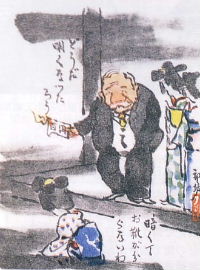
Because of the unprecedented boom, mediocre merchants and producers became suddenly rich and greatly expanded their enterprises. A class of nouveau riche called narikin emerged (in Japanese chess, narikin means a pawn becoming a gold general). They were often without culture or taste and fond of showing off their material wealth.


WW1 required very little military operation from Japan. Japan did not engage in any serious combat. But Japan had a military alliance treaty with the UK (1902-1923, with Russia as the potential enemy), so the government used this treaty as an excuse for capturing German-occupied territories in Jiaozhou Wan (around Qingdao) in China and islands in the Southern Pacific.


In 1918 when WW1 ended, a small business setback occurred. But the economy continued to do well in 1919. Then came the big crash of 1920. This postwar recession meant that the bubble had finally collapsed. Serious price deflation was recorded in many key commodities. Within the year of 1920, the price of cotton yarn fell by 60%, that of silk by 70%, and the stock market index plunged 55%. There was no downward price rigidity in those days. Macroeconomic adjustment was effected mostly in prices and less in output.


When the bubble ended, the lack of competitiveness and overcapacity of the Japanese economy, previously hidden under unsubstantiated exuberance, was now exposed. Most narikin were bankrupted. Their happy days were short.


After that and throughout the 1920s, Japan went through a series of recession and a few banking crises (the biggest bank runs occurred in 1927--see lecture 8). The economy slowed down significantly compared with the WW1 period, but no severe fall in output occurred. Domestic demand was not buoyant but steady. Recessions were frequent but short-lived. Prices remained flexible. Trade deficits returned and persisted, financed by the drawing down of the previously accumulated gold reserves. During the 1920s, the sky above the Japanese economy was neither sunny nor pouring. It was as if thick clouds gathered and stayed above the economy, depressing the economic mood of the country (a bit like now, since the 1990s).


Faced with the onset of a long recessionary period, it is noteworthy how the Japanese government reacted. It had two policy options: to rescue weakened industries and banks saddled with bad debt, or to eliminate inefficient units in order to streamline the economy despite transitional pain. The Japanese government chose the first option. In particular, the Bank of Japan provided emergency loans to ailing banks and industries to avoid further bankruptcies and unemployment. This policy eased the short-term pain but implanted a time bomb in the Japanese economy which exploded several years later.


So who else shares this view? Plenty but the Japan 1920s parallel was suggested by Hugh Hendry (2010).

“There are striking parallels with Japan in the 1920s, when ultimately the whole system collapsed,” said Hendry, 41, whose firm manages $420 million in assets. “China could precipitate a much greater crisis elsewhere in the world.”

Japan’s export boom collapsed after the war amid excess global capacity, slashing growth and sparking a stock-market crash and bank runs.

Hendry’s flagship Eclectica Fund, a global macro hedge fund with $180 million in assets, may gain almost $500 million from its options if China’s economy plunges into a recession, he said. The options cost the fund about 1.5 percent of its net asset value annually, Hendry said.

China’s vulnerability to a crash comes from the “inherent instability” created by a lending binge for infrastructure projects that’s “unprecedented in 400 years of economic history,” Hendry said. The country is also exposed to exports to a U.S. economy that could shrink from $14.6 trillion at the end of March to $10 trillion within 10 years, he said.

“China’s at the mercy of a credit bubble,” Hendry said. “Once you’ve unleashed the genie it’s out there. They are ultimately unstable and it’s that instability that creates their demise.”

China’s bubble may burst within a year or it may take three years, as Citigroup Inc. economists Willem Buiter and Shen Minggao estimate, Hendry said.
2012 - 2013 sits with me.

The narikin in caricature: he burns a 100 yen
note for light so the girl can find his shoes.