Showing posts with label Global Financial/Debt Crisis. Show all posts

Wednesday, 19 September 2012

The Printing Presses Are ON


Bernankenstein has finally caved to the vested interests and is going to start printing money again. This is going to be an end game move. Collapse of the US dollar?

Marc Faber on Bloomberg:


Gold and Oil

This is a must read:
BofA Sees Fed Assets Surpassing $5 Trillion By End Of 2014... Leading To $3350 Gold And $190 Crude

My commentary on Gold is bullish on this and you can confirm that here: Gold Tags.

Back on the 12th May 2012 I posted Eric Sprott Discusses Gold Manipulation On CNBC

Hows that flag going?


Is it going to be a repeat of the 2008 flag?

How did we go? BINGO! Now, will we see a consolidation pull back to say the high $1600s before continuing climb?

Weekly Gold 19th September 2012


QBAMCO argues for $15,000+ as an eventual price target (that makes me dizzy thinking about it) as posted in Perspectives On Gold's "Parabolic" Catch-Up Phase.
Were a USD devaluation and re-pegging to occur as of the end of 2014, following 2 ¼ years of $40 billion monthly MBS debt monetization, we estimate our Shadow Gold Price would approximate $15,000/ounce. (The SGP divides the quantity of USD base money by the quantity of US official gold holdings, as per the Bretton Woods monetary regime.) Over the weekend, Bank of America analysts implied USD base money inflation would increase much more than the Fed announced, to about $5 trillion by the end of 2014. This figure would imply an SGP a bit over $19,000/oz.

The Ridiculous Argument On $AUD Intervention

Meanwhile, bozos like Warwick McKibbin, ensconced in their ivory towers of academia complete with walls papered with failed economic theory and many associated sycophants, propose intervening in the Australian dollar. Here is a gem: How the RBA should clip the dollar

So what happens if we clip the dollar to to say 80c and Oil has jumped from around $100 a barrel to $200 a barrel? Australian consumers and the road transport industry paying over $3/Litre at the pump is what happens.

Sure the high $AUD hurts manufacturers but think about $200 oil and a FALLING $AUD. Sure as daybreak, if the US Fed collapses the $USD, oil will go polaric.

Force the $AUD down whilst Oil doubles and the next boom will be the noise accompanying the immolation of the Australian economy.

Leave it alone fools.

Wednesday, 5 September 2012

Ejecutar! Ejecutar! Ejecutar! Sálvame Spiderman!

(Run!, Run!, Run! Save me Spiderman!)


A few months ago I read with mild amusement Spain's totally insolvent bank, Bankia, making a futile attempt to lure young depositors with a free Spiderman beach towel. We all know that over 50% of Spain's youth is unemployed so they probably need a beach towel. If I was hopelessly unemployed, I'd be sitting my butt on the beach eyeing off equally hopelessly unemployed members of the opposite sex and Spanish ladies are (*ahem*) rather aesthetic. Pity the unemployed haven't got the cash to deposit to buy a beach towel from Bankia.

 
As Broke Bankia Runs Out Of Toasters, It Has A Bold Solution: A Spiderman Beach Towel
 
Ay, Bankia, nos reimos para no llorar


Nationalised Spanish lender Bankia is offering a Spiderman towel to young investors as part of a drive to hold onto deposits after being taken over by the state in the biggest bank rescue in Spain’s history.

The bank, which holds around 10 percent of Spanish deposits, is offering the prize to youngsters if they manage to save 300 euros ($380) by the end of the month. For every 50 euros saved, account holders can enter a draw for a trip to New York.

The drive to push up deposits comes as competitors such as online bank ING Direct embark on aggressive advertising campaigns to poach accounts after a report of a deposit run in early May after the state takeover was announced.


Obviously retention of capital in Spain is vitally important to arrest the spiral to perdition. How is the arrest of capital flight going?


Deposit flight from Spanish banks smashes record in July

Spain has suffered the worst haemorrhaging of bank deposits since the launch of the euro, losing funds equal to 7pc of GDP in a single month.

Data from the European Central Bank shows that outflows from Spanish commercial banks reached €74bn (£59bn) in July, twice the previous monthly record. This brings the total deposit loss over the past year to 10.9pc, replicating the pattern seen in Greece as the crisis spread. 
Spain isn't Greece, it's economy is 5x bigger. It's too big to save and too big to fail without creating a global financial crisis, never before seen or managed.


 The IBEX 35 is the Spanish stock index (sounds like a genetically engineered  African antelope):


Economy secretary Fernando Jimenez Latorre said Spain is in the eye of the storm right now with the “worst falls” in economic output yet to come in the second half of the year. 

No Jimmy, not the eye, the leading edge.


Saturday, 9 June 2012

Why Greece Is Better OUT of the Euro

Ann Pettifor, London based economist, explains why its citizens are better off with drachmas after a short and sharp economic contraction as opposed to years of austerity and social unrest.


The bankers and kleptocrats may not agree.


Saturday, 12 May 2012

The Fiscal Cliff


Heard of it yet? You will hear the term more often in the second half of 2012.

Cliff Dive?


AMERICANS have watched austerity sweep Europe with a certain Schadenfreude. But eight months from now they may get a dose of the same medicine. The political compromises that have produced much of America’s deficit of 8% of GDP are programmed to go into reverse at the end of the year, two months after the election. A stimulus package consisting of a payroll-tax cut, investment tax credit and enhanced unemployment insurance expires then, as do George W. Bush’s tax cuts (which have already been extended by two years from their original end-date of 2010). At the same time an automatic, across-the-board cut in domestic and defence spending, called a “sequester”, takes effect, cutting about $100 billion from government spending next year.

Why You Can't Ignore The Fiscal Cliff

In addition to the economic slowdown, the continued housing crisis, the endless turmoil in Europe and the deceleration in China and India, we are moving closer to the period where the so-called 'fiscal cliff' will become more of a threat to the market.  The fiscal cliff refers to the near-simultaneous January 2013 expiration of the Bush tax cuts, the payroll tax cuts, emergency unemployment benefits and the sequester established in last summer's debt limit agreement.  Various estimates have indicated that the hit to GDP could be as high as 4%. 
Various members of the Federal Reserve Board, including the Chairman, have been concerned enough to make their worries publically known.  Bernanke, at his last press conference, said that the size of the fiscal cliff was so large that "I think there's absolutely no chance that the Federal Reserve could or would have any ability whatsoever to offset the effect on the economy".

Chicago Fed president Charles Evans added that "The cliff at the end of this year is just that writ large.  Whether or not calm heads will prevail and avoid this or do something useful, you know that's as big an uncertainty as I can imagine anybody facing."  Atlanta Fed president Dennis Lockhart stated "Congress and the administration understand that the perception is growing that if a transition isn't engineered that works well, that you're going to end up with a lot of Mojo taken out of the economy in a very brief period of time."


Citi: The Fiscal Cliff Is 'SO RIDICULOUSLY LARGE'

The size of the so-called fiscal cliff at year end, which would unwind a decade’s worth of tax cuts and temporary income supports, is so “ridiculously” large relative to near- term growth prospects that markets may take some comfort in its scale. As Fed Chairman Bernanke warned Congress, the Fed would have “no chance” of offsetting an instantaneous shock so severe and noted he was “hoping” Congress would take action.

Really? Presidential election in November and the new Congress won't take office until January. They'll be hamstrung.


Farage: The EU Titanic Has Hit The Iceberg

You'd have to have been visting Mars this week if you unaware that the Euro chickens are coming home to roost. I won't boringly hash over the details of the utter mess shrouding the mass theft.

Instead, we'll let Nigel Farage get straight to the point.


and, the entirely predictable is coming to fruition as far left and far right parties gain in popularity.


Eric Sprott Discusses Gold Manipulation On CNBC


Hows that flag going?


Is it going to be a repeat of the 2008 flag?


Saturday, 28 April 2012

Gold Flags


I haven't blogged for a while as most of the stuff I've written is coming to fruition so its pointless writing "see, I told you".


  • US debt spiralling out of control and the debt fuelled recovery stalling as the election looms.
  • European debt is spiralling out of control and the Monetary Union is simply imploding and civil unrest spreading as austerity triggers a poverty and economic spiral. 
  • UK debt spiralling and this week, officially in recession.
  • Australian property continues its slide (1.15% fall a month for 5 years is 50% off!) as the mining myth remains a mirage for the simpletons in suburbia as Australian debt approaches 270% of GDP (Australian Debt).
  • The Chinese bubble deflating rapidly.
  • Japan is just a train wreck.


So what next? If you think that Europe or the USA are going to pay their debts, you are delusional. Next step is an attempt at hyperinflation. They'll just print money like confetti in an attempt to make that $15Trillion debt today look like a $15 fifty years ago. It will cause chaos and spiralling unemployment but f*ck the little people, as long as the banking kleptocracy stays high and dry.


The strategy involves central bank simply printing money and buying government securities...


...and the government then drops its new money on the financial sector (M1, broad money supply) like confetti...


In 1980 the Zimbabwean dollar was worth more than the U.S. dollar, with ZWD 1 = USD 1.47. Throw in some money printing and on 18 July 2008, a report on Zimbabwe's inflation, said that an egg costs ZW$50 billion (GBP 0.17, USD 0.32), and it showed adverts for prizes of Z$100 trillion in a Zimbabwean derby and ZW$1.2 Quadrillion ($1,200,000,000,000,000.00: approx. GBP 2,100; USD 4,200) in a lottery. It also showed a monthly war pension currently is ZW$109 billion (GBP 0.37, USD 0.74), shops can only cash cheques if the customer writes double the amount, because the cost will go up by the time the cheque has cleared, and people can only withdraw a maximum of ZW$100 billion froman ATM.
http://en.wikipedia.org/wiki/Zimbabwean_dollar#Exchange_rate_history

In 2008,  thirteen US cents (yes 0.13c) got you...


Has the USA had hyperinflation before? It certainly has, Hyperiflation in History (with 32 cases).

If the USA tries to hyper-inflate, gold is going polaric. Even this week the  Bank of Japan announces fresh stimulus to boost growth.

Some signals.
  1. Fed Signals No Need for More Easing Unless Growth Falters (and growth WILL falter eg The Second Foreclosure Tsunami Is Coming, And Is About To Kill Any Hopes Of A "Housing Bottom")
  2. Risk off? Having Sold Most of its Own, IMF Now Lauds Gold as 'Safe Asset'
  3. Peter Schiff - QE3 is coming

Gold in a Bull Flag?

Firstly, some Technical Analysis 101. What is a Bull Flag?
Bull Flag Pattern 1
Bull Flag Pattern 2

Is Gold in a bull flag like in the links above? I think so.


How high could gold go? I came across this interesting piece of analysis. Ambitious? Maybe (or maybe not).


Wednesday, 4 April 2012

Aiutami Mummia


You can't beat austerity. Such a wonderful tool to spur economic growth and prosperity.

Markit/ADACI Italy Services PMI

Key points:
  • Output and new business both decrease rapidly
    over the month
  • Employment levels fall solidly
  • Petrol price increases maintain high cost
    pressures
Italy is going to enter a depression, the likes of which even nonna never saw.

Read the rest in the link.

Remember Italy, like Spain, is too big to fail.

The US Recovery


If I read any more positive spin on the US recovery I'm going to break something.

I posted this last month:


One of my favourite fund managers (I made quite a few bucks in one of his hedge funds in the noughties), Eric Sprott explains and analyses a few facts (also some encouragement for Silver bulls). For anyone myopic enough to think the party is on its a must read:


The European Shell Game


European links

Four from Spiegel: 
Amid Debt Crisis, Athens Falls Apart (Who would have guessed? *rolleyes*)
Despite Progress, Euro Crisis Is Far From Over (bleeding obvious but worth a read never-the-less)
'The Problem Has Only Been Deferred' (I'd say transferred to the public from the banks and deferred)

Three from ZeroHedge:
Greek Deposit Run Update: Hopeless And Getting Worse  (I've said on this blog before - watch the money flows!)


Europe's Scariest Chart Just Got Scarier (I've written here before - remember the 1920s in Germany and what eventuated)


A Dose of Reality:
  1. If Greece borrows money from the IMF/EU which means that they have more debt now than they did before they defaulted then they are worse off and not better off as they have a larger debt.
  2. If Greece has an additional $107 billion in debt that has not been accounted for because it is not in the name of the Hellenic Republic but is guaranteed by the Hellenic Republic then how are they going to pay off this debt?
  3. If the goal of this entire exercise was to reduce Greece’s debt to GDP ratio to 120% then how will a larger debt accomplish this as it is fiscally impossible.
  4. If the “real REAL goal” was to pay off the European banks so they wouldn’t default then Europe has accomplished this goal but at a terrible cost to Greece and to the Greek people.
New York Times:

Ranks of Working Poor Grow in Europe (Betcha none are bankers)

Finally, from Bloomberg, what actually occurred (must read!):


Delaying Greece’s debt restructuring by more than a year reduced banks’ potential losses as firms trimmed their holdings and most of the risk shifted to European taxpayers. 

Just a redesigned Shell Game.

“This is a horrible deal for the EU taxpayer,” said Raoul Ruparel, chief economist at Open Europe, a London-based research group. “The longer we wait for these restructurings, the worse the deal gets for the public. There’s an ongoing risk transfer from the banks to the taxpayers.” 
 The new borrowing -- in effect, replacing private with public debt -- will amount to 78 billion euros, according to the EU, leaving the actual relief from the swap at 59 billion euros. Greece also will need to draw money from a second, 130 billion- euro EU and IMF rescue fund to repay other private debt and finance the government’s budget deficit. 

And, Greece's total debt?

That will leave Greece’s debt at 161 percent of gross domestic product at the end of the year, 4 percentage points less than the current level, according to a March 11 report by the European Commission. The ratio probably will return to 165 percent in 2013, the commission said.  

Got that? Greece's debt is a mere 4 percentage points less and debt will be back to 'normal' in 2013 whilst most risk is now on the EU taxpayer.

When all IMF and EU loans promised to Greece are disbursed, 66 percent to 75 percent of the country’s debt will be held by the public. In 2010, before the first bailout and before the European Central Bank started buying its bonds, Greece had about 310 billion euros of debt, all held by the private sector.  
If Greece has to restructure again, or defaults, taxpayers will be on the hook.

“The swap doesn’t achieve debt sustainability for Greece,” said Nicola Mai, an economist at JPMorgan Chase & Co. in London. “Debt relief going forward will have to come from the public sector.”
Anyone that can't see the European Monetary Union is a Kleptocracy and in full self destruct mode [whilst its citizens get royally screwed], deserves what's coming to his/her investment holdings.


Friday, 23 March 2012

The Ponzi


last month I wrote  Jobs On the DebtStar, Be Quick! where each US job costs over $1M.

US Jobs added in 2 years 2,283,000 (Great!!)
US National Debt added in 2 years $3,066,000,000,000 (Whoa!!) 
Borrowings per job $1,083,392 (See a problem?)
 

Average US wage is $47,000 so by borrowing $1,083,392, the US Govt has borrowed 23years wages per job.
 

US National Debt increase in 2 years 25%
US National Debt increase in 4 years 64%
 

US National Debt in January 2000 $5.774 Trillion

US National Debt in January 2008 $9.257 Trillion
US National Debt in January 2012 $15.201 Trillion (tripled in 12 years!!)
US National Debt in January 2015 $23.920 Trillion (estimate based on current growth!!)

12 years as a percentage of the USA's 235.5 year history is 5.1 % of the said nation's illustrious existence and in that short period the debt increased 163%. (Congratulations Dubya and Barack!).


Recovery my arse.

Here is a financial snapshot of the USA's last 5 years and the cost government's attempts to keep the US stock market from melting down.


Friday, 2 March 2012

Real Money vs Printed Money


Printed Money
The world's central banks printing and dumping paper to create the illusion of economic growth:


In the end printing money failed in the Weimar Republic, Zimbabwe and Japan. It will eventually fail in the Eurojoke and USA. The equity markets are like junkies and now addicted to their cheap money fix, printing has to resume or markets will tank. As the Dow passes 11,000 down, QE3 will be discussed and 'Real Money' will prepare for liftoff.


Real Money
The barbarous relic.


Who is buying if the plebs aren't?


Supply vs Demand.


Wednesday, 29 February 2012

Ray Dalio Is 'Da Man'


Last year I posted a quick byte on Ray Dalio of Bridgewater, 2012 - We Were Warned

-Dalio is a “macro” investor, which means that he bets mainly on economic trends, such as changes in exchange rates, inflation, and G.D.P. growth.

-In search of profitable opportunities, Bridgewater buys and sells more than a hundred different financial instruments around the world—from Japanese bonds to copper futures traded in London to Brazilian currency contracts—which explains why it keeps a close eye on Greece.

-In 2007, Dalio predicted that the housing-and-lending boom would end badly.

-Later that year, he warned the Bush Administration that many of the world’s largest banks were on the verge of insolvency.

-In 2008, a disastrous year for many of Bridgewater’s rivals, the firm’s flagship Pure Alpha fund rose in value by nine and a half per cent after accounting for fees.
 
-Last year, the Pure Alpha fund rose forty-five per cent (!!!), the highest return of any big hedge fund. This year, it is again doing very well.

We'll, Mr Dalio is now officially the world's No1 Fund Manager. Dalio Earned Clients $13.8 Billion Last Year

Ray Dalio’s Pure Alpha hedge fund made $13.8 billion for its investors last year, while John Paulson lost clients almost $10 billion after an unsuccessful wager that the U.S. economy would recover, according to a report by LCH Investments NV.

Pure Alpha, part of Dalio’s Bridgewater Associates LP, has earned $35.8 billion for investors since its inception in 1975, said LCH, a firm overseen by the Edmond de Rothschild Group. Losses for New York-based Paulson & Co. last year cut gains the firm has made for clients since its 1994 founding to $22.6 billion, LCH estimated.

Dalio’s Pure Alpha II ran up a 23.5 percent gain in the first 10 months of the year. The manager, 62, had three of the industry’s 12 best-performing funds, Bloomberg Markets reported in its February issue. The firm charges 2 percent of assets as a management fee and gets 20 percent of profits.

Bridgewater, based in Westport, Connecticut, has about $120 billion of assets and uses a macro strategy to try to profit from economic trends. It placed diversified bets in 2011 after predicting a flight by other investors to safer assets such as U.S. Treasuries and German bonds, standing out in a year when hedge funds lost 5.2 percent on average, according to data compiled by Bloomberg. Paulson posted a record loss of 51 percent in one of his biggest funds.

“Macro investing is notoriously difficult, but the best managers are able to find opportunities, especially in troubled markets,” London-based Rick Sopher, LCH’s chairman, said in the report. Funds lost a net $123 billion, LCH estimated.

From my earlier link from my post last year:

Dalio believes that some heavily indebted countries, including the United States, will eventually opt for printing money as a way to deal with their debts, which will lead to a collapse in their currency and in their bond markets. “There hasn’t been a case in history where they haven’t eventually printed money and devalued their currency,” he said. Other developed countries, particularly those tied to the euro and thus to the European Central Bank, don’t have the option of printing money and are destined to undergo “classic depressions,” Dalio said. The recent deal to avoid an immediate debt default by Greece didn’t alter his pessimistic view. “People concentrate on the particular thing of the moment, and they forget the larger underlying forces,” he said. “That’s what got us into the debt crisis. It’s just today, today.”

Dalio’s assessment sounded alarmingly plausible. But when one plays the global financial markets a thorough economic analysis is only the first stage of the game. At least as important is getting the timing right. I asked Dalio when all this would start to come together. “I think late 2012 or early 2013 is going to be another very difficult period,” he said.

I'm definitely putting Ray Dalio alongside Hugh Hendry, Kyle Bass and Peter Schiff on my 'financial gurus to watch/monitor' list.

Fly, Be Free


In December I provided a link to Kyle Bass' November newsletter, "A Global Financial Crisis of Epic Proprtions"


In the letter he describes capital flight being a precursor to default.

CNBC had their turn with Kyle in the video embedded below, “Before a default you’re going to see capital flight”:


Saxo bank updates us on 'The Flight' via Mike Shedlock, Capital Flight From Italy, Greece, Portugal Accelerates; Two Trillion Fantasy; Merkel Weaker Every Week; Crude and Geopolitical Risks


How is this going to end? Do you believe the bullshit soothing words out of the EuroSpruikers trying to save their insolvent banks, the brokers on TV business channels who want some commission, or do you listen to guys who make real money putting their money where their mouth is (and advisory newsletters)? Folks like Bass, Dallo and Hendry?

How is this going to end?

What Will 2012 Bring?


Art Cashin
Art is a 40 year trading veteran on the floor of the NYSE working for UBS.
We think a Lehman-like event would most likely be triggered by a run on a bank or a series of banks. The scramble for currency (value) protection among the public could turn into that bank run in the same way that a crowd can instantly turn into a mob. Watch the money flows out of Greece and Italy very carefully. The pot continues to bubble.


Thursday, 23 February 2012

How Goldman Sachs helped mask Greece's debt


Barron's Interviews Hugh Hendry

Anyone that reads this blog knows I'm a fan of Hugh Hendry.


Eclectica's acquired a nice reputation among contrarian investors, thanks to some enviable results. The London-based Eclectica Asset Management saw a 12% return last year in its flagship Eclectica hedge fund, and an eye-popping 46% gain in a new fund that buys credit-default protection on Japanese corporations. Much owes to the relentless logic and cheeky inventiveness of Hugh Hendry, chief investment officer. The Glasgow-born Hendry tells Barron's why he expects a hard landing in China, and why hyperdeflation will precede hyperinflation.

Hugh Hendry of Eclectica talks about hyperdeflation, why China might have a hard landing, and his off-the-beaten tracks Japan plays.

Keeping an Eye on Wealth Creation

Barron's: What makes a great macro fund manager?
 
Hendry: First and foremost, an ability to establish a contentious premise outside the existing belief system, and have it go on and be adopted by the rest of the financial community. My great hero is [Caxton Associates' founder] Bruce Kovner, who was able to imagine the dollar falling to 100 yen—when the rate was 200. I am an existentialist. To my mind, the three most important principles when it comes to investing are Albert Camus' principles of ethics: God is dead, life is absurd and there are no rules. Of course, that's a doctrine of promoting the individual. You own your own decisions. As CIO of Eclectica, with $700 million [under management], I have no engagement with the sell side.

Where do you find yourself outside the existing belief system today?
 
In 2009, I made a YouTube video of the empty skyscrapers in Wuhan, China. Goldman Sachs and others articulate a very reasonable and compelling argument of being invested in China. With the evidence of my own eyes, I concluded that China had a very robust system of creating gross-domestic-product growth, but forsaking the creation of wealth.

When America was having its China moment in the 19th century, it occurred against the backdrop of a gold standard, a hard-money regime, with a public sector that was minuscule versus the overall size of the economy. As an entrepreneur, if your project failed to generate a sustainable level of cash flow, you failed.

China's great opportunity is taking place within the U.S. fiat system, and so the consequences are perhaps less stark than in 19th-century America, which had stops and starts and many depressions, though with an overarching prosperity. China has not had that volatility.

If you talk about a hard landing in China, you talk about GDP growth of 5%, not minus 5% or minus 15%. The Chinese government prints money. It can build superfast railways and overbuild airports, because the rest of the economy can subsidize it. China's swollen public sector is directing asset allocation, rather than pursuing profit maximization. They see [their system] as a success. But it creates a bubble, which can prove quite damaging.

You've already had a hard landing—in the Chinese stock market.
 
I should add something else that is contentious—U.S. quantitative easing [that eventually sent more money flowing to China], promoted because America had two sharp recessions and pursued orthodox policies, and had very little to show in the creation of jobs.


The policy was very successful. China now has inflation. Minimum wages have grown 20% annually for the past three years. This has encouraged the Chinese to tighten monetary policy. When you have bubbles and you tighten, bad things happen. China's stock and property markets are weak, a side-effect of quantitative easing. We may now have the pricking of the Chinese bubble. A year or two down the line, it could have enormous repercussions for the global economy.

How does one play it?
 
The world is very fearful of hyperinflation. Pension schemes have a preponderance of real assets, from forestry to gold to TIPS [Treasury inflation-protected securities], because they are very fearful. The road to hyperinflation is via hyperdeflation. That is why it's proving so difficult for hedge funds to make money. How does the rational mind that anticipates hyperinflation own 10-year government Treasuries yielding less than 2%? It can't. That's why people are struggling. To lay the seeds of hyperinflation, you need really, really bad things to happen. I thought the U.S. housing market having a massive crash would be hyperdeflationary. But then my Chinese friends pumped $1 trillion of credit into their $5 trillion economy, and created a global recovery, which has just come to an end. I'm speculating that hyperdeflation happens before hyperinflation. What's the worst that could happen? But the sum of all my fears would be China having a real hard landing of minus 5% or minus 10% GDP growth. If we had that—and Europe—the Fed would be printing $20 trillion, and I would have gold at $5,000. You can have a modest amount of gold, but you can't have all your assets in real assets, in case we get that hyperdeflation event.

That view would be consistent with interest rates staying low forever.
 
Last year, our fund made 12%, mostly from investing in the short end of interest-rate curves, on the presumption that rates will remain low forever. The risk premium in fixed income was huge, but the performance of global macro last year was quite disappointing. Most people understood Europe, but chose to bet on the euro being weak, which is a hard trade, because there's no risk premium or carry in foreign exchange.

This time last year, British interest rates were at a 300-year-low at 0.5%, and if you asked an investment bank to guess where rates would be in three years, it was betting above 4%. The figure today is more like 1.3%.

So how do you make money?
 
Would you believe that the AIG strategy of selling too much credit protection in risky assets like mortgage-backed securities is alive and booming today in Japan? It doesn't concern mortgages. It is credit-default swaps on individual Japanese corporations.

Do you seriously believe Japanese corporations are going to fail?
 
Clearly, they can and do go bust. I'm buying the CDS on investment-grade Japanese corporations because of the overpricing anomaly. Japan had a bust 20 years ago, and yet today the banking stocks, relative to [Japanese bourse] Topix, are making fresh lows.

If I'm a Japanese bank and I lend money to a new business, I get 1% on 10-year paper. Then the bank gets a call from me, and I'm willing to pay 50 basis points for five-year protection on this same company. So suddenly, the yield has gone from 1% to 1½%. Compare that to five-year Japanese government bonds, yielding 30 basis points. The bank thinks: This is a great trade! Japanese steel companies are investment-grade and won't go bankrupt. So, the bank gets this huge yen yield, and thinks it is not taking any risk. You'd better believe it will sell way too much of that good thing.

One of my partners told me about Japanese steel: Here is a country with no energy, no iron ore or coal, yet it's the largest exporter of steel in the world, exports half its output. To put that in context, China manufactures 700 million tons of steel and exports perhaps 30 million. Japan produces 110 million tons and exports 40 million. As long as Asia is strong, they are fine. But if Asia hiccups or reverses, plant-utilization rates go from very high to very, very low very quickly.

Then we discovered that Warren Buffett owned shares of South Korea's Posco [5490.S. Korea], and that Korea was the biggest importer of Japanese steel, but Posco and Hyundai [5380.S. Korea] are building huge, integrated steel plants. They have a surplus of steel capacity and—guess what?—they're exporting to Japan, because the yen is so strong.

Initially, I wanted to buy a three-year, out-of-the-money put on Nippon Steel. My broker said, "I've been in a 20-year bear market; my boss will kill me." Then I thought, being long credit protection is being long volatility. I redialed his credit counterpart. I said: "I'm thinking of purchasing up to a billion yen of five-year credit-default swaps in Nippon Steel." The first thing he said was, "Would you consider 10 billion?" So one part of the bank is banned from selling volatility, and the other part is having a party. I bought reams of the stuff.

In August 2010, we set up a stand-alone fund to buy this credit protection. You no longer pay 50 basis points, you pay 130 basis points. U.S. Steel credit protection is more like 650 basis points, because in America, people are cautious on selling protection on such volatile businesses. They don't share that worry in Japan. It could make them very, very vulnerable.

Any other potential disaster catalysts? 
 
Continuing yen appreciation; an exogenous shock—like a run on the Italian bond market; a slowdown in China; a sharp Asian recession. Japan is confronted by a European sovereign-type loss of confidence in the JGB market. We bought protection on steel names, and also on businesses with a huge sensitivity to the yen. I think the yen could soar from these levels [about 79 to the dollar] into the 60s, if not the 50s, with further dislocation in European sovereigns or a China hard landing.

From the early 1960s almost, Japan began recording current-account surpluses. Unlike Germany, it always invoiced in dollars.

So Japan is short its own currency, and has an enormous private-sector hoard of foreign assets. If the Nikkei falls, and your hedge and private-equity funds fall, pension funds in Tokyo will have fewer yen assets, but their liabilities will be the same. So they'd have to sell some overseas dollar assets and retrade them back to yen. If we have a series of bad events from China to Europe, that will express itself in a very strong yen rally.

What other names have you bought protection on?
 
Shipping companies, such as Mitsui OSK [9104.Japan]. The only place in the world one can buy credit protection on the shipping industry is Japan. These are very leveraged businesses, and there was overbuilding. We have protection in Nippon Sheet Glass [5202.Japan], which bought Pilkington. We have protection in trading companies like Sumitomo[8053.Japan] and Marubeni [8002.Japan]—companies leveraged, opaque and very geared to the global economy.

We've barely discussed Europe.
 
We are partly playing it through Japan. If events kick off again in Europe, the correlation across all [global] asset classes will go to one. So the steel CDS is 130 basis points, while to insure against default by the French government, I'd be paying the same amount. Which is riskier? A very leveraged steel company that can't tax you? Or a government that can? Our bearish bets are largely outside Europe. As for Greece, the end game will be the Greeks rejecting austerity. The euro is nothing but a gold standard lacking flexibility, and all the onus is on private citizens to take the pain. Eventually, a Greek politician will say, 'Vote for me, and I'll get us out of this system.'

What else do you own?
 
In the next 12 months, we'll see further pathological swings in investor sentiment. Despite my reservations, I'm modestly long equity-market futures, some nonindustrial commodities, and some bullish fixed-income positions. We are very bullish agricultural commodities and agricultural equities, and hold a global basket of businesses—with interests ranging from fertilizer to farm equipment.

What does Greece’s future hold? Ask the Argentinians


By Mathew Partridge, UK Money week.

What does Greece’s future hold? Ask the Argentinians

The Greek crisis is on every front page. Behind many of the headlines is an assumption that a default and exit from the euro would be an unprecedented, unthinkable disaster.

However, Athens’ problems are hardly unique. Little more than a decade ago, Argentina went through a similar process.

Like Greece, Argentina fixed its currency to that of a larger, more powerful neighbour, while running a chronic deficit. And like Greece, Argentina attempted to use cuts, International Monetary Fund bail-outs, and talks with bondholders to solve the problem.

Like Greece, unfortunately, this only led to a bitter recession and riots. And when the country finally devalued, the economic and political pain was huge.

Here’s what happened – and why history could repeat itself.

When did Argentina’s problems begin?


In 1991, Argentina adopted a currency board that fixed the peso to the dollar at a convertible one-to-one rate. This meant that anyone could swap the peso for an equal number of dollars. For all intents and purposes the dollar became the national currency – just as the euro replaced the drachma in 2002.

Initially, this worked well. The tighter monetary policy helped bring inflation under control. However, from 1995 onwards the US dollar began to strengthen in real terms. This meant that the peso followed suit. In turn, Argentina’s exports became more expensive for its customers, while it began to import more from its local trading partners. This meant that the gap between its exports and imports grew larger.

At the same time, government spending, especially by regions and towns, grew faster than revenues. Corruption was also a major problem. This led to public debts mounting up – just as they did in Greece.

What caused the crisis?


The Russian default in late 1998 led to investors panicking, as the assumption that emerging-market sovereign debt was risk-free collapsed. Brazil’s currency fell sharply. As a result, the 30% of Argentinian exports that went there became even less competitive.

At the same time, the US Federal Reserve began to hike interest rates from 4.75% in the summer of 1999 to 6.50% in May 2000. This caused Argentinian monetary growth (M3) to collapse – indeed, the monetary base started to shrink by the end of 2000 – driving the economy from strong growth into recession.

What did Argentina do?


Faced with its high debt levels and faltering economy, Argentina should have let its currency float freely and focused its efforts on converting any foreign debts denominated in other currencies into pesos. This would have helped exports, boosted demand, and also would have meant that a fall in the value of the peso would not have increased the nation’s debt burden.

Instead, it decided to stick with the currency board. It tried to solve its debt problems by slashing spending. It also sought aid from the IMF. In December 2000, the first of several bail-out packages was announced – contingent on austerity.

Did this work?


The strategy failed badly. Even after the US started cutting interest rates, the peso was simply far too expensive. By the summer of 2001, the government began to change course. The currency board was broadened to include the euro – making the currency slightly cheaper. It also started talking to creditors about a debt swap.

However, the new measures were too little, too late. Later in the year, the money supply plunged further, shrinking at an annual rate of 21%. Unemployment rose to 18%, while the economy shrunk by 5%. This economic collapse, combined with the austerity measures, led to widespread riots, strikes and looting. People started taking cash out of banks. There was political chaos with the country going through four different presidents in eleven days.


On Boxing Day 2001 Argentina’s government threw in the towel, ending the currency peg and defaulting on its debt. The peso halved in value against the dollar. Dollar bank accounts and foreign loans were forcibly converted at a rate that favoured debtors.

What happened afterwards?


Cheaper exports and looser monetary policy saw strong growth return by the end of 2002, with the economy expanding at an annual rate of 9% in both 2003 and 2004. While creditors only got a fraction of their money back, the IMF was repaid in full in 2006 (although it did not get all its interest payments).

However, the chaos caused by the delay in breaking with the dollar peg has created serious long-term problems. At the worst point of the crisis, many business owners shut their firms. Many of these firms were later taken over by complete strangers – with the government backing this theft when the original owners tried to reclaim their property.

What are the lessons for Greece?


The lessons for Greece - and other troubled countries - are simple. Firstly, an ill-considered currency union can cause serious damage to the economy by making exports expensive.

A fixed (or single) currency also prevents a government from using monetary policy to boost growth. The Greek money supply fell at an annual rate of 14.6% in December. This means that action is urgently needed to rescue the economy.

Another lesson is that the longer it takes for Greece to quit the euro, the more extensive the damage to its economy will be. Already the situation is getting worse, with the passage of the debt deal leading to riots, which are hardly good for business. Miserable though it may be in the short term, Greece’s best bet would be to get out of the euro now.

As for the investment lessons - they might surprise you. As James Mackintosh noted in a recent column for the Financial Times, “if a devalued drachma appears, investors should pile in.” Why? Research by Elroy Dimson, Paul Marsh and Mike Staunton of London Business School suggests that “investing in the weakest currencies of the previous five years boosted equity and bond returns significantly since 1972.” So “Greece warrants attention: not for a bet on it sticking with the euro, but to be ready to buy in once it exits.”

New York Times describes Greek awareness that its a classic asset strip:
Growing Air of Concern in Greece Over New Bailout

Ms. Katseli, an economist who was labor minister in the government of George Papandreou until she left in a cabinet reshuffle last June, was also upset that Greece’s lenders will have the right to seize the gold reserves in the Bank of Greece under the terms of the new deal, and that future bonds issued will be governed by English law and in Luxembourg courts, conditions more favorable to creditors. 

While their country’s fate is being decided in abstract, high-level negotiations in Brussels, Berlin and Paris as much as in Athens, many Greeks said they had begun to feel that the debt writedown and new loan is aimed at saving the banks more than the country and its citizens.

The gold reserves? In Greece that accounts for 111 Tonnes and is 81% of the countries foreign exchange reserves. If Greece agrees to this they are mad (and bankrupt). At the current spot price of $1774oz, 1 Tonne is $57,035,423; 111 Tonnes is $6.33B.

What did Greece do in 1930s?

http://en.wikipedia.org/wiki/Economic_history_of_Greece_and_the_Greek_world#The_Great_Depression

The Great Depression

As the reverberations of the Great Depression hit Greece in 1932. The Bank of Greece tried to adopt deflationary policies to stave off the crises that were going on in other countries, but these largely failed. For a brief period the drachma was pegged to the US dollar, but this was unsustainable given the country’s large trade deficit and the only long term effects of this were Greece’s foreign exchange reserves being almost totally wiped out in 1932. Remittances from abroad declined sharply and the value of the drachma began to plummet from 77 drachmas to the dollar in March 1931 to 111 drachmas to the dollar in April, 1931. This was especially harmful to Greece as the country relied on imports from the UK, France and the Middle East for many necessities. Greece went off the gold standard in April, 1932 and declared a moratorium on all interest payments. The country also adopted protectionist policies such as import quotas, which a number of European countries did during the time period. Protectionist policies coupled with a weak drachma, stifling imports, allowed Greek industry to expand during the Great Depression. In 1939 Greek Industrial output was 179% that of 1928.[16] These industries were for the most part “built on sand” as one report of the Bank of Greece put it, as without massive protection they would not have been able to survive. Despite the global depression, Greece managed to suffer comparatively little, averaging an average growth rate of 3.5% from 1932-1939. The fascist regime of Yannis Metaxas took over the Greek government in 1936, and economic growth was strong in the years leading up to the Second World War.
 The path is quite clear. Exit the Euro, adopt the Drachma at a low exchange rate and tell the Germans, French and the banks to fuck off. Or, face decades of depression and servitude.

Thursday, 16 February 2012

"Driving Greece Towards Violent Revolution"


Zerohedge
Summary Of Greek Reform "Pledges" 

De Spiegel
Anti-German Mood Heats Up in Greece

UK Telegraph
For Greece a tear, for Brussels a blush 

Greek death spiral accelerates 


We learn that:
Greece's manufacturing output contracted by 15.5pc in December from a year earlier.
Industrial output fell 11.3pc, compared to minus 7.8pc in November.
Unemployment jumped to 20.9pc in November, up from 18.2pc a month earlier.
I have little further to add. This is what a death spiral looks like.

It is what can happen if you join a fixed exchange system, then take out very large debts in what amounts to a foreign currency, and then have simultaneous monetary and fiscal contraction imposed upon you.

Germany discovered this on the Gold Standard when it racked up external debt from 1925 to 1929 (owed to American bankers) in much the same way as Greece has done.

When the music stopped – ie, when the Fed raised rates from 1928 onwards – Germany blew apart in much the same way as Greece is blowing apart. This is not a cultural or anthropological issue. It is the mechanical consequence of capital flows into a country that cannot handle it, as Germany could not handle it in the late 1920s.

By the way, Greeks work an average 42 hours a week, one of the highest in Europe. Just want to put the record straight on that.

 I previously posted a link to the EU's Nigel Farage: Nigel Farage Is On Fire

 Here is his latest, succinctly describes the situation in under 2 minutes.


Some previous posts come to mind
"A Global Financial Crisis of Epic Proprtions"

Youth Unemployment In The EU
Austerity will involve cutting military budgets, pensions and some charismatic officers getting forced early retirement on reduced pensions. Now add reduced social welfare to those youths and you get no hope, no future, no cash. A powderkeg. All it needs is charismatic leadership offering hope and a future (add patriotism and nationalism).

How do you think Franco, Hitler and Mussolini got traction? The stage is set and only fools can't see we are back in the 1920s 


Saturday, 4 February 2012

EuroBank Zombie Super-highway


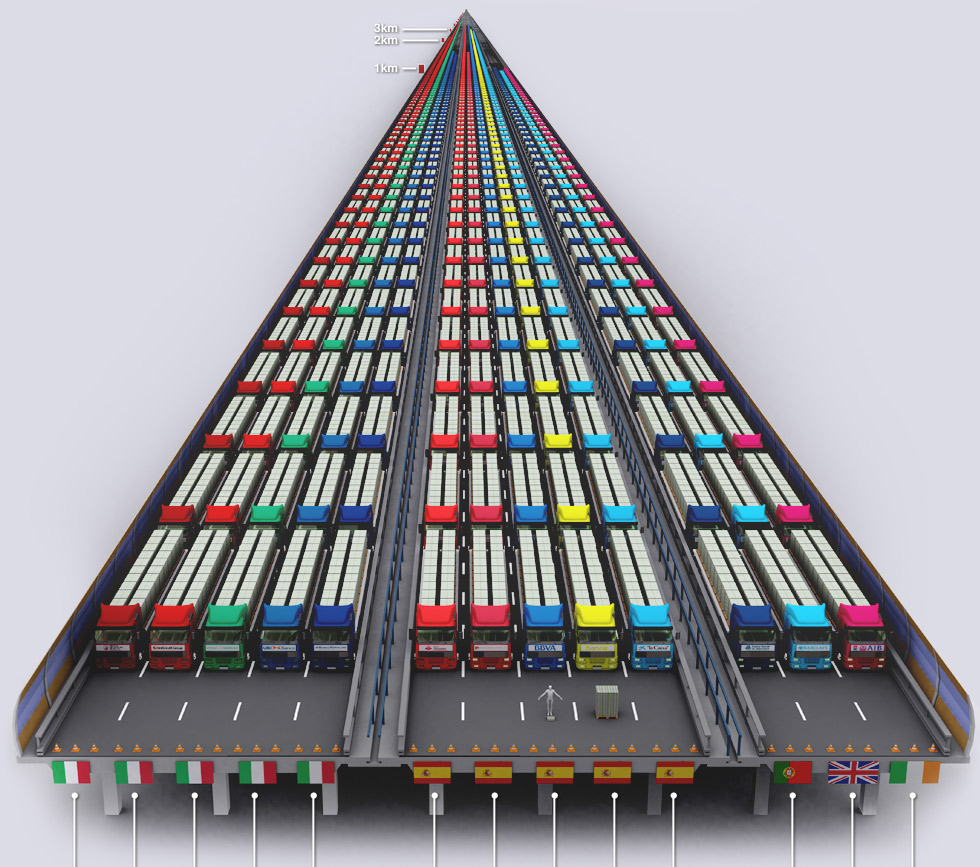
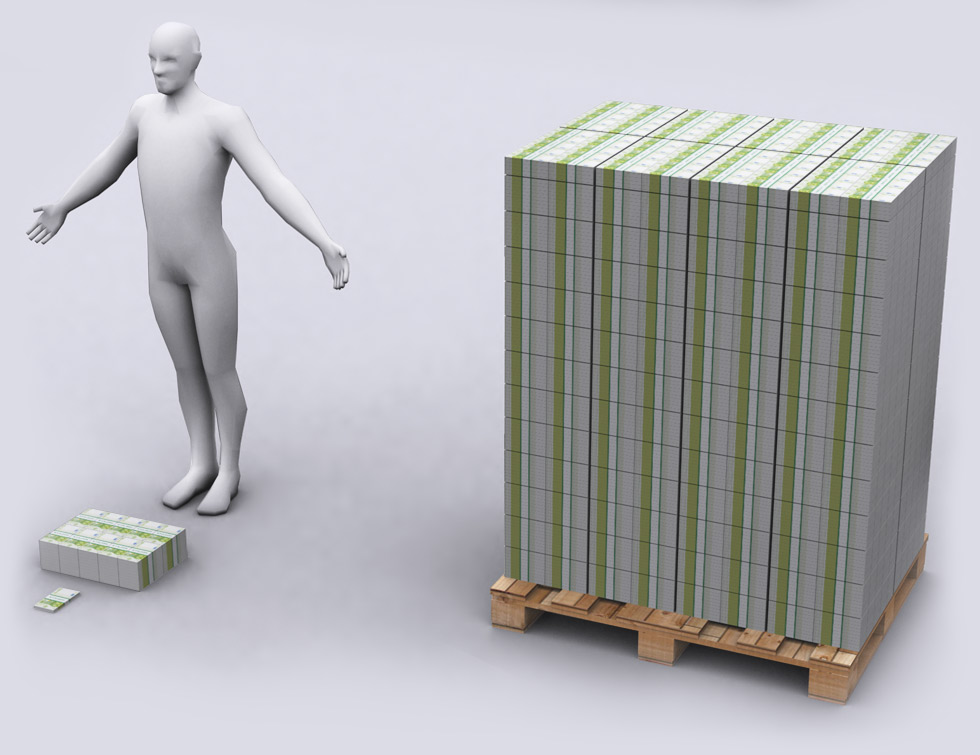
The trucks below are stacked with €100 bills. Each pallet is €100,000,000 - Approximately the size of the bonuses that the CEO's of big banks got during the financial crisis (round 1!!).


€2.91 Trillion: Total amount borrowed by Bankrupt nation's citizens

€2,910,426,000,000 (€2.91 million millions).
13 biggest banks. Each bank has its own lane.
Total Convoy Length: 26.7km (16.59 miles) if you put all 13 lanes together.

The people of Greece, Ireland, Italy, Portugal & Spain owe €2,91 trillion Euros to these 13 banks.

These are only the 13 biggest banks, there are many more that lent money, that together add up to a much bigger debt numbers.

3 pallets of cash would cover the cost of all the trucks shown below, if you bought them new. You'd have enough left over for a lifetime of joy. Each truck has 20 such pallets. 


The Banks.


You can see the full graphic and country and bank specific data at:
Demonocracy - PIIGS Debt

Portugal Unemployment 13.6%
Ireland Unemployment   14.5%
Italy Unemployment         8.9%
Greece Unemployment   19.2%
Spain Unemployment     22.9%

Spanish and Greek youth unemployment is over 45%.

Eurozone Unemployment


As recession bites and unemployment climbs in the PIIGS I wonder how these debts will be repaid? The Euro bailout funds will have to be massive. Who will throw money at those funds? Why would any sane individual throw money at these funds?