Wednesday, 13 July 2011

Tigers


Moody's downgrades Ireland to "junk" ("Tiger" to Junk in 4 years)

SAN FRANCISCO (MarketWatch) -- Moody's Investors Service on Tuesday lowered Ireland's foreign- and local-currency government bond ratings by one notch to non-investment grade of Ba1 from Baa3. "The main driver of today's downgrade is the growing likelihood that participation of existing investors may be required as a pre-condition for any future rounds of official financing, should Ireland be unable to borrow at sustainable rates in the capital markets after the end of the current E.U./IMF support programme at year-end 2013," said Moody's in a statement. The outlook on Ireland's ratings remain negative.

The Celtic Tiger:  Irish Property Bubble

The fact that property valuations were steadily increasing tended to create a systematic feedback loop, where rising prices affected the psychology of market participants, causing further increases in prices.
Never seen that in Australia (*walks away whistling*). What! Our property debt exceeds GDP?

The banks have mortgaged 4 generations so you deluded folk that bought a property at least a decade ago (like me), and saw it go celestial in value could feel good about your perceived wealth last year. Note, LAST year. You are now losing equity at a rate of $000s a week.

Make sure you watch the videos on my post To be sure, to be sure

And, Unstable Pillars.

It will happen here.

The main stream media and the dopeys in suburbia (and Alan Kohler on the ABC) are obsessed with the Carbon Tax. WRONG! A halving in house values to NORMAL levels is the monster, and if that starts to happen there will be no carbon tax because we will become like the Irish. Hypothetically HALVE the values in your Real Estate holdings and see what you have. Feeling happy?

Up to a $400,000,000,000 hole in the finance sector. Bank failures. Credit freeze.
I wrote about this on Whats that on the horizon Captain?.

Keep sitting on your investment properties and snarl invective every evening at the Carbon Tax .


If you don't get it....


Now when the property slide gets to full cry... make sure you blame the government.
Its not YOUR greed or failure to interpret the bubble market. It wasn't the easy credit, the Liberal party policies of 2001 of FHOG, baby bonus, increase money supply etc... they were good policies (The KRudd stimulus of 2008/9 just added the cherry and foolishly kicked the can down the road and created Aussie sub-prime). It was never your failure to learn the history of the markets you were using equity to invest in. It was never your fault.

Blame the government. Its as Australian as a Meat Pie.


Tuesday, 12 July 2011

Just Raise The Ceiling FFS and Sort It Out Later.


Tensions rise on Capitol Hill as America runs out of money


By 2 August the US must raise the legal limit on its $14.3 trillion debt or face dire consequences, and Republicans and Democrats have been locked in battle on Capitol Hill. With the crunch deadline approaching, Obama hit out at Republicans last week, saying they favoured corporate jet owners over children and the elderly. Those high-flying fat cats got six mentions in a speech that set out the president's combative stance

That dire consequence is a debt default. You know, like Greece.

UPDATE: As Debt Talks Intensify, Republicans Shift Further Right

  • Republicans won't support tax increases as part of deal to raise borrowing limit
  • Signs mount that House Republicans who had been willing to compromise on spending may now be less willing
  • Democtratic Rep. Welch wants House speaker to schedule vote on raising the debt ceiling without conditions.


WASHINGTON (Dow Jones)--Republicans dug in their heels Monday and said that they wouldn't support tax increases as part of a deal to raise the U.S. borrowing limit, amid signs that the caucus is shifting further to the right just weeks before the country's ability to finance its deficit expires. 

After Obama's speech, Rep. Michele Bachmann (R., Minn.), a presidential contender who is currently at the top of the polls in Iowa, issued a statement reiterating that she wouldn't vote to raise the debt ceiling. She said Obama "has wrongly assumed that everyone agrees that we need to raise the debt ceiling... I disagree."

Rep. Peter Welch (D., Vt.) said House Republicans appeared to moving farther from a compromise with Democrats instead of closer. "What you're seeing in the Republican caucus is first, no deal that includes revenues; then the fallback position is the cuts aren't deep enough; and then the fallback position is we shouldn't raise the debt ceiling. Michele Bachmann is sort of leading the parade. They're playing dangerous politics and they're looking over their shoulder at a potential tea party challenge if they vote to raise the debt ceiling."

Welch said the House Speaker should schedule a vote on raising the debt ceiling without conditions.
"It would be political malpractice to deny us the chance to vote up or down on an increase in the debt ceiling to avoid a catastrophic default," Welch said.

Boehner already did hold such a vote at the end of May. The measure overwhelmingly failed, 318-97.


Whats wrong with America's wider economy? Mohamed El-Erian, CEO of PIMCO (Numero Uno in Bond Management, Funds and Investment) wrote an excellent article last week. How America can avoid another Lehman.


First, and nearly three years after the global financial crisis, the US housing market is still unable to find a firm enough footing. This undermines confidence and limits labour mobility.


Second, joblessness remains worrisomely high, and to make things even worse, is increasingly structural in nature. Witness the 9 per cent unemployment rate, declining labour participation and an alarming 24 per cent unemployment rate among 16-19-year-olds and a 40 per cent rate for African-Americans.


Third, credit is yet to flow properly in the economy. With bank lending still hampered, it is small companies and poorer households that suffer the most.

Fourth, there is a problem of debt and leverage. Coming off a ‘great age’ of debt and credit-entitlement that went way too far, balance sheet rehabilitation has been uneven and generally insufficient. Yes, some sectors, led by multinational companies, have recovered strongly. But far too many in the private sector are still over-indebted. Meanwhile, public balance sheets, be they of the Federal Reserve or the fiscal agencies, are contaminated to such an extent that they now constitute a source of medium-term uncertainty.

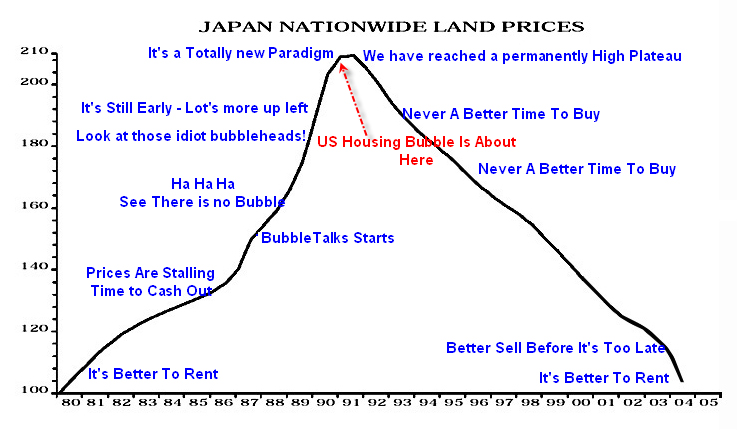
Paradigms and Plateaus


First, lets roll back the clock....

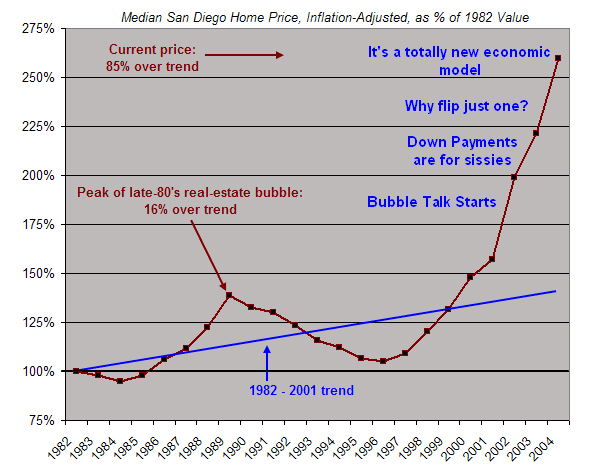
March 26th 2005; Its a totally new paradigm.


Quotes from 2005.

Ron Shuffield, president of Esslinger-Wooten-Maxwell Realtors says that "South Florida is working off of a totally new economic model than any of us have ever experienced in the past." He predicts that a limited supply of land coupled with demand from baby boomers and foreigners will prolong the boom indefinitely.

"I just don't think we have what it takes to prick the bubble," said Diane C. Swonk, chief economist at Mesirow Financial in Chicago, who was an optimist during the 90's. "I don't think prices are going to fall, and I don't think they're even going to be flat."


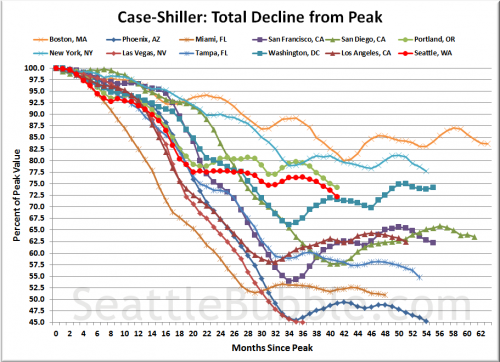
How did those markets go?


That new paradigm in Southern Florida of limited supply of land coupled with demand from baby boomers and foreigners [that] will prolong the boom indefinitely saw 55% falls in 34 months.

Roll forward 6 years to the Weekend's Mexican Bogan Rag, The Herald Sun. What a headline.

Decade of pain for Melbourne's property market


Deluded Quasi Pessimist:

The good news for homeowners is that AMP Capital chief economist Shane Oliver and Grattan Institute program director Saul Eslake - the ANZ's chief number cruncher for close to 14 years - say Victoria will avoid a US-style property crash which saw prices plunge by 30 per cent.

Instead, house prices will continue their single-digit slide into 2012 before stagnating for five to 10 years as wages catch up with a median house price which has climbed 133 per cent since 2000.
"We are facing a situation where we are just spinning the wheels for up to 10 years until incomes catch up with property prices," Mr Oliver said.

Deluded Industry Vested Interest Spruiker:

The Housing Industry Association's chief economist Harley Dale said price growth was likely to track inflation over the next 10 years. "That means you are not talking about any real growth," he said.


FAIL boys FAIL. History has shown it never happens. I wrote about this in April under History Never Repeats. Where Reinhart and Rogoff analyse 800 years of Markets....

The authors present eight centuries of financial folly, demonstrating the common theme that excessive debt accumulation regardless of the source — government, business or consumer — poses greater systemic risks than it seems at the time of the boom. (MoneyWatch recently interviewed Reinhart for her views on the current state of the economy.)

  • Infusions of cash make a government look like it’s providing greater growth than is actually being provided.
  • Private-sector borrowing binges inflate housing and stock prices beyond sustainable levels and make banks seem more stable and profitable than they really are.
  • Large-scale buildups of short-term debt make an economy vulnerable to crisis of confidence.
They demonstrate that financial crises are protracted affairs that share three characteristics:

  • Asset market collapses are deep and prolonged. Declines in real housing prices average 35 percent and stretch over six years. Equity prices collapse an average of 56 percent over a downturn lasting three-and-a-half years. Thus, the most recent crisis seems quite typical.
  • The aftermath of banking crises is associated with deep declines in output and employment. Unemployment rises an average of 7 percent over cycles lasting more than four years on average. Output falls more than 9 percent over two-year periods, and it has taken about four-and-a-half years for output to fully recover.
  • Government debt surges an average of 86 percent in real terms. The main cause is not spending but a decline in revenues
The bottom line is that the aftermath of crises has a deep and lasting effect on asset prices, output and employment. Unemployment increases and housing price declines have extended for five and six years, respectively. The authors also note that V-shaped recoveries in equity prices are far more common than V-shaped recoveries in real housing prices or unemployment. (2009 is certainly not an exception.)

IT IS NEVER DIFFERENT.

To cap it off the industry is as straight as a $3 note. A shining example of the fear, the dishonesty and total disrespect for buyers and the market: Agents withold house price data.


MELBOURNE real estate agents and vendors are increasingly withholding or manipulating data provided to the Real Estate Institute of Victoria, prompting calls for the mandatory reporting of all property sales to protect consumers.

A Sunday Age investigation has found that 27 per cent of all auction results published by the industry body in June were missing critical information - including the sale price, passed-in price or the reserve. Many auctions were not reported at all, distorting clearance rates that are used by buyers and sellers to gauge market strength.


Last month, agency RT Edgar sent a newsletter to clients warning there was a ''serious question mark'' over media reporting on the market because many agents were withholding sale prices and passed-in results. RT Edgar director Michael Ebeling said agents who were doing the right thing were being disadvantaged
because their competitors' clearance rates seemed better because they withheld information.

''We cannot see how the media is getting reliable sales statistics, and as a result are reporting misinformation about the market,'' the email said.

Despite conceding that the reporting system is a ''bit rubbery around the edges'', the Real Estate Institute of Victoria has refused to back calls for compulsory reporting of all auction results.


''It is not the role of the REIV to force home owners to publicly declare the amount for which their homes sell. If a person really wants to know the price for which a home sells, they can attend the auction,'' Mr Raimondo said.

But buyers advocate Christopher Koren said many agents were resorting to ''sneaky behaviour'' to mislead buyers over the true state of the market and that mandatory reporting was ''an obvious and necessary reform''.


Why would they withold the information it if it didn't indicate the shit was hitting the fan?


Sunday, 10 July 2011

We are RED!


No blogging last week as I was beset with Queensland Rugby Fever. Suncorp was magnificent last night. I'll remember it forever.


I'll be back commenting on the impending GFC II and the Australian credit fuelled housing bubble in due course. My week in Brisbane has been magnificent and last night just so special.

For anyone that cares I shorted EURUSD on Independance Day at 1.456 and started taking profits Thursday at 1.426.

Money never sleeps.

Saturday, 2 July 2011

Espana


Spain's unemployment is over 20%.


This is a result of Spanish House Prices going through the floor.


So the unemployed are not paying their mortgage. Bad for banks right (?). Nope, the insolvent Spanish Government to the rescue.

http://www.reuters.com/article/2011/07/01/spain-mortgages-idUSLDE75S0L820110701

MADRID, July 1 (Reuters) - Spain announced measures on Friday to help those struggling with high mortgage payments, but consumers said the moves gave limited relief for Spaniards mired in housing debt after the country's housing bubble burst.

The Socialist government, facing almost certain defeat in general elections that could come as soon as November, said it will increase the amount legally set aside for a debtor's own spending needs when banks start reclaiming funds.

"The amount excluded from any seizure of property will rise to 960 euros ($1,360) per month from just over 700 euros previously," the government said in a statement after Friday's cabinet meeting 
Spaniards, fed up with high unemployment and austerity measures imposed to placate international markets, have taken to the streets calling for changes in the political system and more equality in society.

Banks in Spain have the right to repossess properties and evict owners when they fall behind on debt payments, and the debtor continues to be liable for any shortfall between the value of the property and the mortgage debt.
The value of Spanish mortgage debt roughly doubled in the five years to 2009, as Spaniards leapt onto a bandwagon driven by easy lending conditions and rapid price rises.  (Sound familiar??)

Although bad mortgage debt is only about 2.5 percent of the total, according to Bank of Spain data, many Spaniards are having difficulty making ends meet.

"These measures will help so few people as to be insignificant," said Manuel Pardos, chaiman of banking customer association ADICAE.

ADICAE estimates that more than 1 million families face severe mortgage payment problems -- around 300,000 whose loans have been foreclosed, another 300,000 in the process of foreclosure and around 500,000 having difficulty making payments.

"(Debtors) who are still working have very low wages, and many of them are not working at all, so they have no income," said Pardos. Many Spaniards are eating in soup kitchens so they can make their mortgage payments, he said

Spanish Government Debt.


Who is holding the can?


You can see from the above chart, the Spanish situation dwarfs that of of Greece.

Friday, 1 July 2011

As Safe as Bricks and Mortar.


The latest RP Data residential housing report is out.


Prices.


Yields.


So who is going out to borrow $400,000 ($100,000 deposit) for a $500,000 investment property in Brisbane?

Investor A.
a. Loan Repayment on $400,000 borrowed is $37,000 (interest rate 8% over 25 years)
b. Gross Income (rental yield) $22,500 (4.5% from above chart).

c. Negative Annual Cashflow (a - b) $14,500.
d. Current Annual Capital Loss of Underlying Asset (house prices falling @ 5.9% ) $29,500

e. Total Annual Loss Before Tax (c + d) $44,000.
f. Negative Gearing Tax Refund of  $2,790 (30% marginal tax rate on Interest paid minus Rental income)

g. Nett Loss (e - f) $41,210 (without accounting for management fees, rates, insurance, stamp duty etc)

Investor B.
Puts $100,000 deposit in a Term Deposit @ 6.5%.

a. Earns $6,500 Before Tax.
b. Tax on Interest $1950. (30% marginal assumed).

c. Net Gain (a - b) $4,550


So $100K to invest (Brisbane Real Estate vs a TD). A $41,210 loss or a  $4,550 gain?


So who is going out to borrow $400,000 ($100,000 deposit) for a $500,000 investment property in Sydney?  It went UP 1% in 12 months right!

Investor A.
a. Loan Repayment on $400,000 borrowed is $37,000 (interest rate 8% over 25 years)
b. Gross Income (rental yield) $21,500 (4.3% from above chart).

c. Negative Annual Cashflow (a - b) $15,500.
d. Current Annual Capital Gain of Underlying Asset (house prices rising @ 5.9% ) $5,000

e. Total Annual Loss Before Tax (c - d) $10,500.
f. Negative Gearing Tax Refund of  $3,093 (30% marginal tax rate on Interest paid minus Rental income)

g. Nett Loss (e - f) $7,407 (without accounting for management fees, rates, insurance, stamp duty etc)

Investor B.
Puts $100,000 deposit in a Term Deposit @ 6.5%.

a. Earns $6,500 Before Tax.
b. Tax on Interest $1950. (30% marginal assumed).

c. Net Gain (a - b) $4,550


So $100K to invest (Sydney Real Estate vs a TD). A $7,407 loss or a  $4,550 gain?

Perth? $100K to invest in a $500,000 property (Perth Real Estate vs a TD). A $55,907 loss or a  $4,550 gain?

Hobart? $100K to invest in a $500,000 property (Hobart Real Estate vs a TD). A $25,107 loss or a  $4,550 gain?

Its not...

Whats Wrong With This Picture?


http://www.bloomberg.com/news/2011-06-30/papandreou-wins-enough-votes-to-pass-greek-budget-bill-ensuring-bailout.html

The premier won the vote by 155 to 136, allowing him to implement a 78 billion-euro ($112 billion) package of tax increases and asset sales that was a condition of receiving further European Union aid. Those steps were approved in a vote yesterday which was marred by street violence as police fired tear gas on crowds. That ballot was carried by 155 votes to 138.


Great, 78 billion. How much does Greece owe?


Previous austerity measures passed in 2010 by the govt has seen the economy hammered and unemployment climb from 11% to 16% with no govt revenue benefits. Lets see this crisis (Mk III) again in 2012 when unemployment is 20%+.


What do debt markets think?

The cost of insuring Greek sovereign debt earlier rose 33 basis points to 1,978 basis points, according to CMA prices for credit-default swaps. That signals an 82 percent probability the nation will fail to meet its commitments within five years.